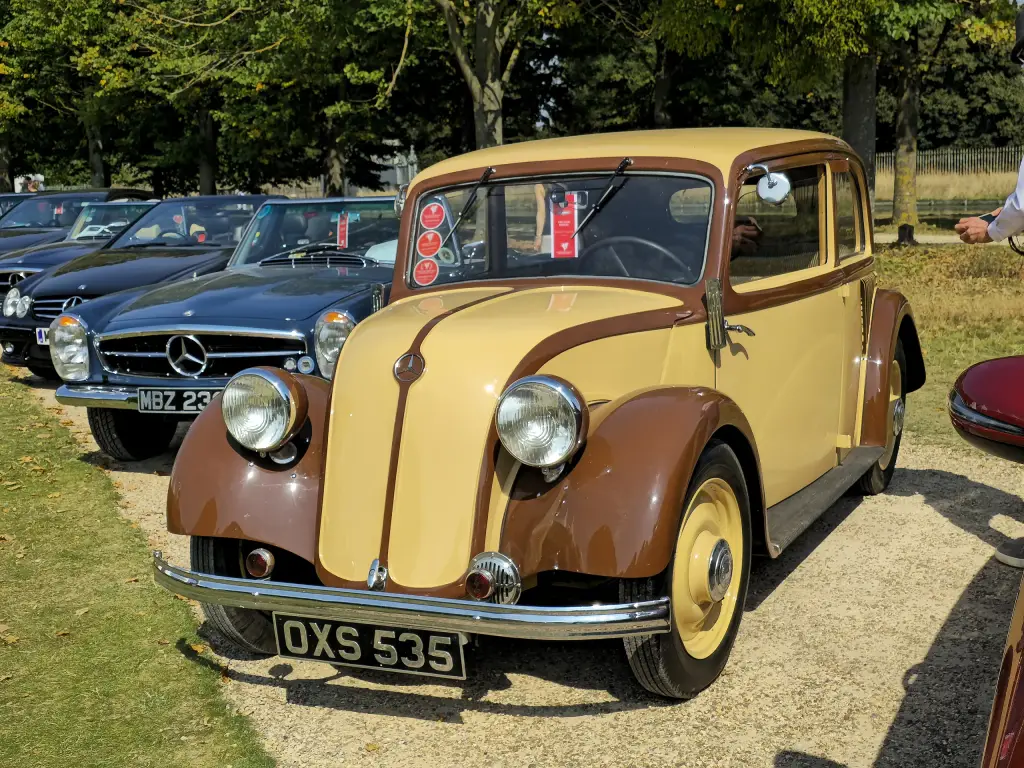
The Mercedes-Benz 130 was a small car with a rear-mounted engine, built in Germany in the 1930s in modest numbers. It was presented in February 1934 at the Berlin car show and was the first of three rear-engined production models from Daimler-Benz.
Mercedes-Benz 130 at a glance
| Shown | February 1934, Berlin car show |
|---|---|
| Production | 1934–1936 |
| Chassis code | W23 |
| Engine | 1,308 cc side-valve four-cylinder, at the rear |
| Power | 26 hp (19 kW) |
| Top speed | 92 km/h |
| Gearbox | three speeds plus a semi-automatic overdrive |
| Chassis | backbone frame |
| Suspension | independent at all four corners |
| Bodies | two-door saloon, open-top saloon, convertible |
| Related models | Mercedes-Benz 150 (W30) and 170 H (W28) |
This article is based on one source, the English Wikipedia article on the Mercedes-Benz 130, which also covers the 150 and 170 H.
History of the Mercedes-Benz 130
At the beginning of the 1930s, designers were attracted by the idea of moving the engine from the front to the rear of the car, which frees space at the front and removes the propeller shaft. The best-known examples were the Tatra 77, 87 and 97 of Hans Ledwinka. In 1930 Daimler-Benz gave Hans Nibel the task of developing a small rear-engined car on the same principles. In 1931, working with Max Wagner, he built the W17 prototype, a two-door four-seater with a 1,200 cc four-cylinder boxer engine at the rear and 25 hp. A 1932–33 prototype with a rounded front foreshadowed the shape of the later Volkswagen Beetle, and twelve test cars were assembled.
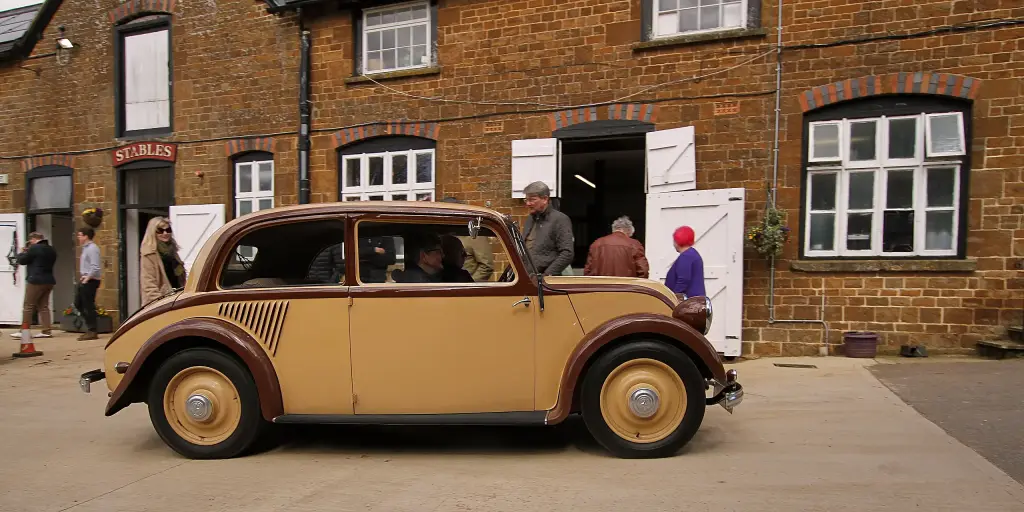
The production 130 was conceived by Nibel and inspired by Edmund Rumpler’s Tropfenwagen. It had a 1,308 cc side-valve four-cylinder engine mounted behind the rear axle, with a fan between the rear coil springs, and drove through a three-speed gearbox and a semi-automatic overdrive that did not need the clutch. The chassis was a backbone frame with independent suspension at all four corners. The engine developed 26 hp and gave a top speed of 92 km/h. The car was sold as a saloon, an open-top saloon or a convertible, always with two doors.
Its road behaviour was the problem. With two-thirds of the mass over the rear axle, handling was awkward, although the ride was better than that of any other German car of the time. Sales were low and the model was discontinued in 1936. Nibel followed it with the 150 of 1935, a two-seat sports roadster with a 1,498 cc overhead-camshaft engine of 55 hp and 125 km/h. It cost 6,600 Reichsmark against 5,500 for the 170 V and only about twenty were built before it too was abandoned in 1936. In 1936 Daimler-Benz also introduced the 170 H, which used the 1,697 cc engine of the 170 V in a rear-engined layout.
Design and features
- Rear engine: the four-cylinder unit sat behind the rear axle, with a fan between the coil springs.
- Backbone chassis: following the ideas of Hans Ledwinka at Tatra.
- Independent suspension: all four wheels, with transverse leaf springs at the front.
- Semi-automatic overdrive: a fourth ratio that could be engaged without the clutch.
Mercedes-Benz 130 versions
- 130 saloon: the standard two-door car.
- 130 open-top saloon: with a folding roof.
- 130 convertible: with and without a cabriolet cover and without side windows.
- 150 Sport Roadster: a 1.5-litre sports car of 55 hp, about twenty built.
- 170 H: a rear-engined car using the 1.7-litre engine of the 170 V.
The 130 was followed by the front-engined 170 V, while the rear-engine idea returned in the 170 S era only in prototypes. More in the Mercedes-Benz collection.
Video: Mercedes-Benz 130
Video by YouTube on YouTube.
Sources
- Mercedes-Benz 130, English Wikipedia: development, dimensions, 150 and 170 H