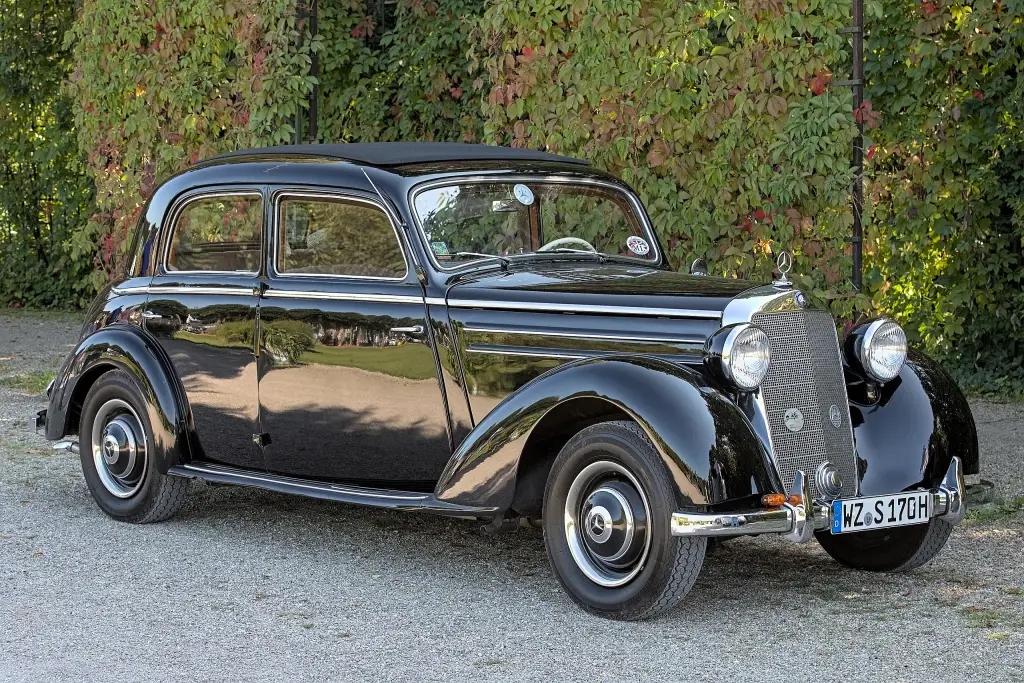
The Mercedes-Benz 170 S was a luxury car produced from 1949 to 1955 in petrol and diesel forms. It was the first Mercedes-Benz to carry the suffix S, for Sondermodell, which marked a higher level of comfort and quality.
Mercedes-Benz 170 S at a glance
| Production | 1949–1955 |
|---|---|
| First shown | May 1949 |
| Chassis codes | W136 at first, W191 from 1952 |
| Engine | 1,767 cc four-cylinder, 52 PS (38 kW) |
| Top speed | 122 km/h |
| Gearbox | four-speed, all-synchromesh |
| Front suspension | coil springs and double wishbones with a stabiliser bar |
| Bodies | four-door saloon, Cabriolet A and Cabriolet B until 1951 |
| Diesel model | 170 DS, 40 PS, 105 km/h |
| Final version | 170 S-V of 1953 with a 45 PS engine |
This article is based on one source, the English Wikipedia article on the Mercedes-Benz 170 S.
History of the Mercedes-Benz 170 S
The 170 S appeared in May 1949, at first on the chassis number of the W136 170 V, which it closely resembled. It was 170 mm longer and 104 mm wider than the 170 V and much better appointed. The 1,697 cc engine of the 170 V was enlarged to 1,767 cc and gave 52 PS instead of 38 PS, for a top speed of 122 km/h. The front wheels used coil springs and double wishbones with a stabiliser bar instead of the leaf-spring arrangement of the 170 V. Besides the four-door saloon, the range included a two-seat Cabriolet A and a four-seat Cabriolet B.
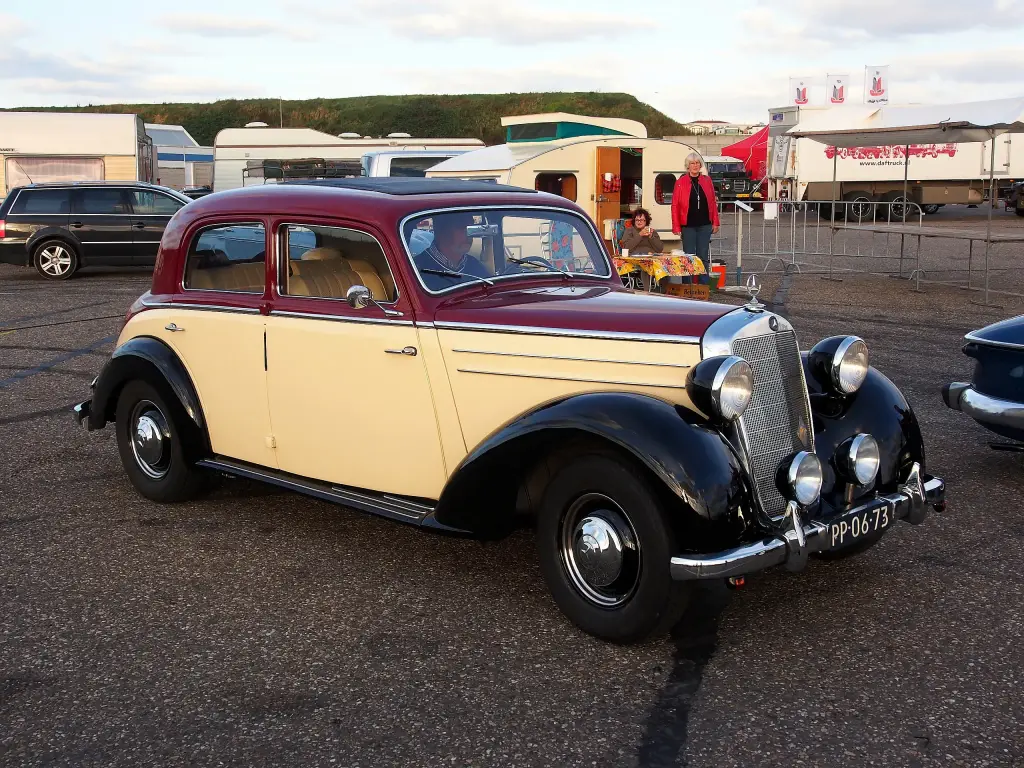
In January 1952 the car was upgraded as the 170 Sb and received its own chassis number, W191. Both cabriolets had been withdrawn in November 1951, so only the saloon remained. The floor gear lever gave way to a column lever, a starter button appeared on the dashboard, the heater was improved and the camshaft was now driven by chain instead of gears. A hypoid differential was fitted and the rear track grew by 15 mm. The same month brought the 170 DS, a diesel version with the 40 PS OM636 engine and a top speed of 105 km/h. Diesel cars were still a novelty in Germany in 1952, but the diesel used more than 25 per cent less fuel.
With the arrival of the 1.8-litre 180 Ponton in 1953 the 170 S looked old fashioned. In July 1953 it was replaced by the reduced 170 S-V, which combined the larger 170 S body with the 45 PS engine of the 170 V, while the diesel model continued as the 170 S-D. The W191 code was dropped and the cars returned to the W136 designation. Production ended in September 1955 with no direct replacement; in the final version more than 80 per cent of the cars sold were diesel powered.
Design and features
- The S suffix: the first use of the letter that later marked the S-Class.
- Larger engine: 1,767 cc and 52 PS against 38 PS in the 170 V.
- Better front suspension: coil springs and double wishbones with a stabiliser bar.
- Diesel option: the 170 DS from 1952, with 40 PS and much lower fuel consumption.
Mercedes-Benz 170 S versions
- 170 S (1949–1952): saloon, Cabriolet A and Cabriolet B.
- 170 Sb (1952–1953): W191 with a column gear lever and other updates.
- 170 DS (1952–1953): diesel version with the OM636 engine.
- 170 S-V (1953–1955): larger body with the 45 PS petrol engine.
- 170 S-D (1953–1955): the diesel model of the final years.
The 170 S grew out of the 170 V and was replaced in spirit by the 180 Ponton. More in the Mercedes-Benz collection.
Video: Mercedes Benz 170 S
Video by YouTube on YouTube.
Sources
- Mercedes-Benz 170S, English Wikipedia: models, engines, updates, production