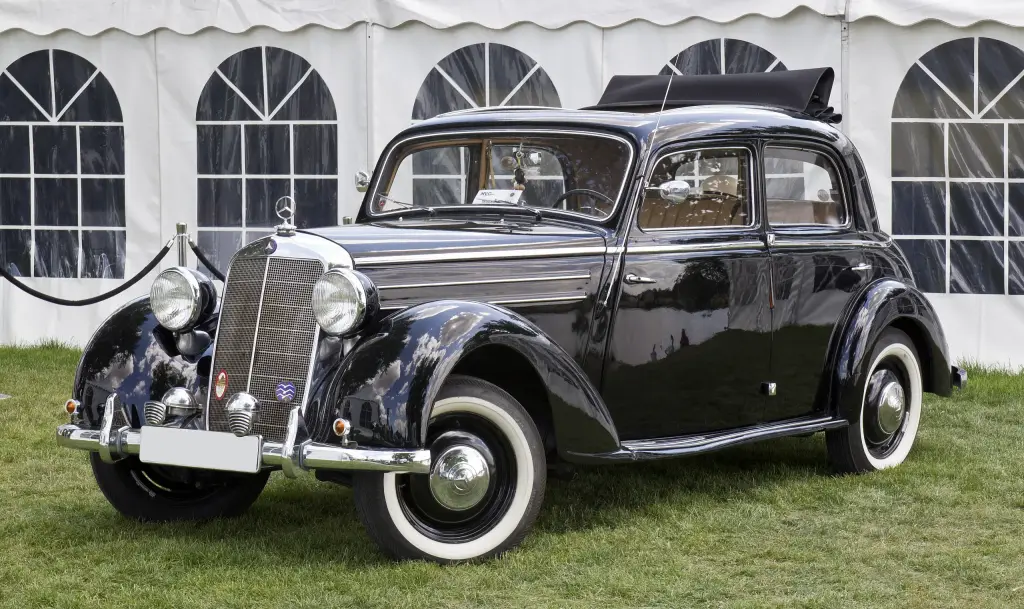
The Mercedes-Benz W136 was the company’s main line of four-cylinder cars from the mid-1930s into the 1950s. The 170 V made its public debut in February 1936 as successor to the W15 Typ 170.
Mercedes-Benz 170 V at a glance
| Introduced | February 1936 |
|---|---|
| Model | 170 V |
| Engine | 1,697 cc side-valve M136 four |
| Power | 38 PS (28 kW) at 3,400 rpm |
| Gearbox | four-speed synchromesh, all ratios from 1940 |
| Fuel consumption | 10 litres per 100 km |
| Built 1936–1942 | over 75,000 |
| Best seller | 1936–1939, and again from 1947 to 1953 |
| V meaning | Vorn, front, to distinguish it from the rear-engined 170 H |
| Bodies | saloon, Cabrio-Limousine, Cabriolet A and B, roadster, van and truck |
| Special versions | ambulance, police, mountain rescue and military |
This article is based on one source, the English Wikipedia article on the Mercedes-Benz W136.
History of the Mercedes-Benz 170 V
The 1.7-litre four-cylinder rear-wheel-drive 170 V was introduced in 1936 to replace the 1.7-litre six-cylinder 170 of the W15. Despite similar capacity, the new car’s side-valve M136 was more powerful. The four-speed gearbox gained synchromesh on all ratios only in 1940, having had it on the top two before, and claimed power was 38 PS (28 kW) at 3,400 rpm with a 6:1 compression ratio. Fuel consumption was 10 litres per 100 km. The engine hung on just two mountings and set the standard for smoothness among four-cylinder motors.
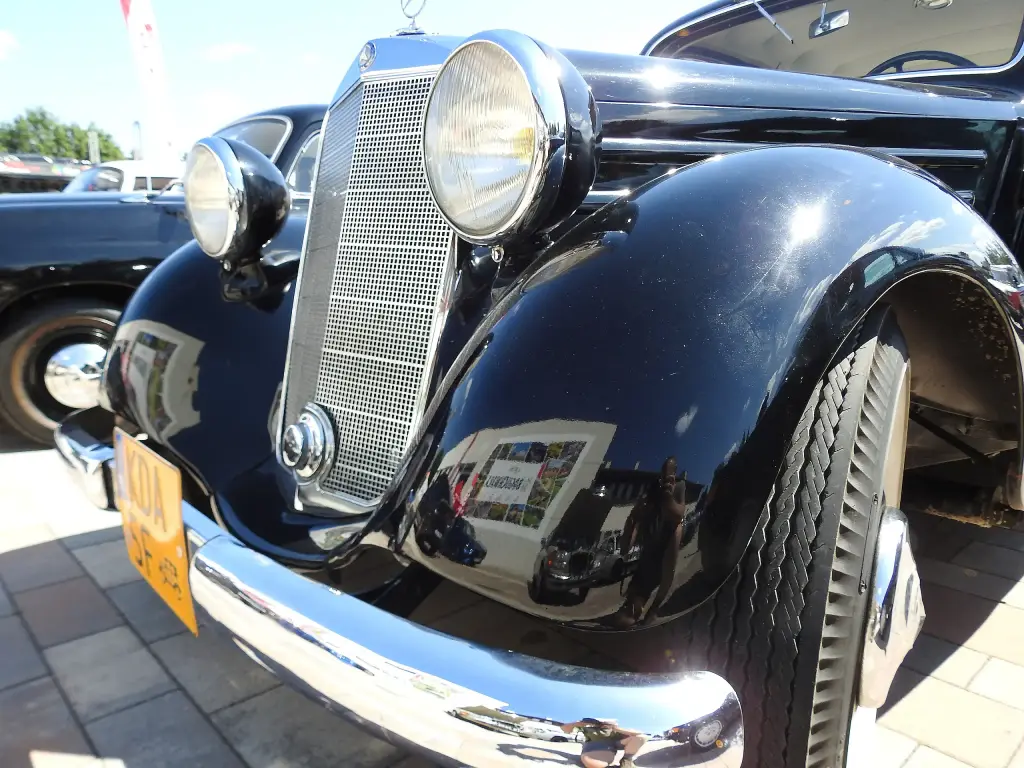
Between 1936 and 1939 the 170 V was Mercedes-Benz’s top-selling model, and between 1936 and 1942 over 75,000 were built, by far the most popular Mercedes-Benz up to that point. Enough of its tooling survived Allied bombing, or could be recreated, for it to become the foundation on which the company rebuilt after the war. By 1947 the 170 V had resumed its place as the top seller, a position it held until 1953. The V stands for Vorn, front, to distinguish it from the rear-engined 170 H, which used the same 1,697 cc engine at the back of the car.
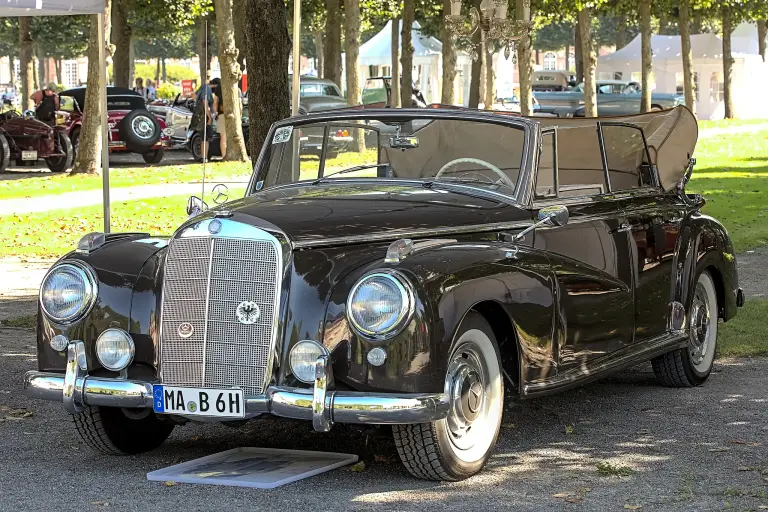
The range of bodies was unusually broad for the 1930s. Most cars were two- or four-door Limousine saloons, but there was also a four-door Cabrio-Limousine with a full-length folding canvas roof, taxi versions of both with large rear luggage racks, a two-seat Cabriolet A and four-seat Cabriolet B, and a roadster with a large flap behind the seats that could serve as a luggage platform or an uncomfortable extra bench. A small commercial version came as a flatbed truck or with a box body, and special versions were made as ambulances and for the police, mountain rescue and the military. Early cars had the star mounted directly on the grille, with the radiator cap under the bonnet.
Design and features
- Long-lived four: the main Mercedes-Benz four-cylinder line for two decades.
- Post-war foundation: the model on which the company rebuilt after 1945.
- Wide body range: saloons, cabriolets, roadster, vans and trucks.
- Smooth engine: the M136 on just two mountings.
Mercedes-Benz 170 V versions
- Limousine: two- and four-door saloons.
- Cabrio-Limousine: four doors with a folding canvas roof.
- Cabriolet A and B: two- and four-seat open cars.
- Roadster: with a rear luggage flap.
- Commercial versions: flatbed and box-body vans.
- Special bodies: ambulance, police and military.
The W136 was followed by the 170 S and the Ponton range. More in the Mercedes-Benz collection.
Sources
- Mercedes-Benz W136, English Wikipedia: engine, production, bodies, post-war role