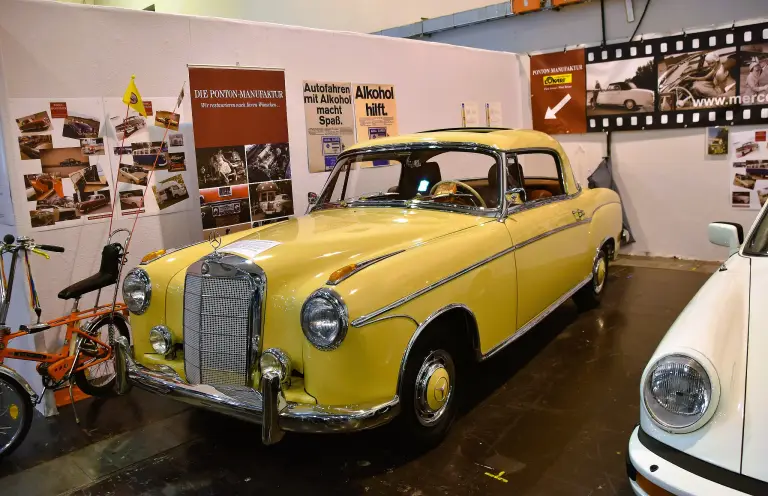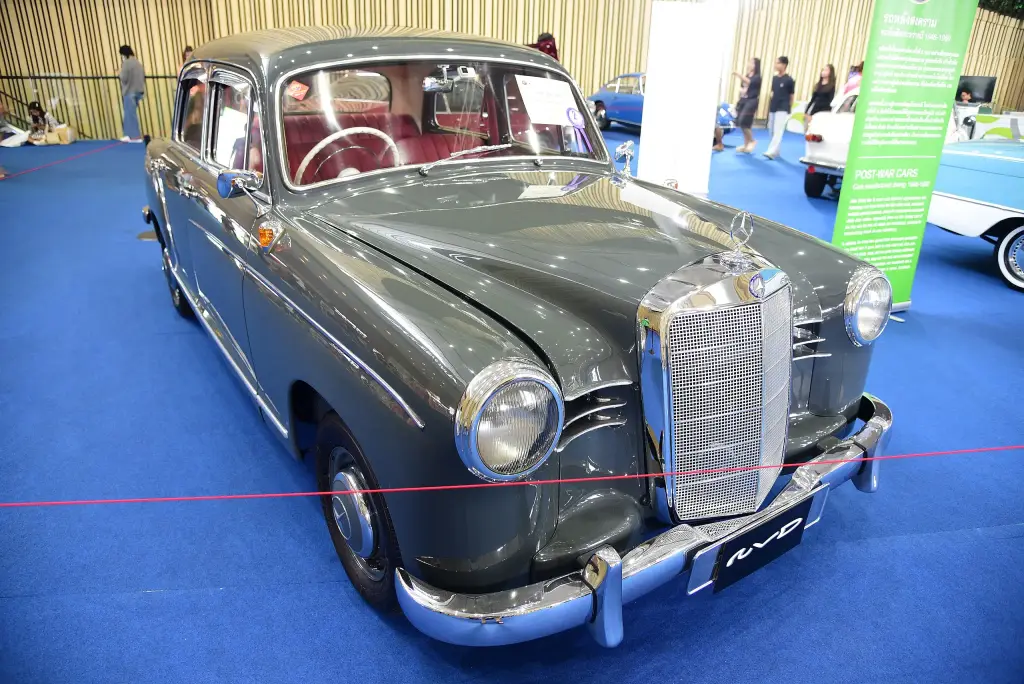
The Ponton is a range of Mercedes-Benz saloons introduced in 1953 and nicknamed after its pontoon styling, which merged bonnet, body, wings and running boards into one slab-sided envelope. Mercedes itself never used the name.
Mercedes-Benz Ponton at a glance
| Introduced | 1953 |
|---|---|
| First model | W120 180 |
| Body | unitary monocoque, first for a Mercedes-Benz production car |
| Engines | 1.8 and 1.9-litre fours, 2.2-litre six |
| Models | 180, 180 D, 190, 190 D, 219, 220 a, 220 S, 220 SE |
| Design team | Dr Fritz Nallinger, styling by Karl Wilfert |
| Safety | Béla Barényi and the crumple-zone patent |
| Share of production | up to 80 per cent of Mercedes-Benz cars, 1953–1959 |
| Last models | until 1962 |
| Successor | W111 Fintail |
This article is based on one source, the English Wikipedia article on the Mercedes-Benz Ponton.
History of the Mercedes-Benz Ponton
After the war Daimler-Benz was known for the expensive, largely hand-built 300 Adenauer and 300 S, while its lower end rested on the pre-war 170. To expand production the company turned to the unitary body, and work on the Ponton began in earnest in 1951 with a design focused on comfort and safety. The team was led by Dr Fritz Nallinger, with styling by Karl Wilfert and passive safety engineering by Béla Barényi.
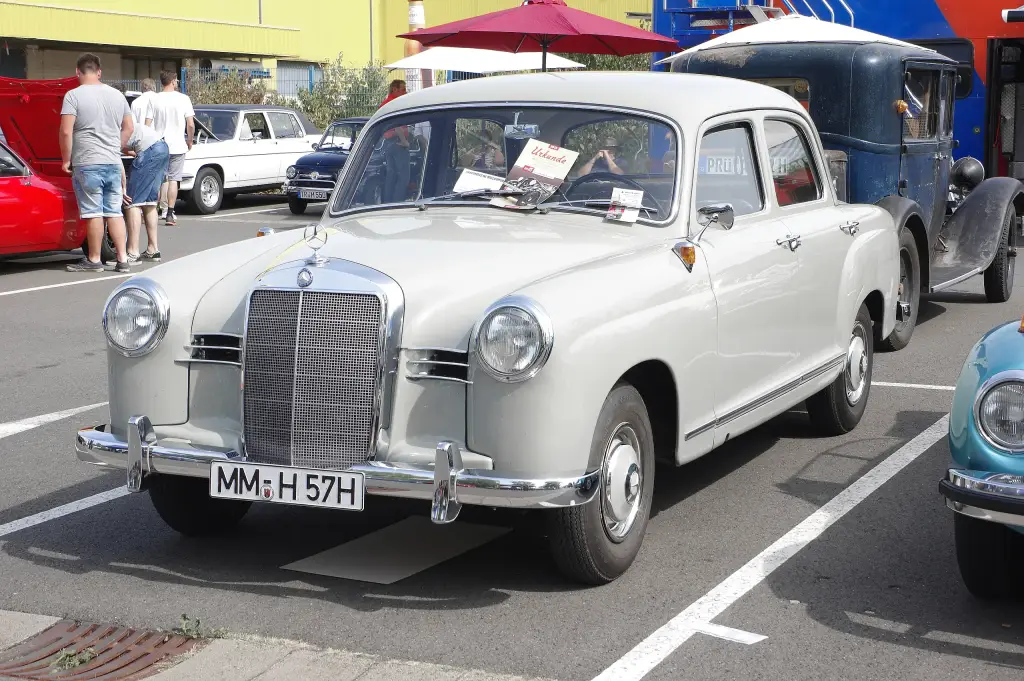
The first model was the W120 180 of 1953, a four-door saloon with a 1.8-litre four-cylinder engine, sold as the 180 petrol and the 180 D diesel. In 1954 the W180 220 a added a six-cylinder engine in a body stretched by 170 mm, 100 mm of it ahead of the firewall for the longer engine and 70 mm at the rear for legroom, with a new rear suspension. In 1956 the six-cylinder line grew into a range: the 220 a gained a second carburettor and became the 220 S, joined by two-door coupé and convertible models on a shorter wheelbase, and the W105 219 combined the six-cylinder nose with the shorter four-cylinder body. The four-cylinder 190 with a new short-stroke 1.9-litre engine arrived in 1956 and a 1.9 diesel in 1958, and in 1958 the 220 S gained fuel injection as the W128 220 SE.
The Ponton was the first Mercedes-Benz production car to use a monocoque body, and it partly applied Barényi’s ideas of crumple zones and a rigid passenger cell, patented in 1952, through a strong deep platform forming a partial safety cell. The full use of the patent came with the 1959 W111 Fintail. The Ponton saloons were the company’s main production models until 1959, taking up to 80 per cent of car production between 1953 and 1959, and some versions lasted until 1962. The shortened floorpan of the four-cylinder saloon also served as the structure of the W121 190 SL roadster.
Design and features
- Pontoon styling: wings and running boards merged into a single slab-sided body.
- Unitary construction: the first monocoque Mercedes-Benz production car.
- Safety thinking: an early application of Barényi’s crumple-zone ideas.
- Big family: four- and six-cylinder saloons, coupés and convertibles.
Mercedes-Benz Ponton versions
- W120 180 and 180 D (1953): the first Pontons.
- W180 220 a (1954): six-cylinder model on a longer body.
- 220 S (1956): twin-carburettor six.
- W105 219: six-cylinder nose on the short body.
- 190 and 190 D (1956, 1958): 1.9-litre four-cylinder models.
- W128 220 SE (1958): fuel-injected six.
The Ponton succeeded the 170 V and was followed by the W111 Fintail; its 190 SL relative has its own page. More in the Mercedes-Benz collection.
Sources
- Mercedes-Benz Ponton, English Wikipedia: design, models, safety, production