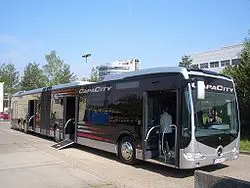
The Mercedes-Benz CapaCity is a four-axle, low-floor articulated bus for city use, built in series since April 2007 by EvoBus, now part of Daimler Buses. It was designed for routes with heavy passenger traffic.
Mercedes-Benz CapaCity at a glance
| Series production | since April 2007 |
|---|---|
| Built at | Mannheim, Germany |
| Builder | Daimler Buses, formerly EvoBus |
| Type | four-axle low-floor articulated bus |
| Capacity | 176 to 193 places, 37 to 45 seated and 133 to 156 standing |
| First generation length | 19.54 m, until early 2015 |
| Doors on the first generation | three or four |
| Second generation | 2015, Euro VI |
| CapaCity L length | 21.0 m |
| Second-generation standard length | 19.73 m |
| Doors on the new models | four or five |
| Gross weight | 32 tonnes, thanks to the steered fourth axle |
| Engine | straight-six diesel OM 470 (Euro VI) or OM 457 hLA (Euro V/EEV) |
This article is based on the German Wikipedia article on the CapaCity, with the description of the O530 GL versions from the English article on the Citaro. Free photographs of the CapaCity were not available, so the record keeps its earlier picture.
History of the Mercedes-Benz CapaCity
The CapaCity was first presented in November 2005 and entered series production in Mannheim in April 2007. With a length of 19.54 m it exceeded the normal legal limit of 18.75 m, so operators needed a special permit. The steered fourth axle in the trailer section raised the permitted gross weight to 32 tonnes and helped the long bus to turn, while a camera at the rear showed the driver on a monitor the path the bus would follow at the current steering angle.
The chassis used a roll and pitch control system of a kind previously seen only on fuel-cell buses with heavy roof loads, with electronically controlled variable damping for safety and comfort. A straight-six diesel, the OM 457 hLA in Euro V and EEV form, drove the third axle. The first generation stayed in production until early 2015 and came with three or four doors.
In 2015 the second generation arrived with Euro VI engines. It was first shown as the 21.0 m CapaCity L and then as the standard CapaCity, now 19.73 m long; both were offered with four or five doors. Among the operators were the Stuttgart streetcar company, which ran four CapaCity on city routes from August 2008 and later had nine, all replaced by Euro VI cars at the end of 2017 and the beginning of 2018 because of limits on older diesels in the city centre. Other buses went to Tübingen, Aachen and Darmstadt, and a CapaCity L was tested by the Berlin transport company in 2015 before delivery to Hamburg.
Design and features
- Extra length: 19.54 m and later 19.73 m, or 21.0 m for the CapaCity L.
- Steered fourth axle: raises the gross weight to 32 tonnes and improves manoeuvrability.
- Rear camera: shows the driver the path of the bus on a monitor.
- Active chassis: electronically controlled damping with roll and pitch control.
Mercedes-Benz CapaCity versions
- CapaCity (2007–2015): first generation, 19.54 m, three or four doors.
- CapaCity L (2015): 21.0 m, Euro VI.
- CapaCity (2015): second-generation standard model, 19.73 m.
- CapaCity L (second generation): 21.0 m with four or five doors.
The CapaCity is the longest member of the Citaro family and works alongside the shorter Cito and the Conecto. More in the Mercedes-Benz collection.
Video: Mercedes-Benz CapaCity
Video by YouTube on YouTube.
Sources
- Mercedes-Benz CapaCity, German Wikipedia: length, capacity, axles, engines, operators
- Mercedes-Benz Citaro, English Wikipedia: place in the Citaro range