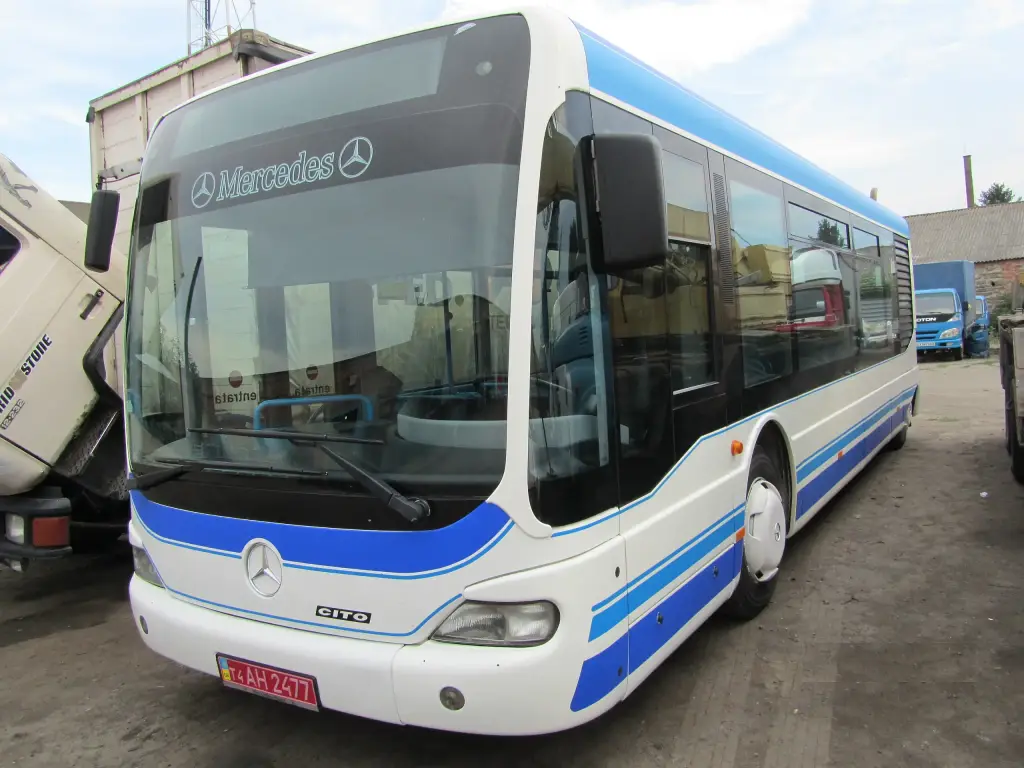
The Mercedes-Benz Cito, coded O520, is a low-floor midibus built by EvoBus for continental Europe between 1999 and 2003. It was unusual for its time in having a diesel-electric transmission.
Mercedes-Benz Cito at a glance
| Model code | O520 |
|---|---|
| Built by | EvoBus |
| Production | 1999–2003 |
| Market | continental Europe |
| Transmission | diesel-electric |
| Engine position | above the rear axle |
| Lengths | 8,100 mm, 8,900 mm and 9,600 mm |
| Width | 2,350 mm |
| Capacity | 31, 34 or 38 passengers |
| Planned variants | hybrid and fuel cell |
| Replaced by | short-wheelbase Citaro K in 2006 |
This article is based on one source, the English Wikipedia article on the Mercedes-Benz Cito.
History of the Mercedes-Benz Cito
The Cito was designed as a small low-floor bus for routes that did not need a full-size vehicle. Its diesel engine sat above the rear axle and drove a generator, with electric motors moving the bus, an arrangement then rare among buses; the plan was to add a hybrid or a fuel cell version at a later stage.

It was sold in three lengths of 8,100 mm, 8,900 mm and 9,600 mm, all 2,350 mm wide, with capacities of 31, 34 or 38 passengers. Production ran from 1999 to 2003, and the model was replaced in 2006 by the short-wheelbase Citaro K. Examples remained in service in several European countries, among them France, Belgium, the Czech Republic and Ukraine.
Design and features
- Diesel-electric drive: an early series application of the principle in a bus.
- Low floor: easy boarding for a midibus.
- Rear engine: mounted above the rear axle.
- Three lengths: from 8.1 to 9.6 metres.
Mercedes-Benz Cito versions
- 8,100 mm: 31 passengers.
- 8,900 mm: 34 passengers.
- 9,600 mm: 38 passengers.
The Cito was the smallest member of the city bus range below the Citaro, and its place was taken by the Citaro K. More in the Mercedes-Benz collection.
Video: Mercedes-Benz O520 cito
Video by YouTube on YouTube.
Sources
- Mercedes-Benz Cito, English Wikipedia: transmission, lengths, capacity, production