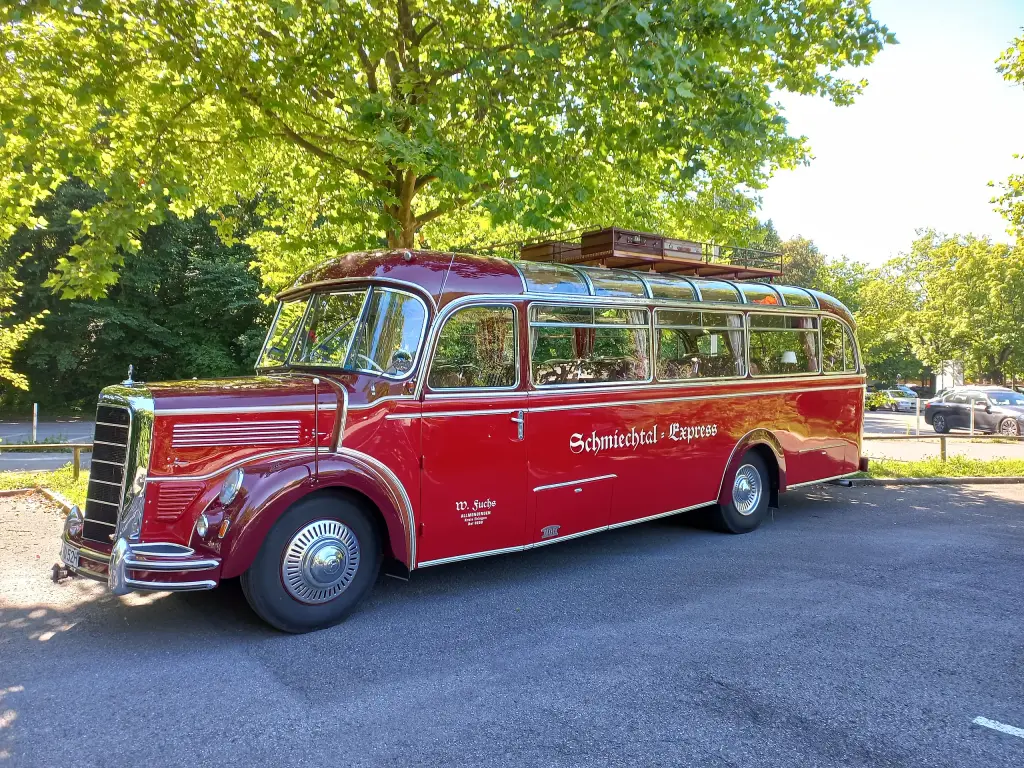
The Mercedes-Benz O 3500 was the first newly developed bus of Daimler-Benz after the Second World War and the first bus built at the Mannheim plant. It was based on the L 3500 truck with its diesel engine under a bonnet at the front.
Mercedes-Benz O 3500 at a glance
| Production | December 1949 – 1955 |
|---|---|
| Built | 6,049 |
| Plant | Mannheim |
| Basis | Mercedes-Benz L 3500 truck |
| Layout | front engine under a bonnet |
| Engine | OM 312 six-cylinder diesel, 4,580 cc |
| Power | 90 PS (66 kW) at 2,800 rpm |
| Top speed | 82 km/h |
| Gearbox | five-speed claw gearbox |
| City bus | 22 seats and 23 standing places |
| Coach | up to 37 passengers |
| Track | 1,700 mm |
This article is based on the German Wikipedia article on the O 3500. Free photographs of the O 3500 were not available, so the record keeps its earlier picture.
History of the Mercedes-Benz O 3500
The O 3500 was developed from the L 3500 truck presented at the same time, and from the compact bus a whole family of touring, intercity and city buses grew within a few years. With 6,049 examples between December 1949 and the end of production in 1955 it was the most successful bus of its time.
The city bus had an air-operated sliding door at the front and an air-operated folding door at the rear. Behind the driver sat four two-seat chairs on each side, followed by a three-seat bench over each wheel arch, giving 22 seats, with 23 standing places in the centre aisle and at the rear platform. The all-weather touring and intercity buses instead had hand-operated doors hinged at the front; the all-weather version also had glazing along the roof edge and a sliding roof more than 2.5 m long, giving 16 m² of glass. The luggage space behind the rear seat was reached through double doors, and a roof rack could be added.
Inside the coaches were twelve two-seat chairs on steel-tube frames, a folding bench at the rear entrance and a five-person bench at the back, plus six single folding seats in the aisle and one or two beside the driver, for up to 37 passengers. All seats were covered in imitation leather, with head restraints, armrests and folding tables available at extra cost. The bus had a driver’s door, flashing indicators, twin wipers, safety glass, an emergency exit in the rear window, a fire extinguisher and a first-aid box, heating and ventilation, six ceiling lights and a bell system. Power came from the 4.6-litre OM 312 six-cylinder pre-chamber diesel of 90 PS, driving through a five-speed claw gearbox to the rear axle, with a top speed of 82 km/h.
Design and features
- First post-war bus: a new design based on the L 3500 truck.
- Bonneted layout: the diesel sat at the front under a bonnet.
- Many bodies: city, intercity, touring and all-weather versions.
- Mechanical simplicity: OM 312 diesel and five-speed gearbox.
Mercedes-Benz O 3500 versions
- City bus: 22 seats and 23 standing places.
- Intercity bus: hand-operated front-hinged doors.
- All-weather touring bus: roof-edge glazing and a long sliding roof.
- Coach: up to 37 passengers with folding seats.
The O 3500 was followed by rear-engined buses such as the O 321 H and later the O 302. More in the Mercedes-Benz collection.
Video: Restoration of a Mercedes-Benz O 3500
Video by YouTube on YouTube.
Sources
- Mercedes-Benz O 3500, German Wikipedia: production, variants, equipment, engine