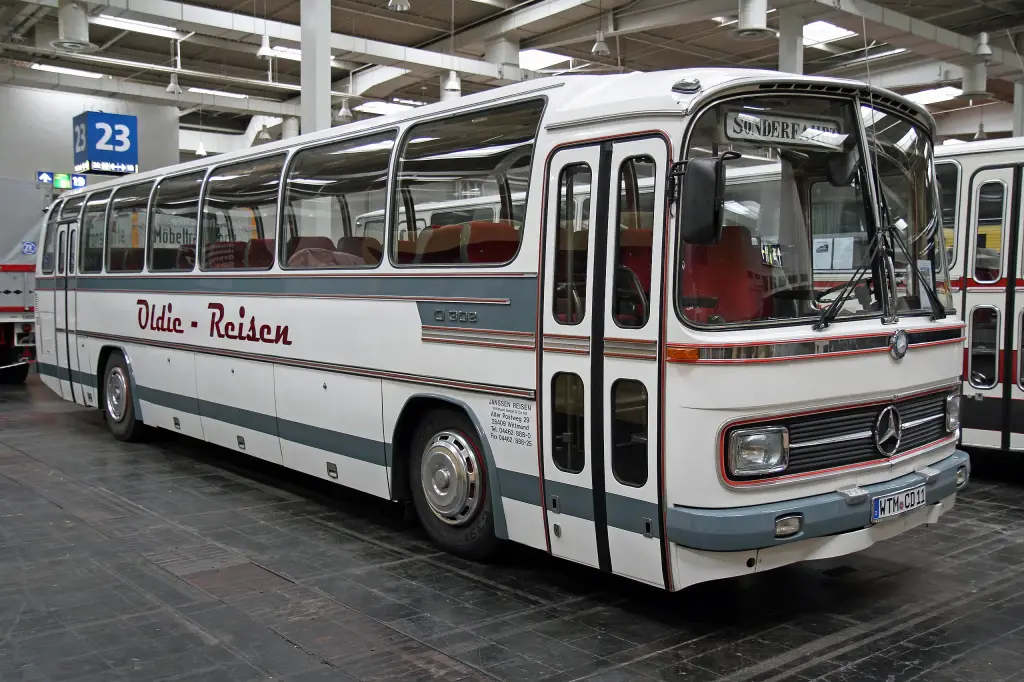
The Mercedes-Benz O 302 is a bus model presented by Daimler-Benz in 1965. It was built as a high-floor bus for city, intercity and long-distance work, and more than 32,000 were made before production ended in 1976.
Mercedes-Benz O 302 at a glance
| Presented | 1965 |
|---|---|
| Production | until 1976 |
| Built | more than 32,000 |
| Type | high-floor city, intercity and coach bus |
| Length | 9.6 to 11.9 m, depending on version |
| Gross weight | 11.6 to 14.5 t |
| Seat rows | 10, 11, 12 or 13 |
| Construction | semi-integral, floor frame with self-supporting body |
| Axles | two, rigid front and rear axles |
| Suspension | coil and leaf springs, or air springs; air standard from 1971 |
| Engines | OM 352 5.7 L, OM 327 8.0 L, OM 360 8.7 L, OM 355 11.6 L |
| Power | 126 to 240 PS |
This article is based on the German Wikipedia article on the O 302. Free photographs of the O 302 were not available, so the record keeps its earlier picture.
History of the Mercedes-Benz O 302
The O 302 was offered with 10, 11, 12 or 13 rows of seats, always on two axles and with a high floor. It was built semi-integrally, with a floor frame carrying the axles and a self-supporting body above it. Depending on the version it measured between 9.6 and 11.9 m and had a gross weight of 11.6 to 14.5 tonnes. Buyers could choose normal-height side windows or windows with extra glazing along the roof edge.
The floor frame was a profile skeleton carrying both axles, which were rigid and located by links. The bus could be ordered with coil springs at the front and leaf springs at the rear, or with air springs, and the rear springs were doubled. From 1971 air suspension became standard on all vehicles. There were shock absorbers front and rear, steel disc wheels with 9-20 tyres twinned at the rear, a hydraulic two-circuit brake with air assistance and drum brakes on all wheels, and ZF ball-and-nut steering with servo assistance. All buses were left-hand drive.
Four naturally aspirated six-cylinder diesels were offered: the 5.7-litre OM 352, the 8-litre OM 327, the 8.7-litre OM 360 and the 11.6-litre OM 355, all with direct injection and water cooling, giving between 126 and 240 PS. Power went through a single dry clutch to a five-speed Daimler-Benz gearbox, later also an eight-speed, and a short shaft to the rear axle. Two final-drive ratios were offered for city and intercity work. Daimler-Benz also built the battery-electric OE 302 from 1969, the O 302 was made under licence by Biamax in Greece, and in 1974 O 302 buses served as team coaches during the football World Cup in Germany.
Design and features
- High floor: a bus for city, intercity and long-distance routes in one model.
- Semi-integral body: a floor frame combined with a self-supporting body.
- Air suspension: optional at first, standard from 1971.
- Four diesel engines: from 5.7 to 11.6 litres and 126 to 240 PS.
Mercedes-Benz O 302 versions
- 10 to 13 seat rows: versions from 9.6 to 11.9 m.
- Roof-edge glazing: an alternative to normal side windows.
- Air-sprung buses: standard from 1971.
- OE 302 (1969): battery-electric version.
- Biamax licence: Greek production, later with O 303 front and rear.
The O 302 was followed by the O 303 and belongs to the older bus range alongside the O 321. More in the Mercedes-Benz collection.
Video: Mercedes-Benz O 302
Video by YouTube on YouTube.
Sources
- Mercedes-Benz O 302, German Wikipedia: versions, chassis, engines, production, licence