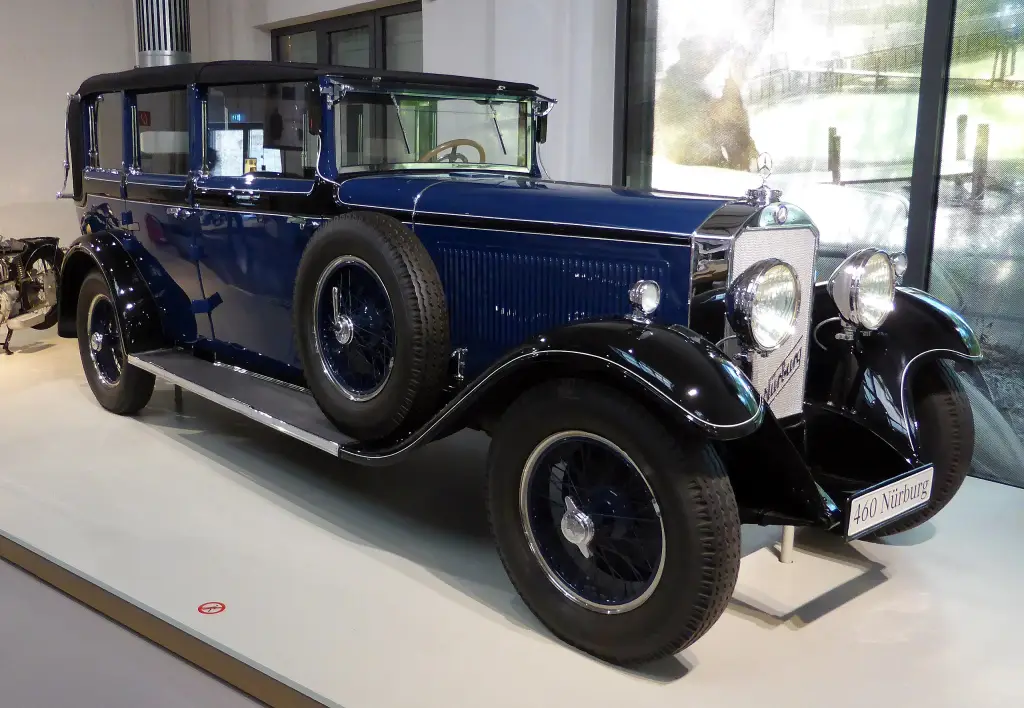
The Mercedes-Benz W08 was a large luxury car introduced in the autumn of 1928 as the company’s first eight-cylinder passenger car. With various modifications it stayed in production until the summer of 1939.
Mercedes-Benz W08 at a glance
| Introduced | autumn 1928 |
|---|---|
| First model | Typ Nürburg 460 |
| Designer | Ferdinand Porsche |
| Engine | 4,622 cc side-valve straight-eight |
| Power | 80 PS (59 kW) at 3,400 rpm |
| Top speed | 100 km/h |
| Chassis | tall overslung frame |
| Axles | rigid, on semi-elliptic leaf springs |
| Brakes | servo-assisted mechanical with Bosch-Dewandre vacuum |
| Pullman limousine | 4,890 mm long, 2,150 kg, 15,000 marks |
| Tourenwagen | 14,000 marks |
| Cabriolet D | 17,500 marks |
| Production end | 1939 |
This article is based on one source, the English Wikipedia article on the Mercedes-Benz W08.
History of the Mercedes-Benz W08
The name Nürburg refers to the village of Nürburg and the Nürburg-Ring racetrack opened in 1927, where the newly merged Mercedes-Benz brand won the first Eifelrennen and the German Grands Prix of 1927 and 1928 with the six-cylinder W06 Types S and SS. The W08 was developed by Ferdinand Porsche, who had come to Daimler in 1923 and was the board member responsible for new products. The aim was a serious rival to the Horch 8.
Porsche’s work was rushed, and the result kept a traditional tall overslung chassis, with the longitudinal members above the axles, at a time when newer designs used lower underslung frames. The 1928 W08 therefore looked unfashionably tall and was harder to enter than lower cars. The engine was a 4,622 cc side-valve straight-eight giving 80 PS at 3,400 rpm and a top speed of 100 km/h. Wheels hung on rigid axles with semi-elliptic leaf springs front and rear, and the four-wheel brakes used a servo-assisted mechanical linkage with a Bosch-Dewandre vacuum booster.
The car was close in size to the Horch 8 Type 303 on which it had been benchmarked: the Pullman limousine was 4,890 mm long, or 5,200 mm with the detachable boot, and weighed 2,150 kg. Besides the Pullman at 15,000 marks, buyers could choose a six-seat Torpedo Tourenwagen for 14,000 marks or a four-door Cabriolet D for 17,500. The big, old-fashioned and expensive car found few customers at first and had to be replaced in the range, but the W08 line itself continued with modifications and upgrades until 1939, making it the longest-lived Mercedes-Benz model of the 1920s and 1930s.
Design and features
- First eight-cylinder Mercedes: a 4.6-litre side-valve straight eight.
- Tall chassis: an overslung frame that looked old fashioned by 1928.
- Servo brakes: mechanical linkage with a Bosch-Dewandre vacuum booster.
- Long life: built from 1928 to 1939 with constant updates.
Mercedes-Benz W08 versions
- Pullman limousine: 15,000 marks.
- Torpedo Tourenwagen: six seats, 14,000 marks.
- Cabriolet D: four doors, 17,500 marks.
- Short-wheelbase cabriolet: mentioned but possibly not built on the 1928 W08.
The W08 was the eight-cylinder flagship before the 770 and stood above the six-cylinder S-Series. More in the Mercedes-Benz collection.
Sources
- Mercedes-Benz W08, English Wikipedia: development, engine, chassis, bodies, prices