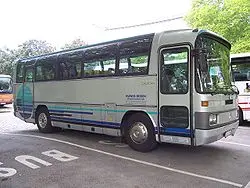
The Mercedes-Benz O 303 was a coach built by Daimler-Benz in the 1970s and 1980s. It was presented at the Paris motor show in 1974 as a smoother, more modern development of the very successful O 302.
Mercedes-Benz O 303 at a glance
| Presented | 1974, Paris motor show |
|---|---|
| Type | coach range with line and combination versions |
| Body | smoother than the O 302, skeleton frame calculated by computer |
| Seat rows | 9, 10, 11, 13, 14 or 15 |
| Body lengths | six |
| Maximum seats | up to 55 with full seating and no WC |
| Engines | new V6 and V8 diesels, plus a V10 of 235 kW (320 PS) |
| Suspension | air suspension as standard |
| Options | automatic gearbox, ABS from 1981, electronic-pneumatic shift from 1985 |
| Facelift | 1982 |
| High-decker | from 1979 |
This article is based on the German Wikipedia article on the O 303. Free photographs of the O 303 were not available, so the record keeps its earlier picture.
History of the Mercedes-Benz O 303
The O 303 was shown in Paris in 1974 with a body much smoother than that of the O 302, following the taste of the time, and it was technically a development of that model. Its skeleton frame was calculated by computer for the first time, which made the O 303 an independent design rather than a facelift. It was conceived even more clearly as a coach, but the modular system still included line buses, combination buses and coaches from simple specifications to the high-decker long-distance version that appeared in 1979. A city version was not offered because the standard O 305 and O 307 covered that work.
The bus kept rigid axles and drum brakes throughout its life, but gained newly developed V6 and V8 diesels and, until the high-decker and the parallel NG 80 truck update, a V10 of 235 kW (320 PS). Air suspension was standard from the start and made up for the comfort of rigid axles. Automatic gearboxes were optional, ABS became available in 1981 and from 1985 the semi-automatic electro-pneumatic shift could be ordered, while manual six-speed gearboxes were the norm. Early cars had a front windscreen split vertically in the middle; from 1979 a one-piece screen was optional on normal models and standard on the high-decker.
The only major facelift came in 1982: part of the front panel was made of plastic, the chrome surround around the headlamps and radiator disappeared, the overhead luggage racks were closed underneath with a continuous grab rail and the dashboard was redesigned. Black window surrounds could be ordered to make the side glazing look like one band. The O 303 was offered with 9, 10, 11, 13, 14 or 15 seat rows in six body lengths, and the number of seat rows was part of the type designation. With full seating, including folding seats at the second door on combination versions and without a WC, up to 55 seats were available.
Design and features
- Smoother body: a new shape and a computer-calculated skeleton frame.
- Air suspension: standard on every O 303.
- New engines: V6 and V8 diesels, with a V10 of 320 PS in the early years.
- Modular range: line, combination and coach versions with up to 15 seat rows.
Mercedes-Benz O 303 versions
- Line and combination buses: simpler specifications of the range.
- Coach versions: from basic to high-decker.
- High-decker (1979): the long-distance version with a higher front screen.
- Facelift (1982): plastic front panel and redesigned interior.
The O 303 followed the O 302 and was replaced by the O 404 in 1992; city buses were covered by the O 305. More in the Mercedes-Benz collection.
Video: Mercedes-Benz O 303
Video by YouTube on YouTube.
Sources
- Mercedes-Benz O 303, German Wikipedia: design, engines, options, body lengths