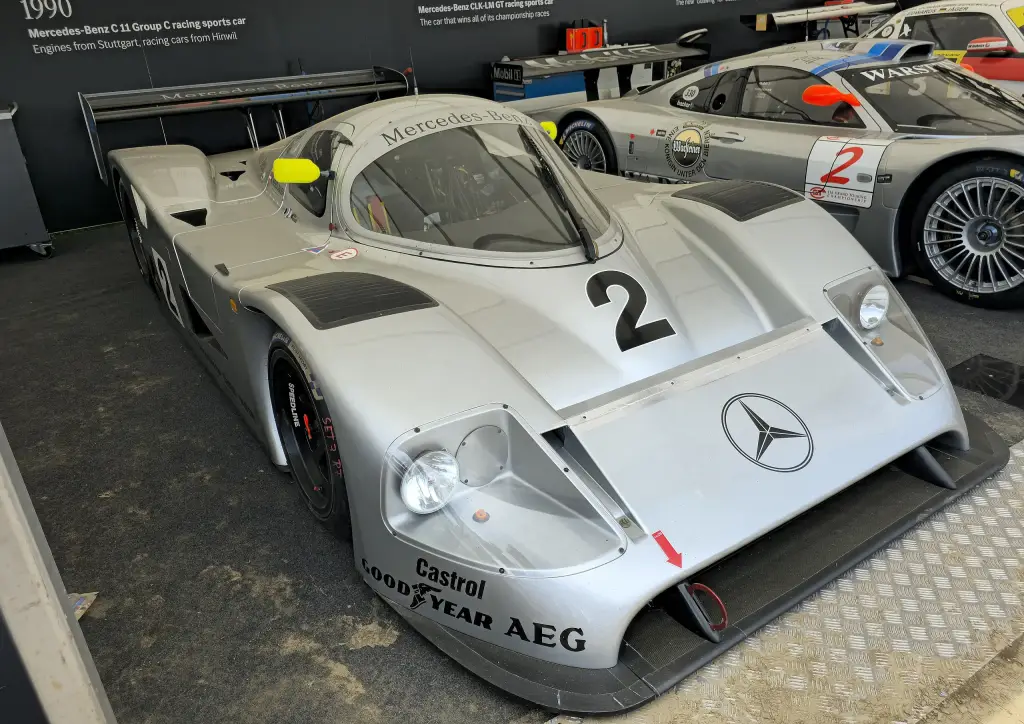
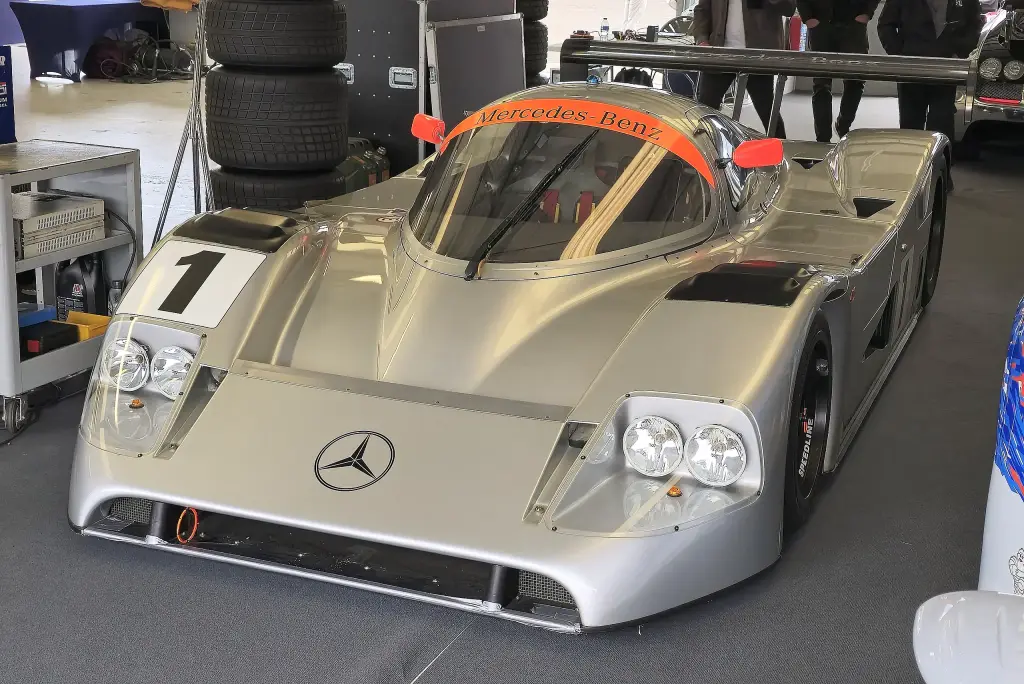
The Mercedes-Benz C11 is a Group C prototype race car introduced for the 1990 World Sports-Prototype Championship. Built by Sauber as the successor to the C9, it used the same Mercedes-Benz M119 5.0-litre twin-turbo V8.
Mercedes-Benz C11 at a glance
| Introduced | 1990 |
|---|---|
| Built by | Sauber, for Mercedes-Benz |
| Category | Group C |
| Engine | 5.0-litre M119 twin-turbo V8 |
| Race power | about 730 hp |
| Maximum power | 850 hp at 7,000 rpm at high boost |
| Chassis | carbon fibre, designed by Leo Ress |
| Minimum weight | 900 kg plus 5 kg for safety |
| Downforce | 5,879 lbf at 320 km/h |
| Gearbox | five-speed Mercedes transaxle |
| Tyres | Goodyear |
| Chassis built | five |
This article is based on one source, the English Wikipedia article on the Mercedes-Benz C11.
History of the Mercedes-Benz C11
The C11 was the last Group C prototype built by Sauber-Mercedes before the 3.5-litre category arrived. Unlike the aluminium C9, the new car had a carbon-fibre chassis designed from scratch by Leo Ress; the first example was built by the Swiss firm Nobrac and the rest by DPS Composites in Surrey. The body was designed for more downforce and a lower frontal area: at 320 km/h it made 5,879 lbf of downforce, about 1,000 lbf more than the C9 at the same speed. The car was lighter and stiffer than its predecessor, and ballast was added to reach the minimum weight.
The M119 engine was tuned to about 730 hp in race trim, the best balance of power and economy for Group C’s fuel formula, and could reach 850 hp at 7,000 rpm with high boost. A new five-speed Mercedes transaxle was designed with the rear suspension in mind, using push rods and a transverse spring and damper layout instead of the C9’s longitudinal arrangement. The brakes were Brembo and the tyres Goodyear.
The car first ran at Paul Ricard in October 1989 and was due to debut at Suzuka in April 1990, but Jean-Louis Schlesser crashed it in practice and the team raced the C9 instead. At Monza, the second round, Mauro Baldi and Jochen Mass qualified first and second and finished in the same order. The C11 then won all but one race and took the team championship; the only failure was an engine failure at Silverstone while leading, and the number 1 car was disqualified in Mexico for exceeding its fuel allocation. Five chassis were built, and C11-03 was the most successful with four wins in 1990. Problems with the C291’s new engine kept the C11 racing in 1991, when it took three more class wins before being replaced.
Design and features
- Carbon-fibre chassis: a first for the Sauber-Mercedes partnership.
- Downforce: about 1,000 lbf more than the C9 at 320 km/h.
- Fuel-efficient engine: 730 hp tuned for Group C fuel allocation.
- Transverse rear suspension: push rods and a stiffer integrated rear end.
Mercedes-Benz C11 versions
- 1990 race car: the standard Group C specification.
- High-boost engine: 850 hp at 7,000 rpm.
- C11-03: the most successful chassis with four wins in 1990.
- 1991 cars: kept in service alongside the C291.
The C11 followed the Sauber C9 and was replaced by the C291. Its road-car relative in engineering spirit is the C111; more in the Mercedes-Benz collection.
Video: Group C Sauber Mercedes-Benz C11 onboard
Video by YouTube on YouTube.
Sources
- Mercedes-Benz C11, English Wikipedia: design, engine, season results