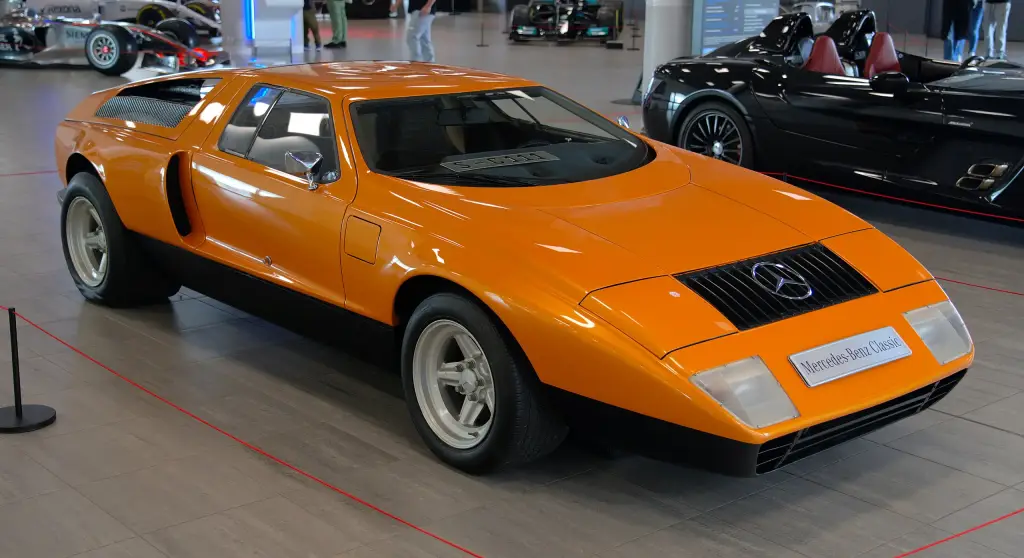
The Mercedes-Benz C111 was a series of experimental cars built in the 1960s and 1970s. The company used the platform to test Wankel engines, diesels and turbochargers, along with multi-link rear suspension and gullwing doors.
Mercedes-Benz C111 at a glance
| First car completed | 1969 |
|---|---|
| First show | 1969 IAA, Frankfurt |
| First engine | three-rotor Wankel, M950F |
| Second version | 1970, four-rotor Wankel with 260 kW |
| C111-IID engine | OM 617 diesel, 140 kW (188 hp) |
| C111 III | 1978, 3-litre diesel with 170 kW (228 hp) |
| C111 III drag coefficient | 0.195 |
| C111 III record | 338 km/h at Nardò |
| C111 IV | 4.5-litre twin-turbo V8, 368 kW (500 PS) |
| C111 IV record | 403.78 km/h at Nardò in 1979 |
| Total built | 16 cars |
| C112 | 1991 show car with a 6.0-litre V12 |
This article is based on one source, the English Wikipedia article on the Mercedes-Benz C111.
History of the Mercedes-Benz C111
The first C111 was finished in 1969 and shown at the Frankfurt motor show that year. It had a fibreglass body and a mid-mounted three-rotor Wankel engine with direct fuel injection, coded M950F. A second car appeared in 1970 at the Geneva show with a four-rotor engine of 260 kW and a claimed 300 km/h. The company decided not to put the Wankel engine into production and turned to diesel experiments.
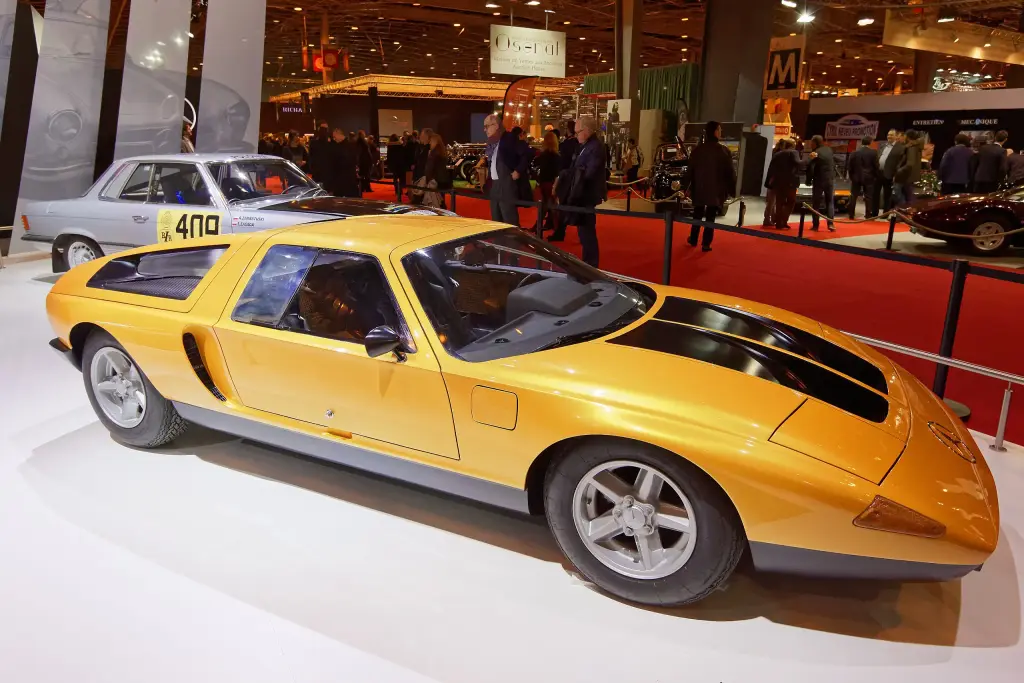
The C111-IID used the OM 617 five-cylinder diesel of the W116 S-Class, but with 140 kW (188 hp) thanks to a turbocharger without a wastegate and an intercooler that improved thermal efficiency. The third car, completed in 1978, had more aerodynamic bodywork with a drag coefficient of 0.195, a 3-litre version of the same diesel producing 170 kW (228 hp) and 401 Nm, and reached 338 km/h at the Nardò ring in Italy while averaging 16 litres per 100 km at 325 km/h.
The fourth car used a 4.5-litre twin-turbo V8 of 368 kW (500 PS) and in 1979 set another record at Nardò, driven by Hans Liebold, with an average speed of 403.78 km/h. In all, sixteen cars were built: thirteen of the first two Wankel generations, two diesel cars of the third generation and one V8 car of the fourth. In 1991 Mercedes-Benz showed the C112 at the Frankfurt motor show, a proposed production sports car with a mid-mounted 6.0-litre V12; the company took 700 deposits and then decided not to build it.
Design and features
- Engine laboratory: Wankel, diesel and turbocharged petrol power tested in one platform.
- Low drag: the C111 III reached a drag coefficient of 0.195.
- Records at Nardò: 338 km/h in 1978 and 403.78 km/h in 1979.
- Advanced chassis: multi-link rear suspension and gullwing doors.
Mercedes-Benz C111 versions
- C111 (1969): three-rotor Wankel.
- C111-II (1970): four-rotor Wankel with 260 kW.
- C111-IID: turbocharged five-cylinder diesel of 140 kW.
- C111 III (1978): 3-litre diesel, 170 kW, 338 km/h.
- C111 IV (1979): 4.5-litre twin-turbo V8, 403.78 km/h.
- C112 (1991): V12 show car that was never built.
The C111 was a research car rather than a racer; the competition cars of the same years were the C11 and C291. More in the Mercedes-Benz collection.
Video: Mercedes C111
Video by YouTube on YouTube.
Sources
- Mercedes-Benz C111, English Wikipedia: versions, engines, records, production