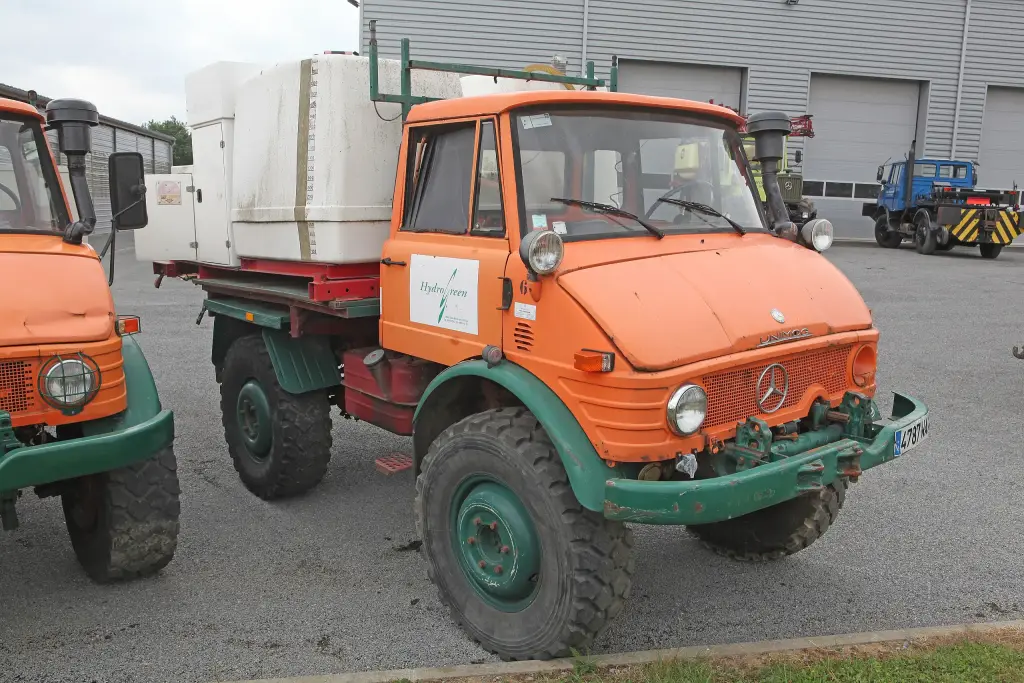
The Unimog is a line of multi-purpose, highly off-road-capable four-wheel-drive vehicles produced by Daimler Truck since 1948. Its name is short for Universal-Motor-Gerät.
Unimog at a glance
| Produced since | 1948 |
|---|---|
| Name | Universal-Motor-Gerät |
| First design | Albert Friedrich and Heinrich Rößler, 1944 |
| First production | 1948 at Boehringer, Göppingen |
| Daimler-Benz took over | 1951, at Gaggenau |
| Mercedes star | first used on the Unimog in 1953 |
| Built at Wörth | since 2002 |
| Other plants | Aksaray in Turkey, Argentina 1968–1983 |
| Axles | coil-sprung portal axles |
| Current series | 405 (UGN) and 437 (UHN) |
| Related model | MB-trac, 1973–1991 |
This article is based on one source, the English Wikipedia article on the Unimog.
History of the Unimog
The Unimog was conceived in 1944 in response to the Morgenthau Plan by former Daimler-Benz aircraft engine engineers. The small 25 hp workhorse was designed to fit over two rows of potatoes to work in fields like a slow agricultural tractor, but with four equal-size wheels on portal axles, coil spring suspension and many gears so that it could also run on roads like a truck. The first model was designed by Albert Friedrich and Heinrich Rößler shortly after the war as a self-propelled machine with a power take-off for saws in forests or harvesting machines in fields. It had rear-wheel drive with switchable front drive and equal-size wheels.
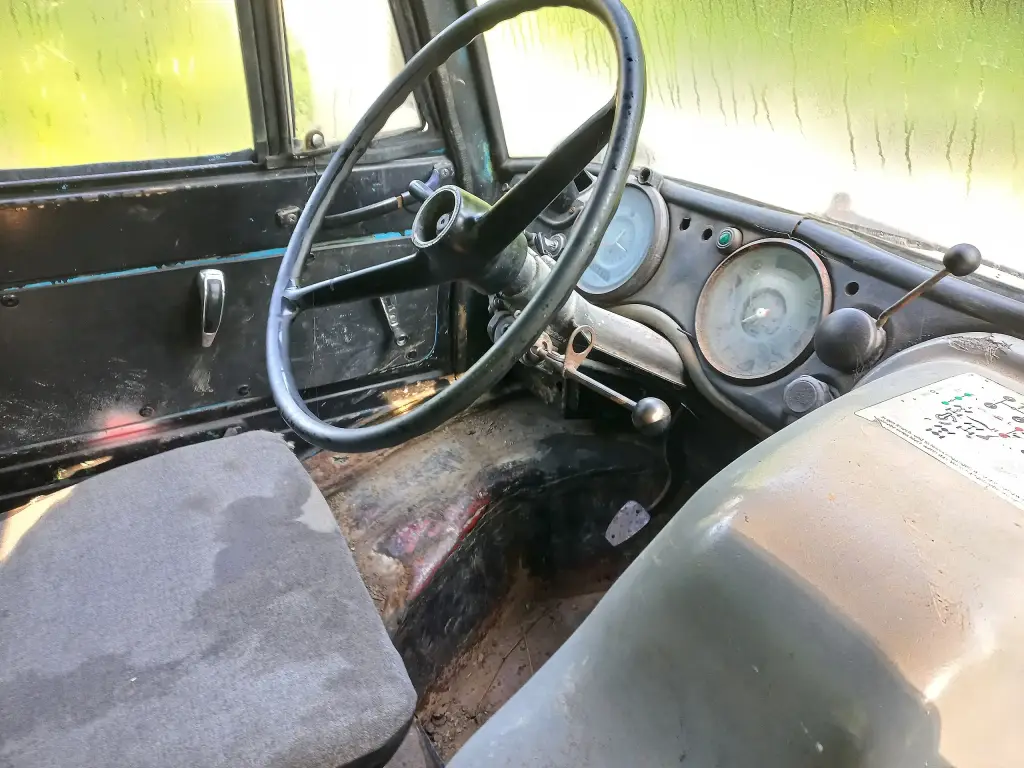
Production started in 1948 at Boehringer in Göppingen. When larger numbers were needed Daimler-Benz took over manufacture in 1951, first at Gaggenau, and the Unimog was sold under the Mercedes-Benz brand, though the first car to wear the three-pointed star rather than the Boehringer bullhead appeared only in 1953. From 1973 the more tractor-like MB-trac was offered alongside it until 1991. Since 2002 the Unimog has been built at the Mercedes-Benz truck plant in Wörth am Rhein, and the Mercedes-Benz Türk plant assembles it in Aksaray, Turkey. It was also built in Argentina from 1968 to 1983, the first country outside Germany.
Its characteristic design is a flexible ladder frame with short overhangs and coil-sprung beam portal axles with a central torque tube and transverse links. Because the wheel centres sit below the axle centres, the Unimog has very high ground clearance, and its flexible frame acts as part of the suspension, though it is not designed to carry as much load as an ordinary truck. That has made it useful as a military vehicle, fire engine, expedition camper and competition vehicle, and in Western Europe as a snowplough, municipal equipment carrier, forest ranger vehicle, construction machine or road-rail vehicle. New Unimogs come in two series, the medium 405 or UGN equipment carrier and the heavy 437 or UHN highly mobile cross-country vehicle.
Design and features
- Portal axles: wheel centres below the axle for very high ground clearance.
- Flexible frame: the ladder frame acts as part of the suspension.
- Power take-offs: engine-driven PTOs for saws, pumps and implements.
- Great variety: from farm tractor to military carrier and rally vehicle.
Unimog versions
- Series 405 (UGN): the medium equipment carrier.
- Series 437 (UHN): the heavy cross-country vehicle.
- Military versions: armoured personnel and equipment carriers.
- Road-rail versions: for railway maintenance.
The Unimog is the other long-lived off-road line beside the G-Class and served as the basis for the Zetros idea of a specialist truck. More in the Mercedes-Benz collection.
Video: Mercedes-Benz Unimog
Video by YouTube on YouTube.
Sources
- Unimog, English Wikipedia: origin, design, plants, uses, series