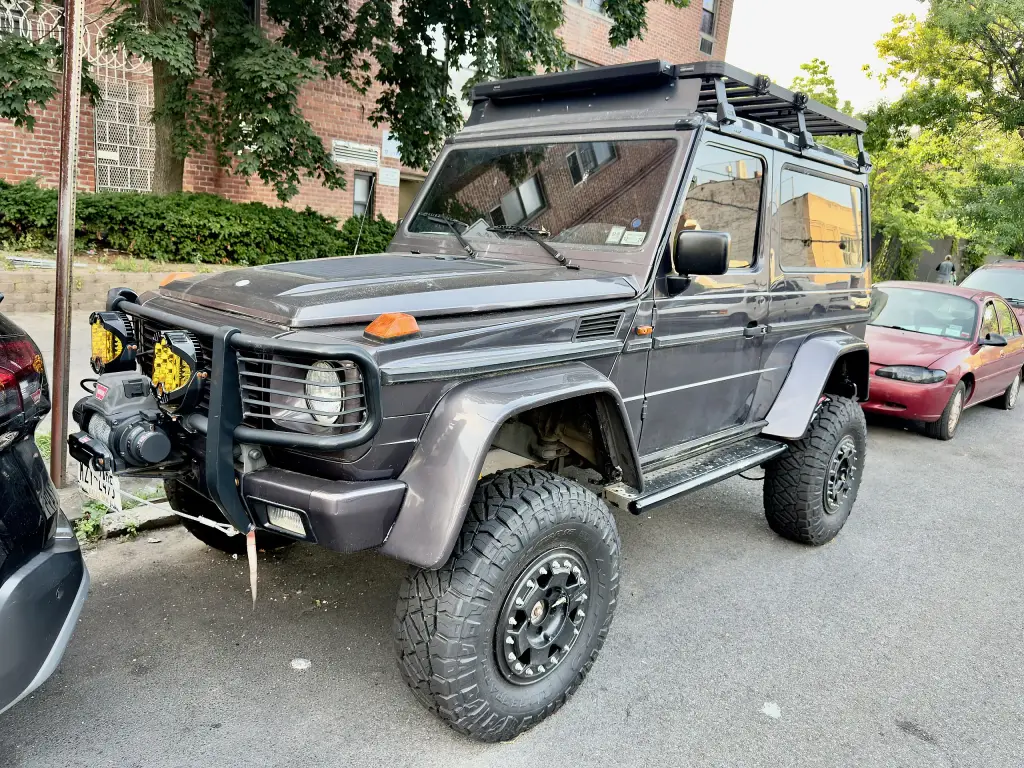
The Mercedes-Benz G-Class, known as the G-Wagon or G-Wagen from Geländewagen, is a four-wheel-drive luxury SUV sold since 1979. It began as a military off-roader and remains in production, one of the longest-lived vehicles in the company’s history.
Mercedes-Benz G-Class at a glance
| Production | since 1979 |
|---|---|
| Name | Geländewagen, off-road vehicle |
| Construction | body on frame |
| Differentials | three, all lockable |
| Development began | 1972, with Steyr-Daimler-Puch in Graz |
| First prototype | 1974, tested from coalfields to the Arctic |
| Production start | 1979, in Graz |
| First facelift | 1990 |
| Renamed G-Class | 1994 |
| Second generation | W463, 2018 |
| 400,000th car | 4 December 2020 |
| 500,000th car | April 2023 |
This article is based on one source, the English Wikipedia article on the Mercedes-Benz G-Class.
History of the Mercedes-Benz G-Class
Development started in 1972 under an agreement between Daimler-Benz and Steyr-Daimler-Puch of Graz, Austria, after a suggestion by the Shah of Iran, Mohammad Reza Pahlavi. Engineers in Stuttgart designed and tested the car while the Graz team planned production. The first wooden model was shown to management in 1973, and a drivable prototype began testing in German coalfields, the Sahara and the Arctic Circle in 1974. Production of the G Model started in Graz in 1979, assembled almost entirely by hand.
In 1980 the Vatican took delivery of a G-Wagen with a clear thermoplastic top as a Popemobile. Refinements came steadily: an automatic gearbox, air conditioning, an auxiliary tank and a winch in 1981; fuel injection with the 230 GE in 1982; differential locks, central locking and a tachometer as standard by 1985. By 1986 more than 50,000 had been built. A facelift arrived in 1990, and for 1992 a sub-series for professional users began. The 100,000th G Model was built in 1992, and in 1994 the line was officially renamed the G-Class, with ventilated front discs and a driver’s airbag becoming standard.
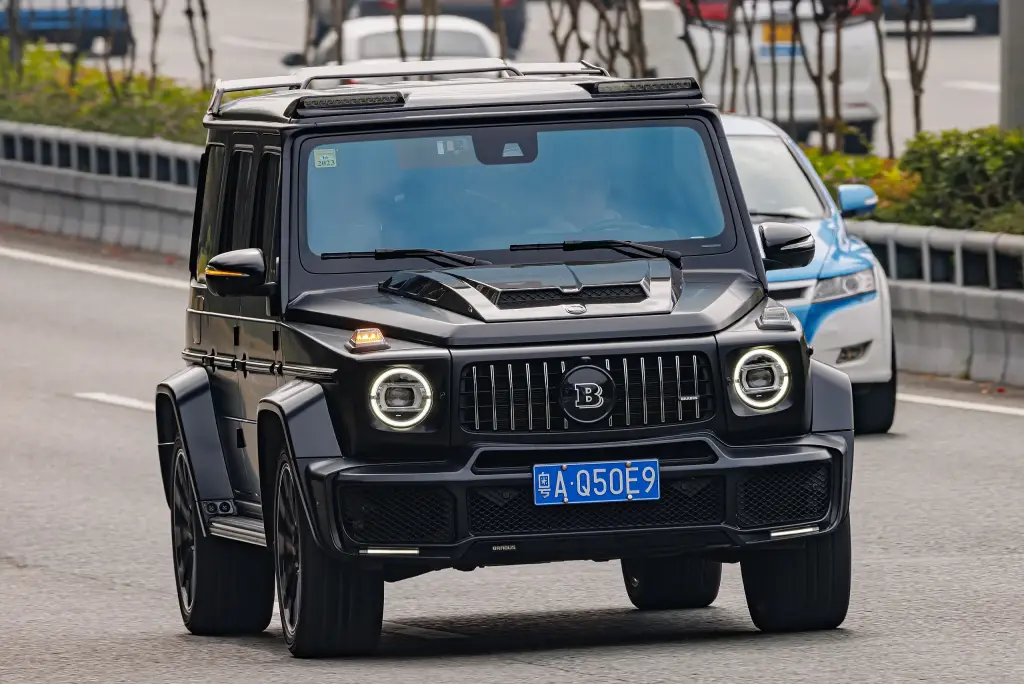
The range-topping G 500 with a 300 PS V8 arrived in 1998, followed by the G 55 AMG in 1999 with 354 hp and later 480 PS from a supercharged V8. The G-Class reached the United States in 2001 with ESP, Brake Assist and four-wheel Electronic Traction System. Despite the arrival of the GL-Class in 2006 as an intended replacement, the G-Class stayed in production. A second-generation W463 with a heavily revised chassis, powertrain and interior appeared in 2018. The 400,000th car was built in December 2020 and the 500,000th in April 2023; the G-Class has also been sold as the Puch G and used as the military Wolf.
Design and features
- Three locking differentials: a rare feature among passenger vehicles.
- Body on frame: the construction behind its durability and its boxy shape.
- Military origins: developed as a military vehicle and still used as the Wolf.
- Long production: 47 years, beaten in the company only by the Unimog.
Mercedes-Benz G-Class versions
- W460 (1979–1991): the first generation.
- W461: the professional and military sub-series from 1992.
- W463: the civilian line from 1990, renamed G-Class in 1994.
- G 500 (1998): 300 PS V8.
- G 55 AMG: 354 hp, later 480 PS supercharged.
- W463 second generation (2018): new chassis and interior.
The G-Class is the ancestor of the GL-Class and GLK and is related in purpose to the Unimog. More in the Mercedes-Benz collection.
Video: Mercedes-Benz G-Class
Video by YouTube on YouTube.
Sources
- Mercedes-Benz G-Class, English Wikipedia: history, development, models, production