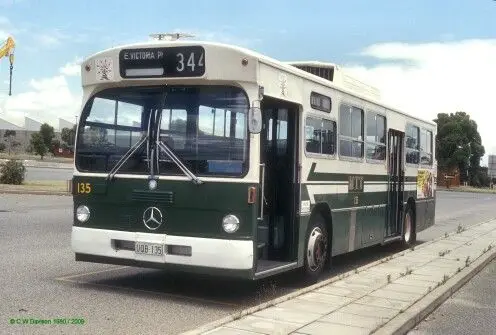
The Mercedes-Benz O 305 was one of the first-generation standard city buses developed to the VÖV guidelines. The prototype was shown in 1967 and series production began in 1969 at Mannheim.
Mercedes-Benz O 305 at a glance
| Prototype | 1967, IAA |
|---|---|
| Series production | from 1969, Mannheim |
| Production ended | 1985 |
| Built | about 16,000 |
| Chassis delivered | 4,743 bare chassis, bodied by other firms until 1987 |
| Layout | city bus with 41 seats and 61 standing places |
| Engine | OM 360 diesel, 141 kW (192 PS) or 125 kW (170 PS) |
| Later engine | OM 407 h, 154 kW (210 PS) or 132 kW (180 PS) |
| Gearbox | four-speed manual or W3D 080 three-speed automatic |
| Suspension | air-sprung rigid axles |
| Articulated version | O 305 G, from 1977 |
This article is based on the German Wikipedia article on the O 305. Free photographs of the O 305 were not available, so the record keeps its earlier picture.
History of the Mercedes-Benz O 305
The O 305 was first shown at the IAA in 1967 and entered series production in 1969. It was designed as a city bus with 41 seats and 61 standing places, and although around 147 kW (200 PS) was intended, Daimler-Benz fitted the OM 360 diesel with 141 kW (192 PS) or a derated 125 kW (170 PS). Power went to the rear axle through a synchronised four-speed gearbox or the W3D 080 three-speed automatic, and the rigid axles ran on air springs. From 1969 an 11.3 m intercity version with a longer rear overhang was also built, replaced in 1972 by the O 307.
A first facelift came in 1972 with new front and rear roof edges and smooth side panelling. From the 1974 model year the bus received the more powerful OM 407 h diesel of 154 kW (210 PS), or 132 kW (180 PS) derated, with sound insulation, and the same engine later appeared with 147 and 177 kW. The bus grew slightly to 11,110 mm, and a rear axle with outboard planetary drive, developed with MAN, was fitted; it produced a distinctive singing noise at speed. When the O 307 intercity bus arrived, its front with larger wrap-around screens could be ordered for the O 305 as well, making the bus 15 cm longer.
In the early 1980s the standard city buses were modernised: rectangular multi-chamber tail lights replaced round units, the driver’s area was updated and cabins with a small door became optional, the standard VÖV dashboard was revised and a wood-covered perforated ceiling replaced sheet metal for better sound insulation. After 1989 many older O 305 buses were sold or given to East Germany, for example from Wiesbaden to Görlitz and from Heilbronn to Frankfurt an der Oder. Most have since left German roads, replaced by low-floor buses, though some went to Eastern Europe and a few are kept as historic vehicles.
Design and features
- VÖV standard: built to the German operators’ common specification.
- Air-sprung axles: rigid axles with air suspension.
- Two engines: the OM 360 and later the more powerful OM 407 h.
- Articulated version: the O 305 G of 1977.
Mercedes-Benz O 305 versions
- O 305 (1969): the standard city bus.
- 11.3 m intercity version: built from 1969 to 1972.
- O 305 with O 307 front: a longer option from the later years.
- O 305 G (1977): the articulated bus.
The O 305 was replaced by the O 405 and stood beside the coach range of the O 303. More in the Mercedes-Benz collection.
Sources
- Mercedes-Benz O 305, German Wikipedia: production, engines, updates, versions