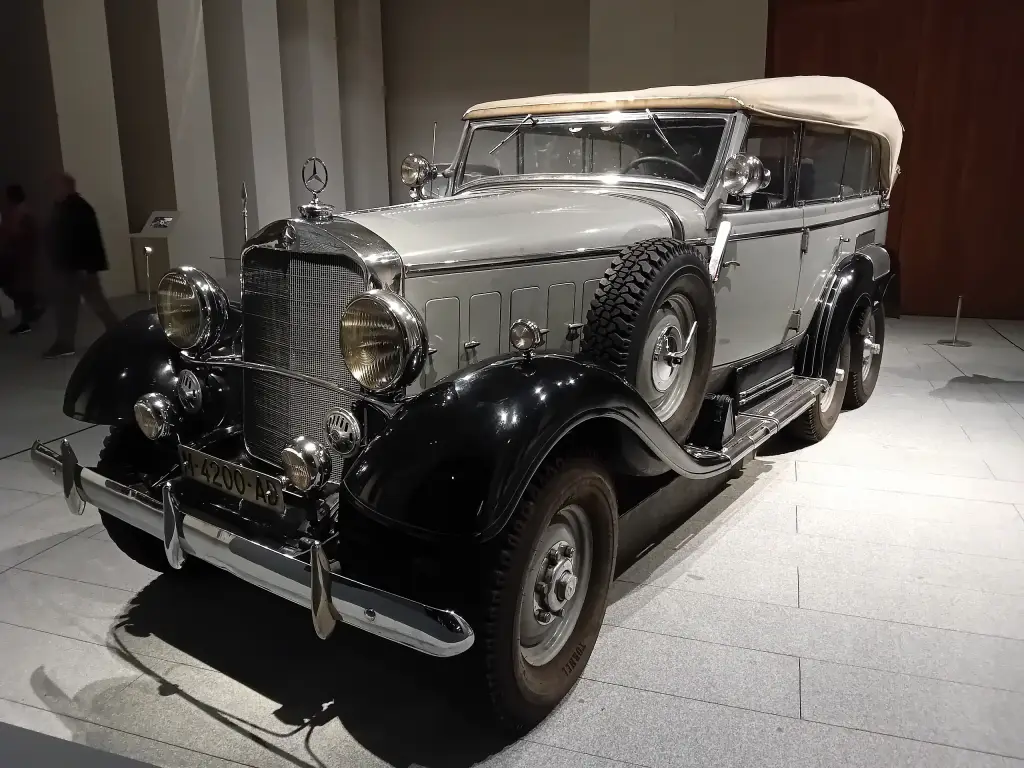
The Mercedes-Benz W31 type G4 is a German three-axle off-road vehicle first produced in 1934 as a staff and command car for the Wehrmacht. It was designed as a seven-seat touring car or closed saloon.
Mercedes-Benz G4 at a glance
| First produced | 1934 |
|---|---|
| Type | three-axle off-road staff car |
| Based on | the G1 of 1926 |
| Layout | 6×4, four rear wheels driven |
| Engine | straight eight, 5,018 cc and 100 PS at first |
| Later engines | 5,252 cc and 115 PS from 1937, 5,401 cc and 110 PS from 1938 |
| Gearbox | four-speed, upper gears synchronised |
| Rear axles | two rigid axles 950 mm apart on shared leaf springs |
| Brakes | hydraulic with servo assistance on all six wheels |
| Top speed | 67 km/h |
| Delivered to the Wehrmacht | 11 of the first series |
| Total built | 57 |
This article is based on one source, the English Wikipedia article on the Mercedes-Benz W31.
History of the Mercedes-Benz G4
The G4 was a development of the G1 launched in 1926. All versions had an eight-cylinder inline engine, in the first three years of 5,018 cc giving 100 PS. It was a 6×4 with a four-speed gearbox whose upper gears were synchronised, sending drive to all four rear wheels through self-locking differentials; the front wheels did not drive. The rear wheels sat on two rigid axles 950 mm apart, suspended on shared semi-elliptic leaf springs, with a rigid front axle on semi-elliptic springs. All six wheels had servo-assisted hydraulic brakes, and the top speed of only 67 km/h was limited by the all-terrain tyres. The elongated box-section frame gave generous interior room, with comfortable seating for up to seven on front and rear benches and a middle row of two with separate armrests.
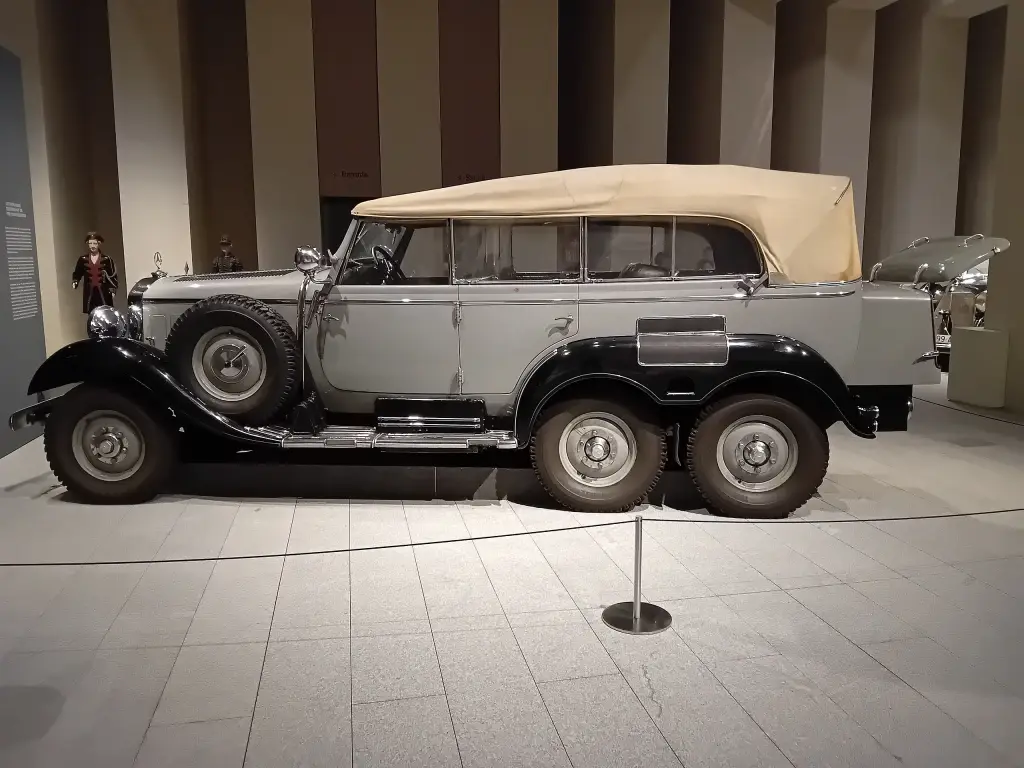
The first cars were delivered to the SS for Hitler and his adjutants, painted gloss grey over gloss black wings and running boards, but by the end of the war all had received matt or camouflage finishes for military use. Many G4s belonging to senior party members also had rear-facing spotlights to blind unauthorised drivers who followed too closely. The cars were considered too expensive for general Army use.
From 1937 a more powerful engine of 5,252 cc and 115 PS was used, with performance unchanged, and 16 cars were built in 1937 and 1938. From 1938 a larger 5,401 cc engine of 110 PS powered cars used by Hitler and his staff in the parades marking the annexation of Austria and the Sudetenland; thirty of these were built, ending in 1939. Of the 57 cars produced, at least four survive in original form, among them one in the Sinsheim Auto & Technik Museum and another given by Hitler to Francisco Franco, now in the collection of the Spanish Royal Guard.
Design and features
- Six wheels: a 6×4 layout with two rear axles.
- Straight eight: from 5.0 to 5.4 litres.
- Comfortable interior: seating for seven on a long box-section frame.
- State use: built for parades and inspections rather than general army work.
Mercedes-Benz G4 versions
- G4 with 5,018 cc (1934–1937): 11 delivered to the Wehrmacht.
- G4 with 5,252 cc (1937–1938): 16 built.
- G4 with 5,401 cc (1938–1939): 30 built.
The G4 was an early three-axle off-roader, long before the G-Class, and shared the state-car role of the 770. More in the Mercedes-Benz collection.
Video: Mercedes-Benz G4
Video by YouTube on YouTube.
Sources
- Mercedes-Benz W31, English Wikipedia: design, engines, production, survivors