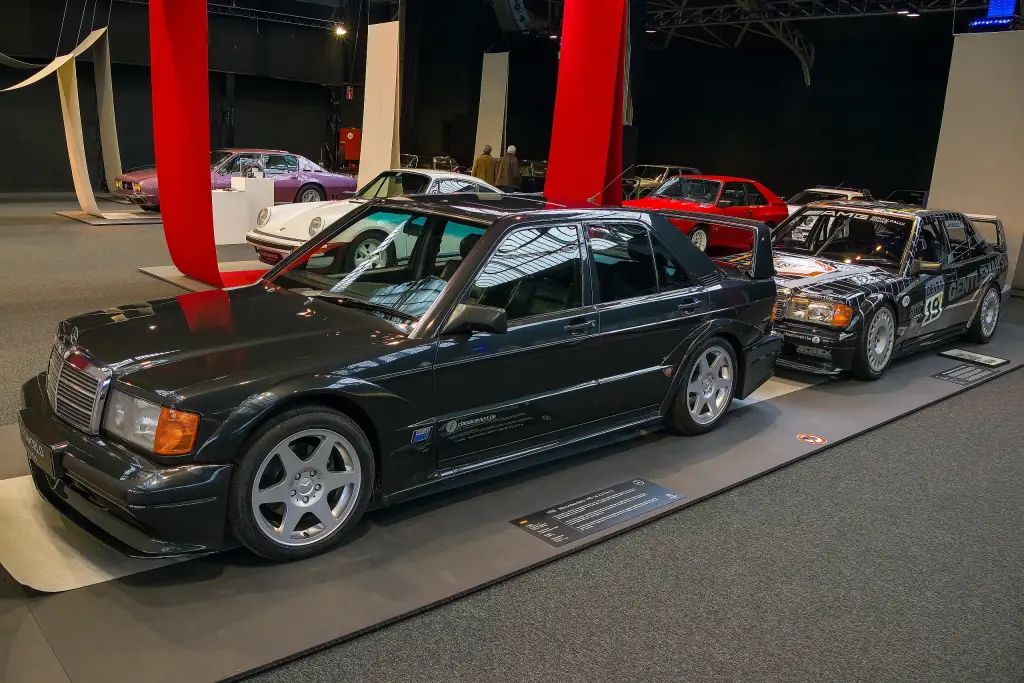
The Mercedes-Benz 190E 2.5-16 Evolution II was shown at the Geneva Auto Show in March 1990. It was the last and wildest version of the sporting 190 E, built in 502 examples so that Mercedes could race it in the German touring-car championship, the DTM, against the BMW M3.
Mercedes-Benz 190E 2.5-16 Evolution II at a glance
| Shown | Geneva Auto Show, March 1990 |
|---|---|
| Built | 502, with production from 1990 to 1991, the shortest run of any 190 model |
| Price, 1990 | DM 136,720 |
| Engine | 2,463 cc short-stroke Cosworth-based inline-four, 16 valves |
| Output | 235 PS (173 kW; 232 hp) at 7,200 rpm and 245 N·m at 5,000 rpm |
| Aero | wind-tunnel-tested body kit by Prof. Richard Eppler, drag coefficient 0.29 |
| Wheels | 17-inch alloys |
| Paint | 500 in blue-black metallic, the last two (501 and 502) in astral silver |
| Predecessor | 190 E 2.5-16 Evolution, shown March 1989, also 502 built |
| Rival | BMW M3 (E30) |
History of the Mercedes-Benz 190E 2.5-16 Evolution II
In the late 1970s Mercedes competed in rallying with the big V8-powered coupés of the R107 series. It wanted to take the 190 E rallying and asked the British engineering firm Cosworth to develop an engine with 320 hp for the rally car, a project Cosworth called WAA. The Audi Quattro, with four-wheel drive and a turbocharged engine, then made that plan look outclassed, and Mercedes turned instead to the DTM, the German Touring Car Championship, whose cars had to be based on a road model. It therefore put into production a 190 with a detuned version of the Cosworth engine. The 190 E 2.3-16 debuted at the 1983 Frankfurt Motor Show, after three nearly standard cars had set twelve international endurance records at Nardò in Italy, averaging 154.06 mph (247.94 km/h) over 50,000 km.
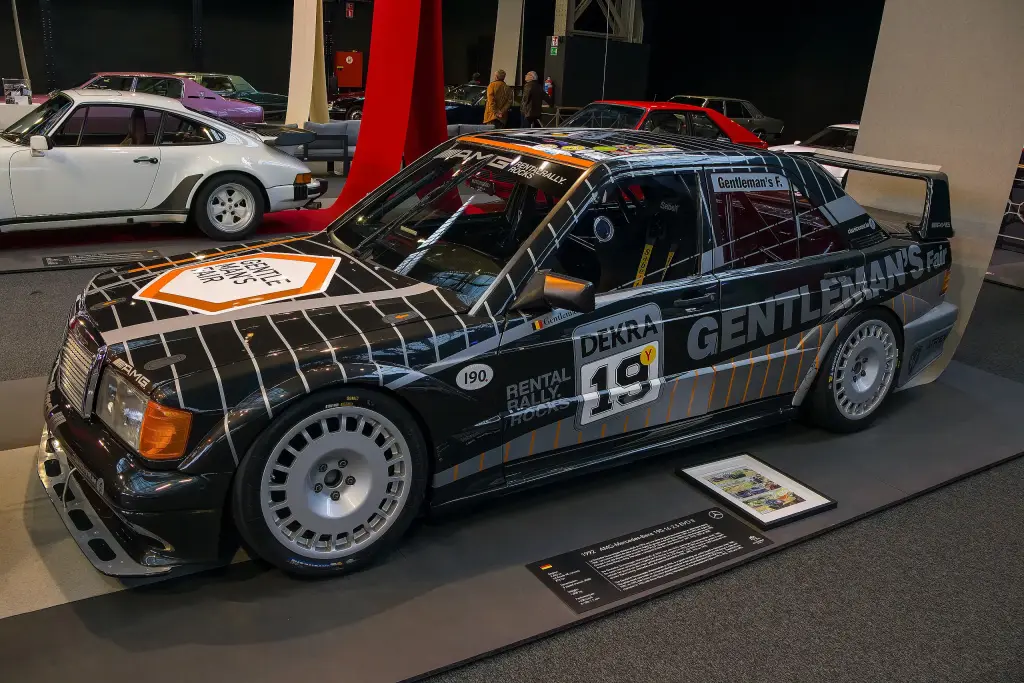
Cosworth developed the cylinder head, made of light alloy with dual overhead camshafts and four valves per cylinder; the road engine made 183 hp. The 16-valve cars differed from other 190s in many ways. The body kit lowered the drag coefficient to 0.32, one of the lowest values for a four-door saloon of its time, and the car had quicker steering, a bigger fuel tank, a unique Getrag five-speed gearbox with a dog-leg pattern, an oil cooler, a lower and stiffer suspension with self-levelling at the rear and a limited-slip differential. In 1984 a then unknown Ayrton Senna won a race of identical 190 Es at the opening of the new Nürburgring. An enlarged 2.5-litre engine replaced the 2.3 in 1988, with double-row timing chains to cure the snapping single chains of early cars, and delivered up to 204 PS without a catalytic converter or 195 PS with one.
Evolution I
With the debut of the BMW M3 Evolution 2 in March 1988 it became clear that the 2.5-16 needed more power to stay competitive. In March 1989 the 190 E 2.5-16 Evolution appeared at the Geneva show, with a new rear spoiler, wider wheel arches and many changes to brakes and suspension, including a ride height adjustable from a switch inside the car. Its engine had a shorter stroke and bigger bore, allowing a higher rev limit. Only 502 were produced for homologation under the DTM rules. For customers wanting more, an AMG PowerPack cost DM 18,000 and raised output by 30 hp to 225 PS.
Evolution II
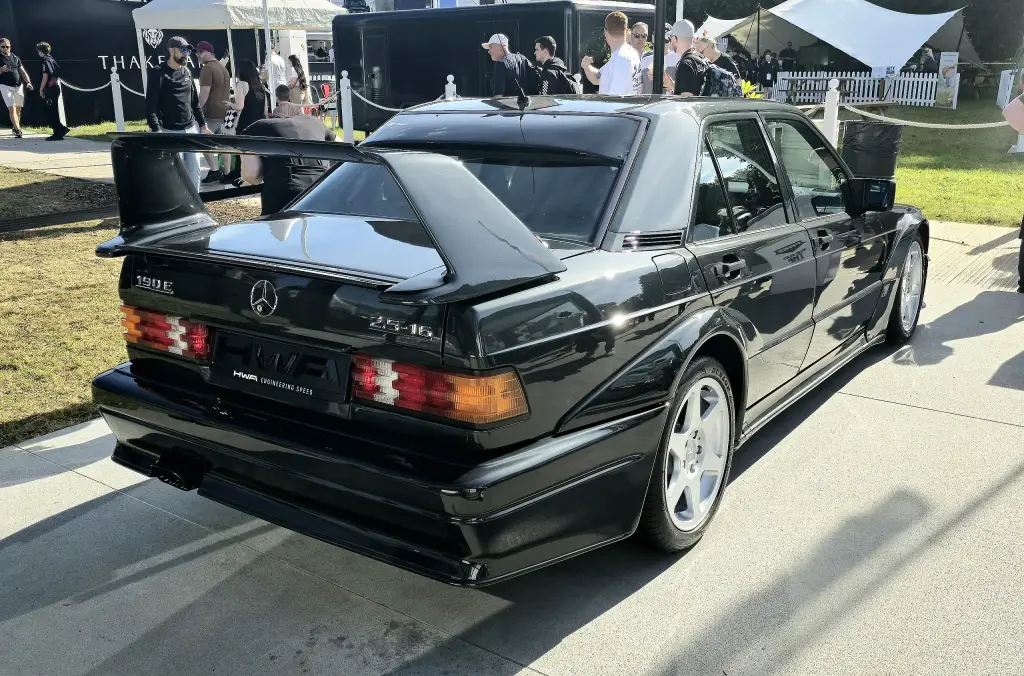
The Evolution II was shown in March 1990 and its 502 cars were already sold before the unveiling. It carried the AMG PowerPack on the same short-stroke 2,463 cc engine, giving 235 PS at 7,200 rpm, and a full adjustable suspension. The obvious change was the radical body kit, designed by Prof. Richard Eppler of the University of Stuttgart, with a large adjustable rear wing, a rear-window spoiler and 17-inch wheels. It was tested in a wind tunnel and cut drag to 0.29 while adding downforce. A period anecdote has the BMW research chief Wolfgang Reitzle saying that the laws of aerodynamics must be different between Munich and Stuttgart, and that if the wing worked BMW would have to redesign its wind tunnel; the story adds that BMW did so. The Evolution II had the shortest production run of the 190 series, from 1990 to 1991. Five hundred were painted blue-black metallic, and the last two cars, numbers 501 and 502, were painted astral silver, making them the rarest.
Design and features
- Engine: a short-stroke 2.5-litre 16-valve four developed with Cosworth, with the AMG PowerPack as standard.
- Aero: an adjustable rear wing, a rear-window spoiler and a drag coefficient of 0.29.
- Rarity: 502 built, all sold before the Geneva unveiling.
Mercedes-Benz 190E 2.5-16 Evolution II versions
- 190 E 2.3-16 (1983): the first Cosworth-engined 190, 183 hp.
- 190 E 2.5-16 (1988): a 2.5-litre engine with 195 or 204 PS.
- 2.5-16 Evolution (1989): 502 cars with a wing and wider arches.
- 2.5-16 Evolution II (1990): 502 cars with the 235 PS engine and the large wing.
It was the Mercedes answer to the BMW of its day, told in the BMW 3.0 CSL story and in our guide to homologation specials. For the standard car, see the Mercedes-Benz W201, and for the rest, our Mercedes-Benz collection.
Sources
- Mercedes-Benz W201, English Wikipedia: 190 E 2.3-16, 2.5-16, Evolution I and II
- Mercedes-Benz W 201, German Wikipedia: special editions and the 502-car production figures