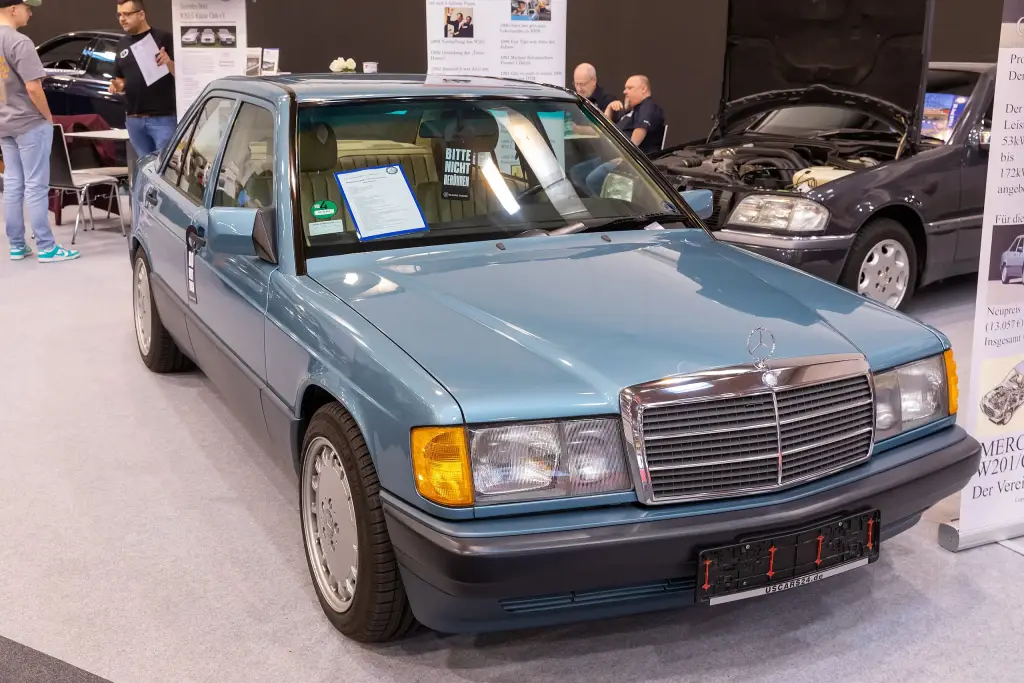
The Mercedes-Benz W201 is the internal designation of the 190 series saloons, a range of five-seat four-door cars built from 1983 to 1993 as the company’s first compact class automobile.
Mercedes-Benz 190 at a glance
| Production | 1983–1993 |
|---|---|
| Model | 190, with 190 E and 190 D versions |
| Chassis | W201 |
| Designer | Bruno Sacco |
| Debut | 1982 Paris Motor Show |
| Launch in Germany | 9 December 1982 |
| Built | 1,879,629 |
| Plants | Sindelfingen and Bremen |
| Rear suspension | five-link axle, later used in the E and C Classes |
| Safety | airbags, ABS and seatbelt pretensioners |
| Performance model | 190 E 2.3-16V from 1983 |
| Development cost | over £600 million from 1974 to 1982 |
This article is based on one source, the English Wikipedia article on the Mercedes-Benz W201.
History of the Mercedes-Benz 190
Mercedes-Benz spent more than £600 million between January 1974 and January 1982 researching and developing the W201, later calling it massively over-engineered. Early prototypes were tested from 1978, final styling was approved on 6 March 1979 and the first prototypes based on that design were tested later that year. Pilot production began in February 1982 after engineering sign-off, the car was unveiled on 8 December 1982 and launched in Germany the next day. It was sold in right-hand drive for Britain from September 1983. When difficulties prevented manufacture in Bremen, production began at Sindelfingen with capacity for only 140,000 cars a year, until Bremen was cleared for the W201.
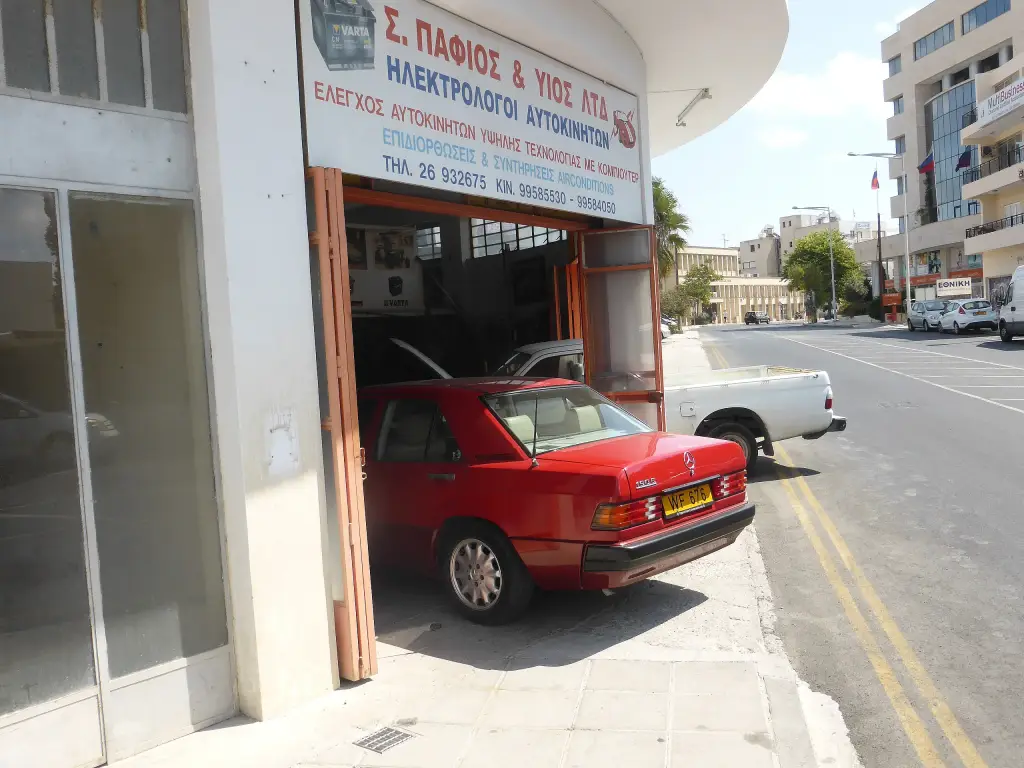
The W201 introduced a five-link rear suspension later used in the E and C Classes, front and rear anti-roll bars, anti-dive and anti-squat geometry, airbags, ABS and seatbelt pretensioners. Its extensive use of lightweight high-strength steel let it withstand a concrete barrier offset crash at 56 km/h without serious injury or cabin deformation. Mercedes introduced a performance variant, the 190 E 2.3-16V, at the Frankfurt Motor Show in 1983.
In 1982 the first models were the 190 with an M102 1,997 cc four of 90 PS and the 190 E with fuel injection and 120 PS. In September 1983 the 190 E 2.3 was launched for North America with 113 hp, reduced for local emissions rules, and later sold elsewhere too. The 190 E used Bosch KE-Jetronic multi-point injection instead of the carburettor of the base 190, and its larger intake and exhaust valves gave more power. In April 1990 the carburetted 190 was dropped and replaced at the bottom of the range by a fuel-injected 1.8-litre version. For 1991 the car received light exterior changes, such as body-coloured door frames instead of black anodised ones, and the last 190 E was built on 17 May 1993.
Design and features
- First compact Mercedes: a new class below the C-Class that followed.
- Five-link rear axle: later used across the E and C Classes.
- Safety equipment: airbags, ABS and belt pretensioners.
- Strong body: a high-strength steel shell that passed a 56 km/h offset crash.
Mercedes-Benz 190 versions
- 190: the carburetted 2.0-litre model.
- 190 E: fuel-injected 2.0-litre with 120 PS.
- 190 E 2.3 (1983): North American model.
- 190 E 2.3-16V: the performance version.
- 190 D: diesel version.
- 1.8-litre model (1990): the new entry car.
The W201 was the predecessor of the C-Class and a smaller relative of the W124. More in the Mercedes-Benz collection.
Sources
- Mercedes-Benz W201, English Wikipedia: development, engineering, models, production