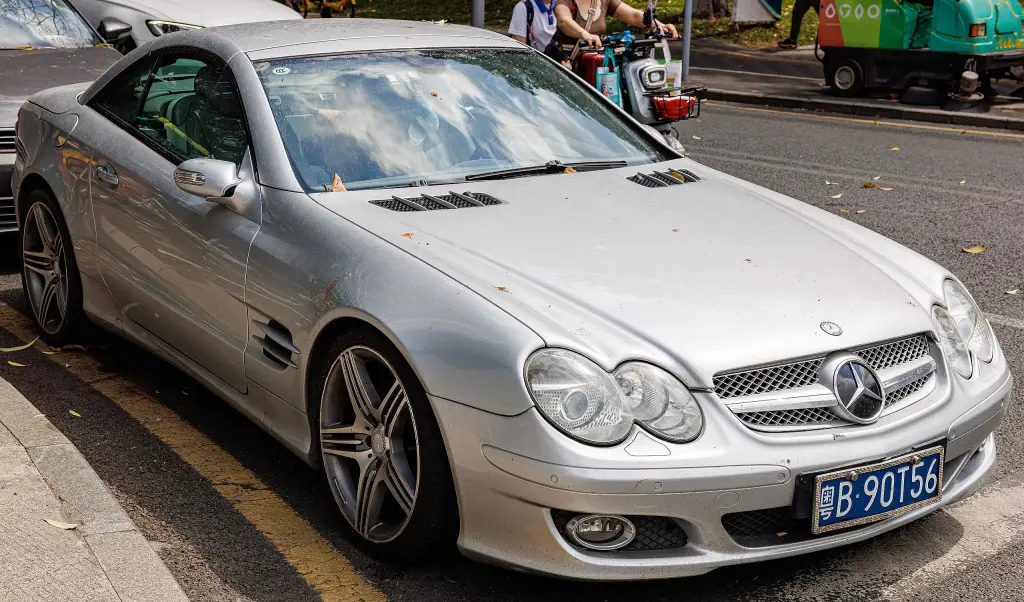
The Mercedes-Benz SL-Class is a grand touring sports car made since 1954, marketed as Mercedes-AMG SL from 2022. The letters SL stand for Super-Leicht, super light.
Mercedes-Benz SL at a glance
| Built since | 1954 |
|---|---|
| Name | Super-Leicht, super light |
| First car | 300 SL of 1952, a racing sports car |
| Road version | 300 SL coupé of 1954 |
| 300 SL coupé | 1954–1957, with gullwing doors |
| 300 SL roadster | 1957–1963 |
| 190 SL | 1955–1963, 1.9-litre four |
| W113 | 230 SL, 250 SL and 280 SL, 1963–1971 |
| R107 | 1971–1989 |
| R129 | from 1989 |
| Name clarification | Super-Leicht confirmed from company archives in 2017 |
This article is based on one source, the English Wikipedia article on the Mercedes-Benz SL-Class.
History of the Mercedes-Benz SL
The first 300 SL was a racing sports car built in 1952 with no thought of a road version. In 1954 the American importer Max Hoffman suggested a street version for wealthy performance-car buyers in the United States, where the market for personal luxury cars was growing after the war. The road-going 300 SL coupé kept the racing car’s gullwing doors and was joined in 1957 by a roadster with conventional doors and larger headlamps, built until 1963. In 1955 the smaller 190 SL offered a more affordable alternative with a 1.9-litre four-cylinder engine, sharing the styling and independent suspension of the bigger car but using a shortened unitary floorpan from the W121 saloon instead of the 300 SL’s tubular spaceframe.
Both were replaced in 1963 by the W113, whose 230 SL had a distinctive concave roofline that earned it the nickname pagoda top. It had a low waistline, large curved greenhouse windows, a detachable hardtop and a new 2.3-litre straight six. For 1967 the engine grew to 2.5 litres and the car became the 250 SL, with interior changes including a padded dashboard, new switches, steering wheel and door pockets, and wheel covers replacing the smaller hubcaps. A year later the engine grew again to 2.8 litres and the model became the 280 SL.
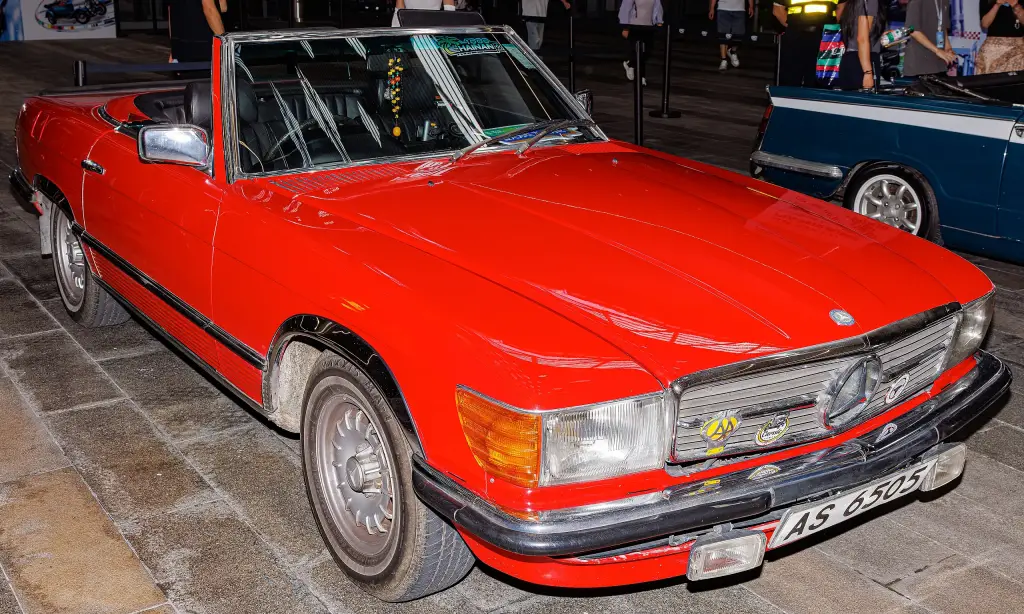
The R107 followed in 1971 with new design language and safety features that spread to later Mercedes-Benz models, and for the first time V8 engines were fitted to the SL. It stayed in production until 1989, one of the longest runs in the company’s history, and its replacement, the R129, arrived the same year. The meaning of the letters was long unclear: whether SL came from the 1931 SSKL was unknown, magazines and company officials used Sport Leicht and Super Leicht interchangeably, and only in 2017 did a find in the corporate archive confirm Super-Leicht.
Design and features
- Long line: the SL name has been in use since 1954.
- Racing origin: the 300 SL came from the 1952 racing car.
- Two-seat roadsters: with soft tops and detachable hardtops.
- Pagoda roof: the W113’s concave hardtop.
Mercedes-Benz SL versions
- 300 SL coupé (1954): gullwing doors.
- 300 SL roadster (1957): conventional doors.
- 190 SL (1955): the smaller four-cylinder car.
- W113 (1963): 230 SL, 250 SL and 280 SL pagoda.
- R107 (1971): the long-running roadster with V8 engines.
- R129 (1989): the next generation.
The line began with the 300 SL and 190 SL, continued with the W113 and R107, and its small relative is the SLK. More in the Mercedes-Benz collection.
Video: Mercedes-Benz SL 500 test
Video by YouTube on YouTube.
Sources
- Mercedes-Benz SL-Class, English Wikipedia: history, generations, SL abbreviation