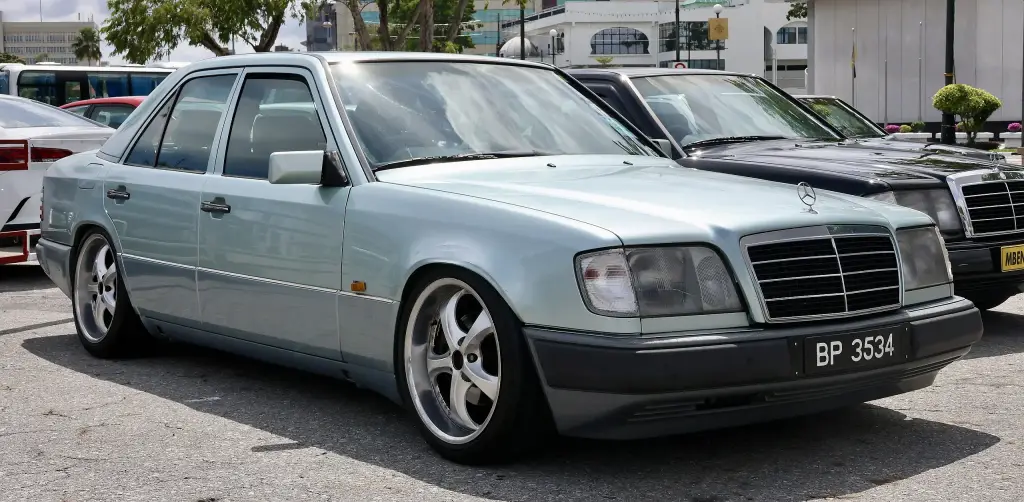
The Mercedes-Benz W124 is a range of executive cars made by Daimler-Benz from 1984 to 1997. From 1993 it was officially marketed as the E-Class.
Mercedes-Benz W124 at a glance
| Production | 1984–1997 |
|---|---|
| Market name | E-Class from 1993 |
| Bodies | saloon W124, estate S124, coupé C124, cabriolet A124, limousine V124 |
| Pre-series production | November 1984 |
| Press presentation | 26 November 1984, Seville |
| European launch | January 1985 |
| North America | from November 1985 as a 1986 model |
| Design director | Bruno Sacco |
| Drag coefficient | 0.28 for the European 200 and 200 D |
| Rear suspension | multi-link axle from the W201 |
| Wheels | 15-hole Gullideckel alloy wheels |
| Successors | W210 E-Class and C208 CLK |
This article is based on one source, the English Wikipedia article on the Mercedes-Benz W124.
History of the Mercedes-Benz W124
The W124 was planned from the autumn of 1976 under Hans Scherenberg, and the programme officially began in July 1977 with Werner Breitschwerdt managing development. In April 1978 it was decided to base the car on the W201 programme, and by April 1979 a package plan laid out the guidelines. The final exterior was completed in the winter of 1980–81, chosen as the leading proposal by design director Bruno Sacco and approved by the board in early 1981. By mid-1982 the first production-shaped prototypes were assembled for testing, pilot production began in March 1984 and engineering sign-off followed.
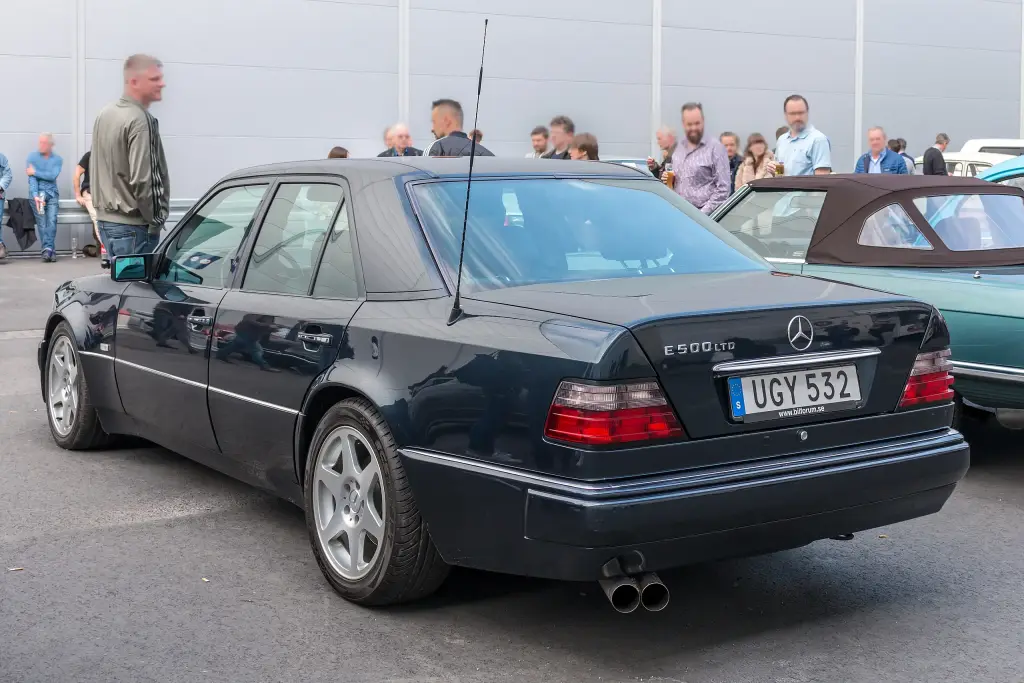
Pre-series production started at the beginning of November 1984, the press saw the car on 26 November 1984 in Seville and customer deliveries and the European launch began in January 1985. In North America the car arrived in early November 1985 as a 1986 model and was sold through the 1995 model year. Front suspension used a separate spring and damper with a rubber top mount and control arms mounted directly to the body without a subframe, while the rear used the multi-link axle introduced on the W201 in 1982. Estates, and optionally saloons and coupés, had self-levelling rear suspension with struts, gas-filled spheres and an under-bonnet pump, keeping a fixed ride height with coil springs when parked.
The W124 was the first Mercedes series with the 15-hole flat-faced alloy wheels of the 1980s and 1990s, nicknamed Gullideckel or manhole covers, which later appeared on the facelifted W126, R107 and W201 and as the standard wheel of the R129. Much of its engineering was advanced for the time, including one of the lowest drag coefficients of any car, 0.28 for the European 200 and 200 D. The range covered saloon, estate, coupé, cabriolet, limousine and bare chassis, and the car was succeeded after 1995 by the W210 E-Class saloons and estates and in 1997 by the C208 CLK coupés and cabriolets.
Design and features
- Low drag: a coefficient of 0.28 on the European 200 and 200 D.
- Multi-link rear axle: carried over from the W201.
- Self-levelling: available on estates, saloons and coupés.
- Gullideckel wheels: the 15-hole alloy that became a 1980s symbol.
Mercedes-Benz W124 versions
- W124 saloon: the main body.
- S124 estate: with self-levelling suspension.
- C124 coupé: two-door version.
- A124 cabriolet: open version.
- V124 limousine: long-wheelbase car.
- F124 and VF124 chassis: rolling chassis for bodybuilders.
The W124 followed the W123 and became the E-Class; its small relative was the 190. More in the Mercedes-Benz collection.
Sources
- Mercedes-Benz W124, English Wikipedia: development, bodies, suspension, wheels, drag