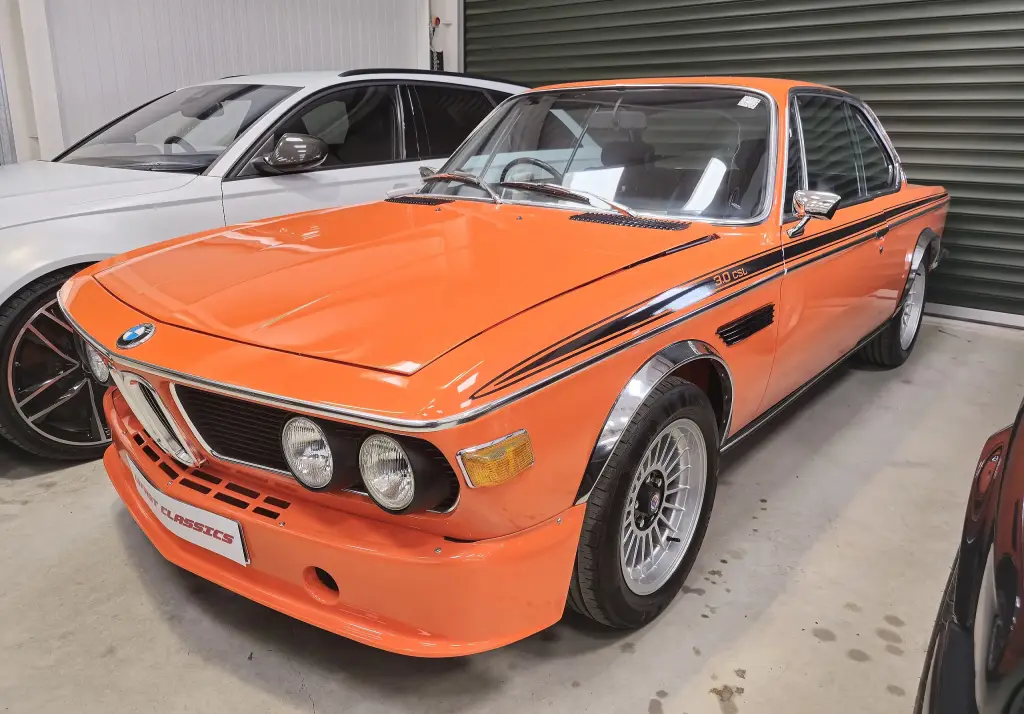
The BMW 3.0 CSL is the most famous version of the E9, the range of coupés BMW built from 1968 to 1975 with bodies made by Karmann. Introduced in May 1972, it was a homologation special built to make the car eligible for the European Touring Car Championship, and 1,265 were built.
BMW 3.0 CSL at a glance
| E9 range | 1968 to 1975, bodies by Karmann |
|---|---|
| 3.0 CSL introduced | May 1972 |
| Built | 1,265 |
| Meaning of L | leicht, German for light |
| Engine | straight-six: 2,986 cc at first, 3,003 cc from August 1972, 3,153 cc from 1973 |
| Final output | 206 PS (152 kW) at 5,600 rpm and 286 N·m at 4,200 rpm |
| Final homologation | July 1973, with an aerodynamic package |
| Weight saving | thinner steel, no trim or soundproofing, aluminium doors, bonnet and boot lid, Perspex side windows |
| Touring-car titles | European Touring Car Championship drivers’ title in 1973 and from 1975 to 1979 |
| Not sold in | the United States |
History of the BMW 3.0 CSL
The E9 began as the 2800 CS, which replaced the four-cylinder 2000 C and 2000 CS coupés in 1968. The wheelbase and length were increased to fit the new M30 straight-six, and the front was restyled to resemble the E3 sedan; the lead designer was Wilhelm Hofmeister. In 1971 it became the 3.0 CS and the fuel-injected 3.0 CSi, with a bore enlarged to 2,986 cc and 180 and 200 hp respectively.
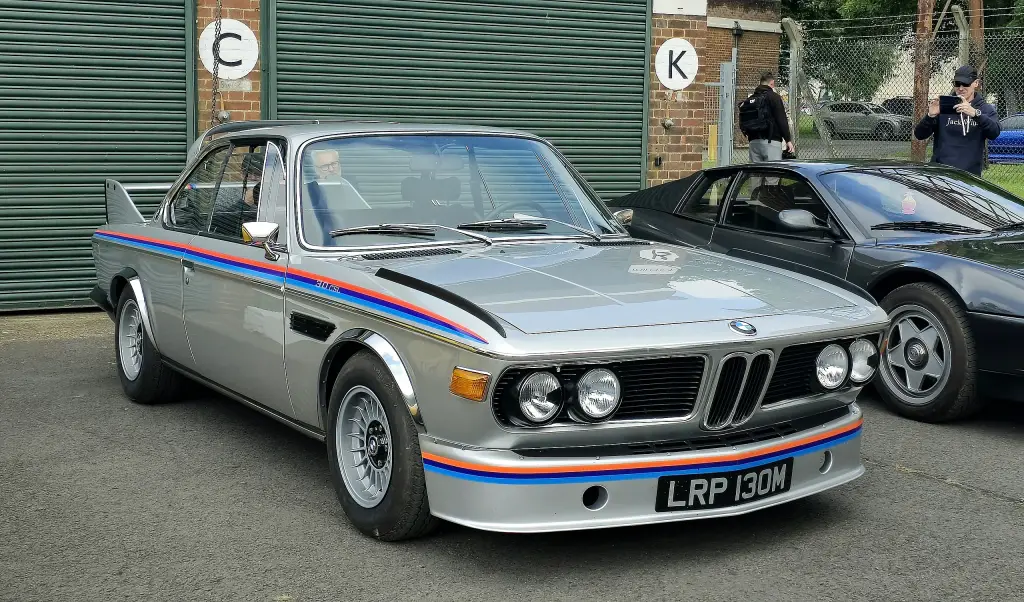
The 3.0 CSL arrived in May 1972. It was a homologation special, built to make the car eligible for the European Touring Car Championship. The “L” meant leicht, light, unlike in other BMW designations where it meant lang, long. The lightness came from using thinner steel for the unit body, deleting the trim and soundproofing, and making the doors, bonnet and boot lid from aluminium alloy and the side windows from Perspex. The 500 cars exported to the United Kingdom were not quite as light as the others, because the importer insisted on keeping the soundproofing, electric windows and standard E9 bumpers. The CSL was not sold in the United States.
Engine and wings
Initially the engine was the same as the 3.0 CS. In August 1972 its capacity rose to 3,003 cc by boring it out by a quarter of a millimetre, so that the CSL could be raced in the “over three litre” category and the racing engines could be enlarged. In 1973 a longer stroke took the engine to 3,153 cc, rated at 206 PS. This final version was homologated in July 1973 along with an aerodynamic package: a large air dam, short fins along the front fenders, a spoiler above the trailing edge of the roof and a tall rear wing. The rear wings were not fitted at the factory but left in the boot for installation after purchase.
Racing
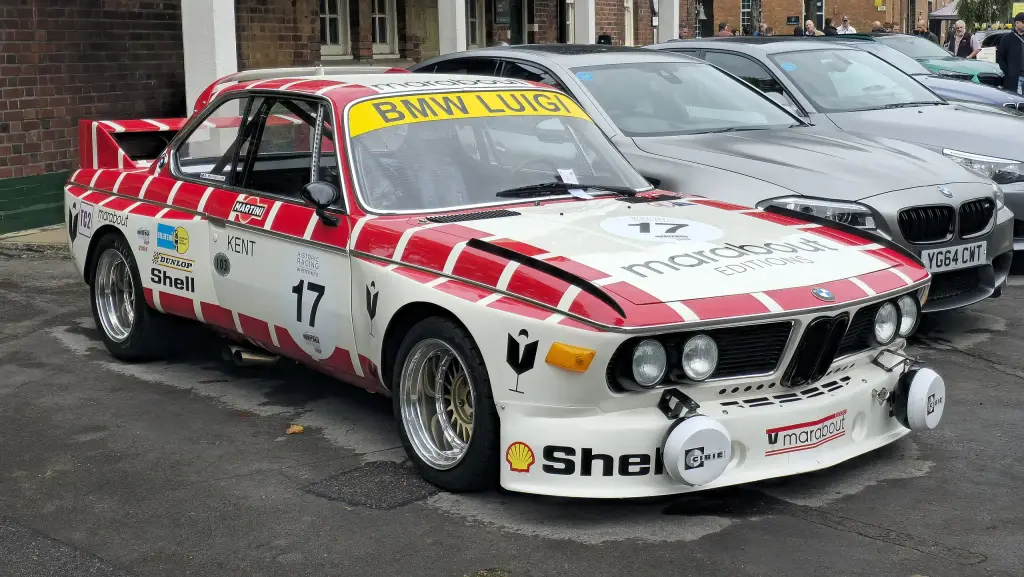
The CSL competed in Group 2 form in the European Touring Car Championship, and drivers of CSLs won the drivers’ title in 1973 and again every year from 1975 to 1979, six times in all. In 1973 Toine Hezemans won the championship and, co-driving with Dieter Quester, took a class victory at Le Mans. The CSL also raced in Group 5 Special Production form, winning three rounds of the 1976 World Championship for Makes with the 3.5 CSL, and in the 1975 IMSA GT Championship. In Group 4 form, notably with Hans-Joachim Stuck, it raced against the Porsche 911 and the Ford Capri.
The first two BMW Art Cars were 3.0 CSLs, painted by Alexander Calder and Frank Stella. The last E9 to be introduced, the 2.5 CS of 1974, was a response to the 1973 oil crisis, and only 874 were made before E9 production ended in 1975.
Design and features
- Body: thin-gauge steel with aluminium doors, bonnet and boot lid, built on the Karmann-made E9 shell.
- Aero parts: an air dam, fender fins, a roof spoiler and a rear wing left in the boot.
- Engine: a 3.0 to 3.2-litre straight-six, enlarged twice to suit racing classes.
BMW 3.0 CSL versions
- 3.0 CSL (1972): the first lightweight car, with a 3.0-litre engine.
- 3.0 CSL (1973): the 3,153 cc car with the aerodynamic package.
- 3.5 CSL: a racing version built for Group 5.
- UK cars: 500 heavier cars with soundproofing and electric windows.
The CSL is one of the road cars behind BMW’s racing name, a story told in the guide to homologation specials. It was followed by the mid-engined BMW M1 and the BMW M3. More BMWs are in our BMW collection.
Sources
- BMW E9, English Wikipedia: models, 3.0 CSL, motorsport, Art Cars
- BMW E9, German Wikipedia: cross-check