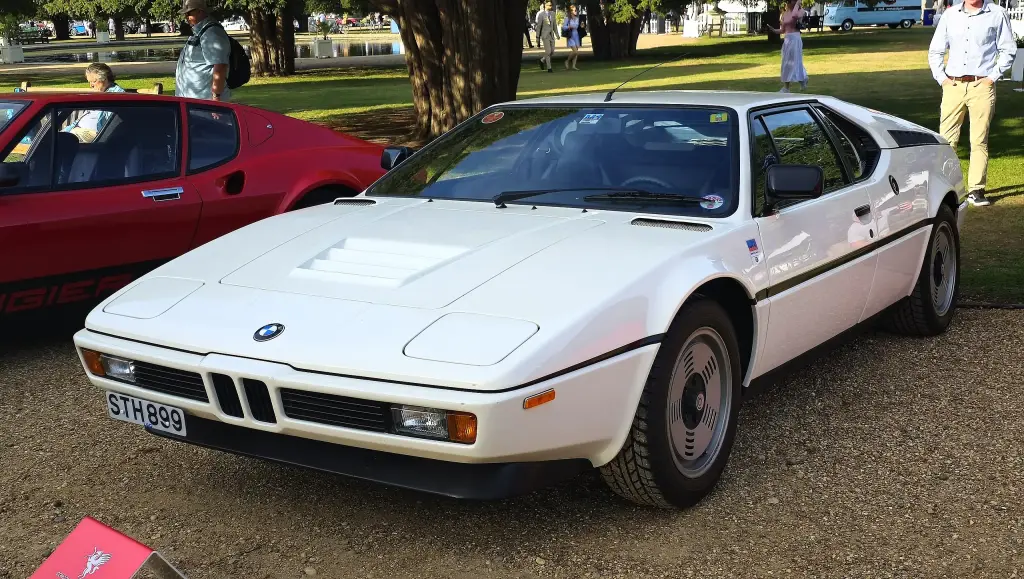
The BMW M1 (model code E26) is a mid-engined sports car that BMW produced from 1978 to 1981. It was a homologation special for sports car racing, the first car developed solely by BMW Motorsport, and the first mid-engined BMW to be mass-produced.
BMW M1 at a glance
| Produced | 1978 to 1981 |
|---|---|
| Model code | E26 |
| Engine | M88/1 straight-six, 3,453 cc, twin cams, four valves per cylinder, six throttle bodies |
| Output | 277 PS (204 kW) at 6,500 rpm and 330 N·m at 5,000 rpm in road trim |
| Gearbox | 5-speed ZF manual with a 40% limited-slip differential |
| Top speed | 265 km/h (165 mph) |
| Chassis | tubular steel space frame by Gianpaolo Dallara; fibreglass body |
| Design | Giorgetto Giugiaro, from the 1972 BMW Turbo concept |
| Brakes | ventilated steel discs, 300 mm at the front and 297 mm at the rear |
| Built | 453 in the English-language account; 460 in the German one |
| Price in 1979 | 113,000 Deutsche Mark |
History of the BMW M1
In the 1970s BMW’s motorsport division, headed by Jochen Neerpasch, wanted to compete with Porsche in Group 5 racing with a car developed for competition. Neerpasch insisted on a strictly mid-engined layout. The rules required 400 road cars, which BMW could not build in the time allowed, so it turned to Lamborghini to work out the chassis, assemble prototypes and manufacture the cars.
The tubular steel space-frame chassis was the work of Gianpaolo Dallara. Lamborghini’s financial position then deteriorated and the prospect of its building the car faded, so BMW took the project back in April 1978, after seven prototypes had been built. A group of former Lamborghini engineers founded a company called Italengineering to finish the design, working less than 10 miles from the Lamborghini shop. The delay, and changes to the Group 5 rules, forced BMW to race the car in Group 4.
Styling and construction
The fibreglass body was designed by Giorgetto Giugiaro, who drew on the 1972 BMW Turbo concept by Paul Bracq. The body was made by TIR in Reggio Emilia, the chassis by Marchesi of Modena, and the body was completed with its interior by Italdesign in Turin. The partly finished cars then went to the German specialist Baur, which assembled them by hand, installing engines supplied from Munich; the finished cars were sent to BMW Motorsport for inspection and delivery. For a BMW the M1 was unusual in having pop-up headlights, which the German source says were needed to meet American rules on lamp height with such a low front end, and tail-lights taken from the 6 Series.
Engine and driving
The M88/1 engine was the work of Paul Rosche, who also created the S14 four-cylinder and the S70/2 V12. With mechanical Kugelfischer-Bosch fuel injection and six separate throttle bodies it produced 277 PS in road form. The M1 had unassisted rack-and-pinion steering, double-wishbone suspension with adjustable coil springs and Bilstein gas dampers, and Campagnolo alloy wheels, 7×16 inches at the front and 8×16 at the rear, with Pirelli P7 tyres. Inside it was basic, with leather and cloth, many parts from other BMWs, air conditioning and power windows but no seat adjustment; only left-hand drive was offered. The engine was later used in the E24 M6 and the E28 M5.
Procar and racing
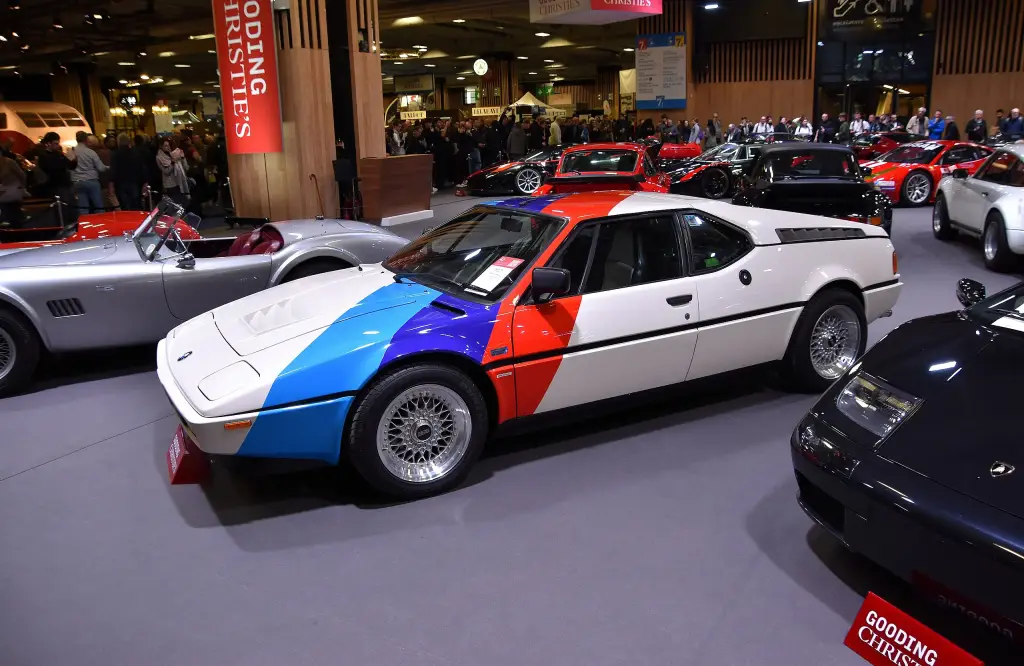
In 1979 Neerpasch devised a one-make championship for race-modified M1s, the Procar BMW M1 Championship. It ran as a support series for Formula One and put Grand Prix drivers into identical cars, helping BMW build enough cars for Group 4. Niki Lauda won the 1979 season and Nelson Piquet the 1980 season. In June 1979 Hervé Poulain, Manfred Winkelhock and Marcel Mignot raced an M1 painted by Andy Warhol at Le Mans, finishing sixth overall and second in the IMSA GTX class.
The M1 returned to Le Mans from 1981 to 1986, and BMW France converted a Procar M1 to Group B rally specification for 1982. Bernard Béguin won the Rallye de La Baule and the Rallye de Lorraine in it in 1984, and took second at the Rallye d’Antibes. After that season the car was not campaigned again.
Successors
BMW unveiled the M1 Homage concept in April 2008 to mark the car’s 30th anniversary. The next mid-engined BMW in series production was the i8 plug-in hybrid, whose production began in April 2014.
Design and features
- Engine: the M88/1, a 3.5-litre straight-six with six individual throttle bodies; a version of it later powered the E28 M5.
- Chassis: a tubular steel space frame with a fibreglass body, built by Italian suppliers and finished by Baur.
- Interior: basic, with no seat adjustment, and left-hand drive only.
- Headlamps: pop-up units, unusual for a BMW.
BMW M1 versions
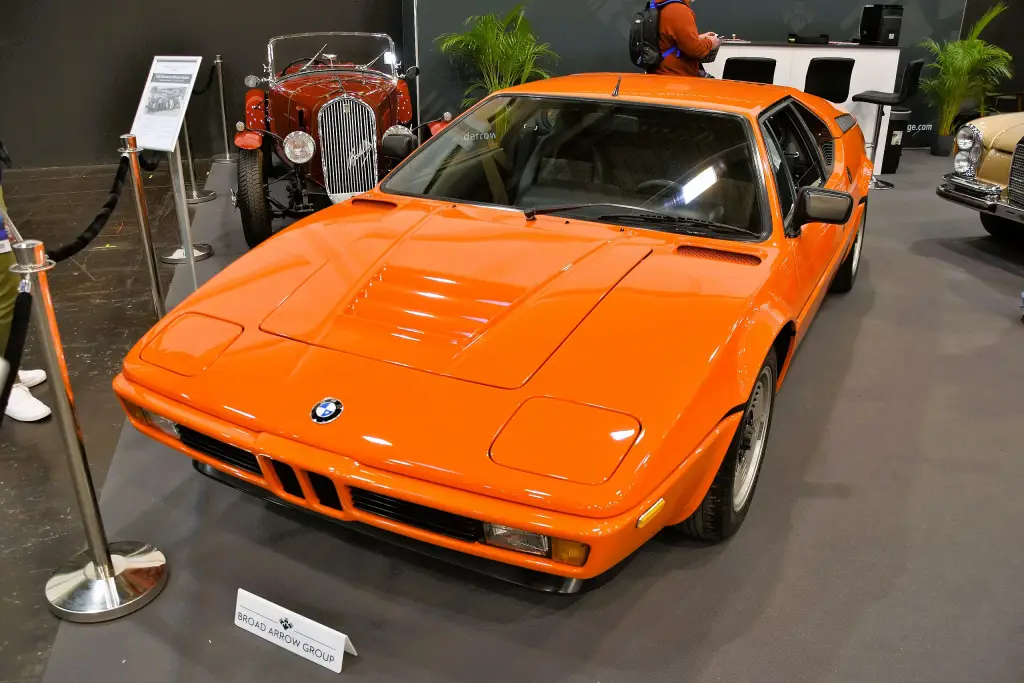
- Road car (1978–1981): 277 PS, the car sold to the public.
- Procar M1: the race-modified car used in the one-make support series for Formula One.
- Group 4 and Group B cars: competition versions used at Le Mans and in rallying.
- March-BMW M1/C: a heavily modified sports-prototype built by March Engineering in 1981 for IMSA racing.
The M1’s styling came from the BMW Turbo gullwing concept, and its racing rival at the time was Porsche, as in the Porsche 911 GT3 story. For the road-car line that followed see the BMW M3. More BMWs are in our BMW collection.
BMW M1 questions and answers
When was the BMW M1 built?
From 1978 to 1981, hand-assembled with Italian bodies and German final assembly.
Who designed it?
Giorgetto Giugiaro, inspired by the 1972 BMW Turbo concept by Paul Bracq.
Why did BMW build it?
As a homologation special so that BMW could race against Porsche in Group 4 and Group 5.
How powerful was it?
277 PS from a 3.5-litre straight-six, enough for a top speed of 265 km/h.
What was the Procar series?
A one-make championship for M1s that supported Formula One in 1979 and 1980; Niki Lauda won the first year and Nelson Piquet the second.
How many were made?
453 according to the English Wikipedia and 460 according to the German one.
Sources
- BMW M1, English Wikipedia: development, engine, production and racing
- BMW M1, German Wikipedia: history, body and technology, production figure, 1979 price
- BMW M1, Italian Wikipedia: cross-check of the development story