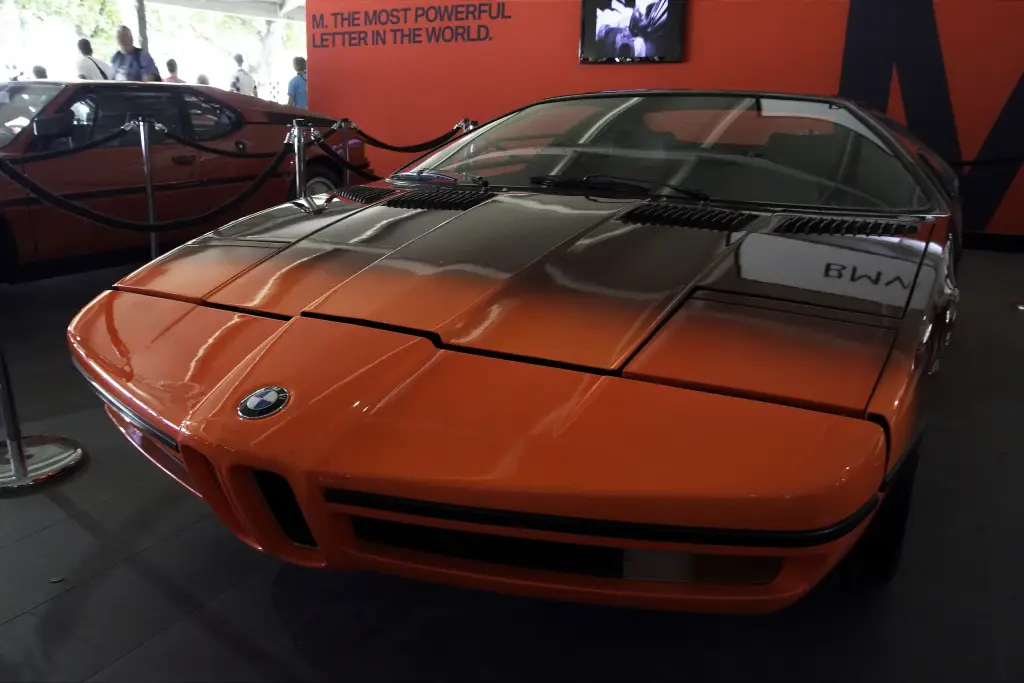
The BMW E25 Turbo is a concept sports car that BMW built to celebrate the 1972 Summer Olympics in Munich. It was designed by Paul Bracq, with gullwing doors, on a modified 2002 chassis with a mid-mounted engine. Only two were ever built.
BMW Turbo at a glance
| Maker | BMW |
|---|---|
| Year | 1972, for the Munich Olympics |
| Designer | Paul Bracq |
| Chassis | modified BMW 2002, mid-mounted engine |
| Engine | turbocharged 2.0 L (1,990 cc) four |
| Power | 206 kW (280 PS, 276 hp) at 7,100 rpm |
| 0–100 km/h | 6.6 seconds |
| Top speed | limited to 250 km/h |
| Gearbox | four-speed manual |
| Weight | 1,272 kg |
| Dimensions | 4,155 mm long, 1,880 mm wide, 1,100 mm high |
| Built | 2 |
The English and German Wikipedia pages agree on the main figures; the German page adds the technical data and the weight.
History of the BMW Turbo
A technology carrier
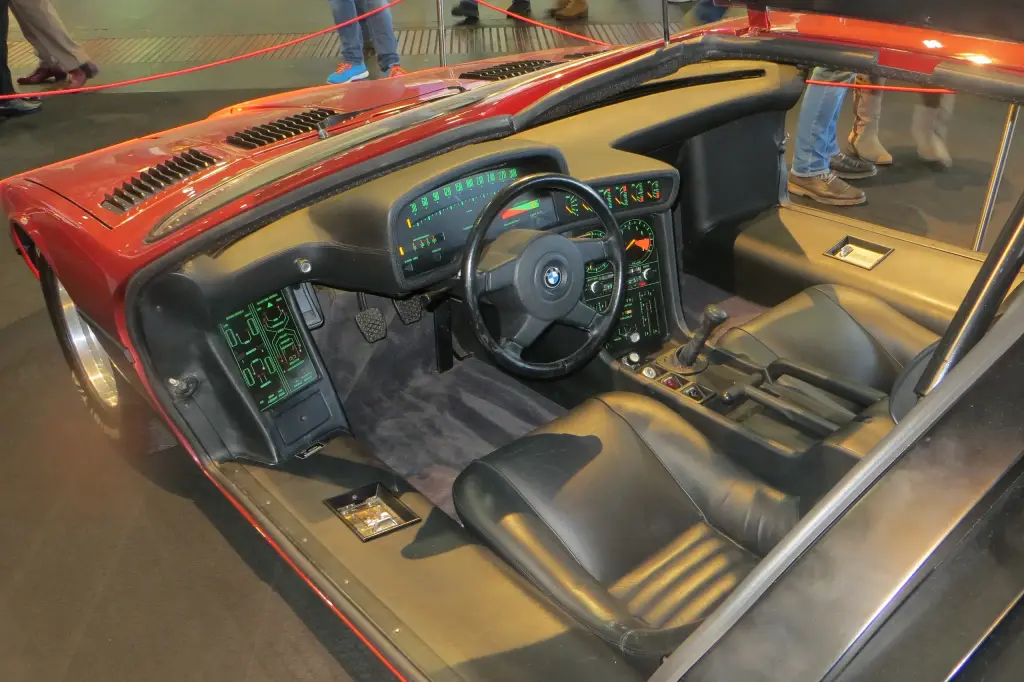
The Turbo was first shown in 1972 in front of the new BMW high-rise, the “Four Cylinder”, and was meant purely as a technology carrier. It was designed by the then chief designer Paul Bracq, who also drew the 6 Series coupé (E24) and the first 3 Series (E21). The steel body carried Europe’s first deformable bumpers, made of ABS foam, front and rear; the front and rear sections were foam-filled, there were side impact beams and a radar-based braking distance monitor, and the interior showed for the first time a centre console slightly tilted towards the driver.
Engine and second car
The engine came from the BMW 2002: a turbocharged 2.0-litre producing 206 kW (280 PS), with a 0 to 100 km/h time of 6.6 seconds and a top speed limited to 250 km/h. Because trade fairs wanted to show it, BMW built a second car, whose rear wheels are half covered for better aerodynamics; the covers were later made for the first car too. The gullwing doors of the second car had a small sliding window. Today one car is usually at BMW in Munich and the other at the BMW centre in Greer, South Carolina.
Legacy
Ideas and details from the Turbo went into the BMW M1, built from autumn 1978 to the end of 1981, such as the pop-up headlights and the BMW badges at the left and right of the tail. English Wikipedia adds that BMW later used the Turbo’s design themes on the 8 Series, the Z1 and the 2008 M1 Homage concept.
Design and features
- Doors: gullwings, with a small sliding window on the second car.
- Safety: foam bumpers, side impact beams and a radar braking monitor.
- Legacy: the M1 took the pop-up headlights and tail badges.
BMW Turbo versions
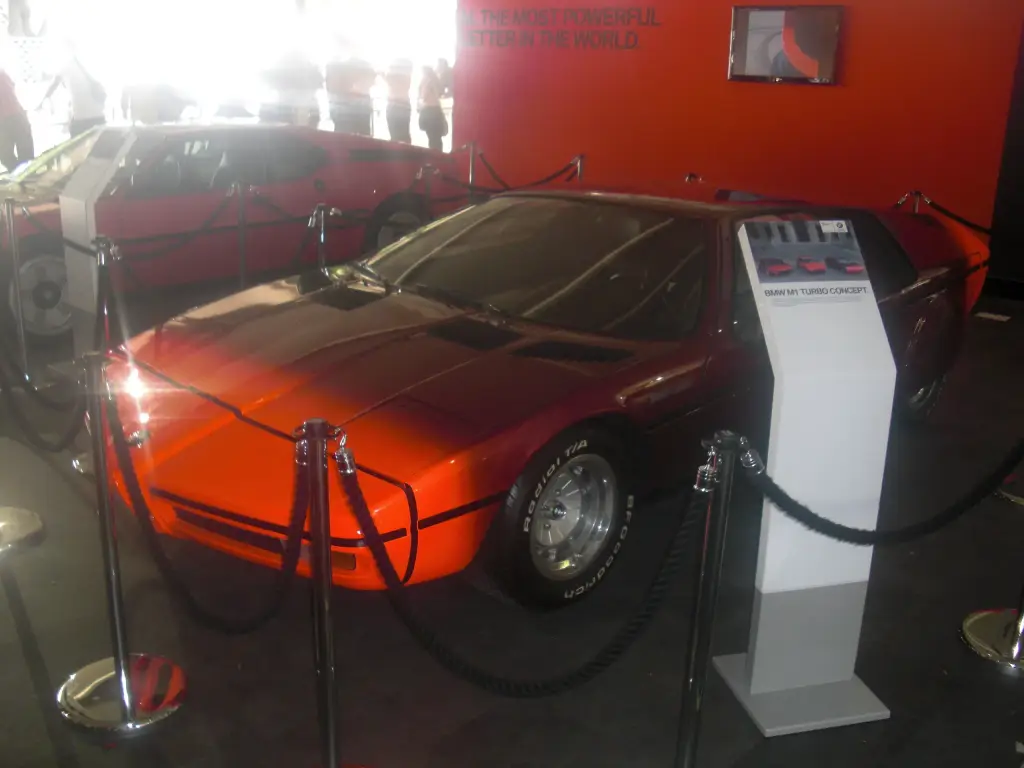
- Car 1 (1972): the first Turbo, with rear wheel covers added later.
- Car 2: built for the fairs, rear wheels half covered.
More BMW cars are in our BMW collection and more show cars in Concept Cars.
Sources
- BMW Turbo, English Wikipedia: overview
- BMW Turbo, German Wikipedia: history, technical data