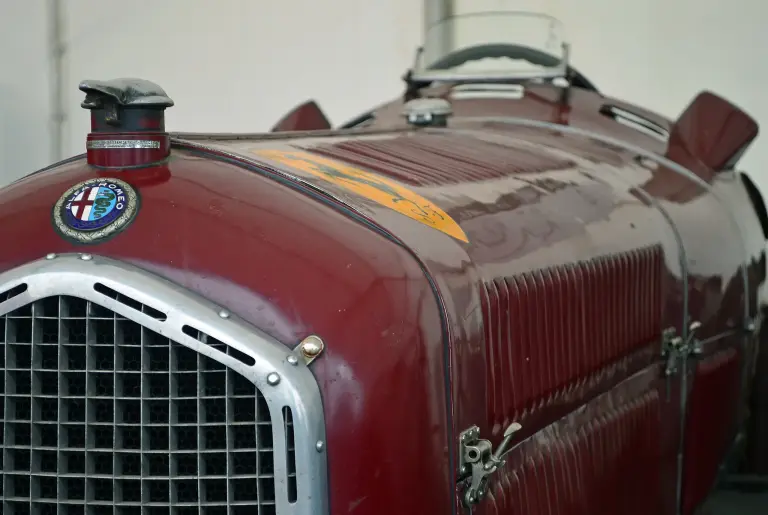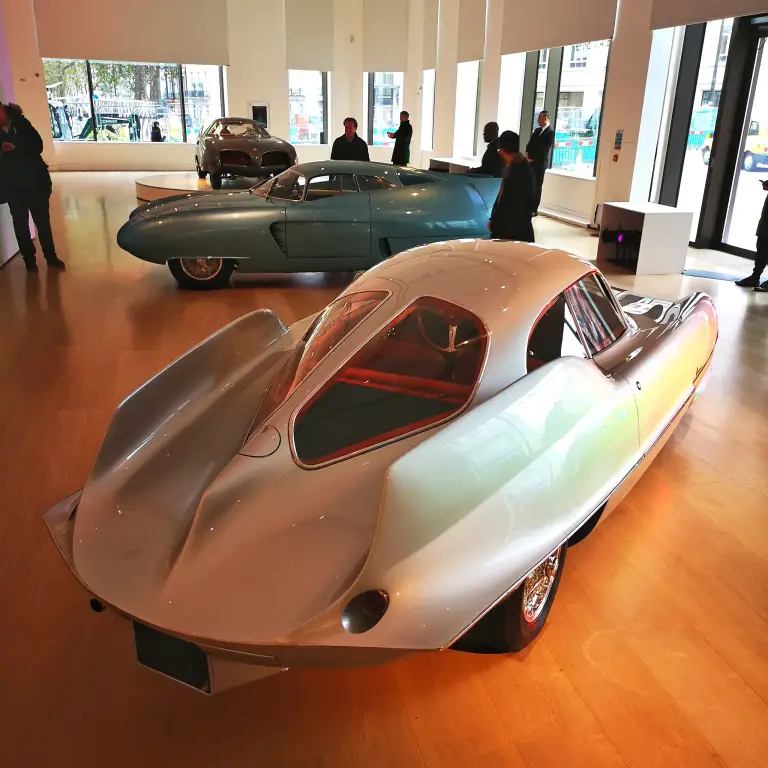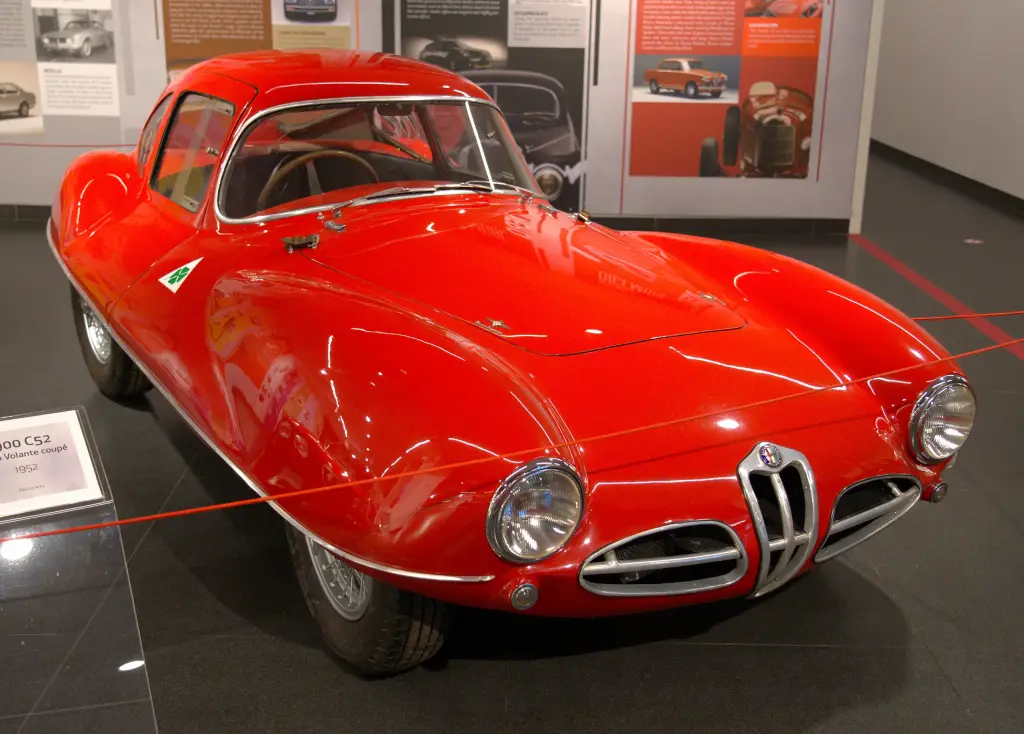
The Alfa Romeo 1900 C52 “Disco Volante” (“flying saucer”) is a series of experimental sports racing cars built in 1952 and 1953 by Alfa Romeo with the Milanese coachbuilder Carrozzeria Touring. It was distinguished by streamlined, wind-tunnel-tested bodywork, and five cars were built in total, four of which survive today.
Alfa Romeo Disco Volante at a glance
| Years | 1952–1953 |
|---|---|
| Builder | Alfa Romeo with Carrozzeria Touring |
| Units | 5 (three 2.0 L spiders, two 3.5 L six-cylinder cars); four survive |
| Frame | all-new tubular space frame |
| Engine (2.0 L cars) | inline four, aluminium block, twin overhead camshafts, 1,997.4 cc, bore 85 mm, stroke 88 mm, compression 8.73:1 |
| Power | 158 PS (116 kW) at 6,500 rpm |
| Engine (3.5 L cars) | 3,495 cc straight-six from the 6C 3000 CM racing car |
| Gearbox | 4-speed, synchronised forward gears |
| Brakes and tyres | drums on all four wheels, 6.0×16 tyres on wire wheels |
| Top speed | 220 km/h (140 mph) |
This page is based on English Wikipedia only, so the figures could not be cross-checked against a second source.
History of the Alfa Romeo Disco Volante
The 1900 C52 was developed in 1952 for the Sport category of racing. Its fully enveloping bodywork was developed with Carrozzeria Touring and tested in a wind tunnel; the body had a lenticular cross-section seen from both front and side, with a faired-in underbody, to give low drag even in crosswinds. According to some authors, the Jaguar D-Type and E-Type were inspired by the Disco Volante spider and coupé.
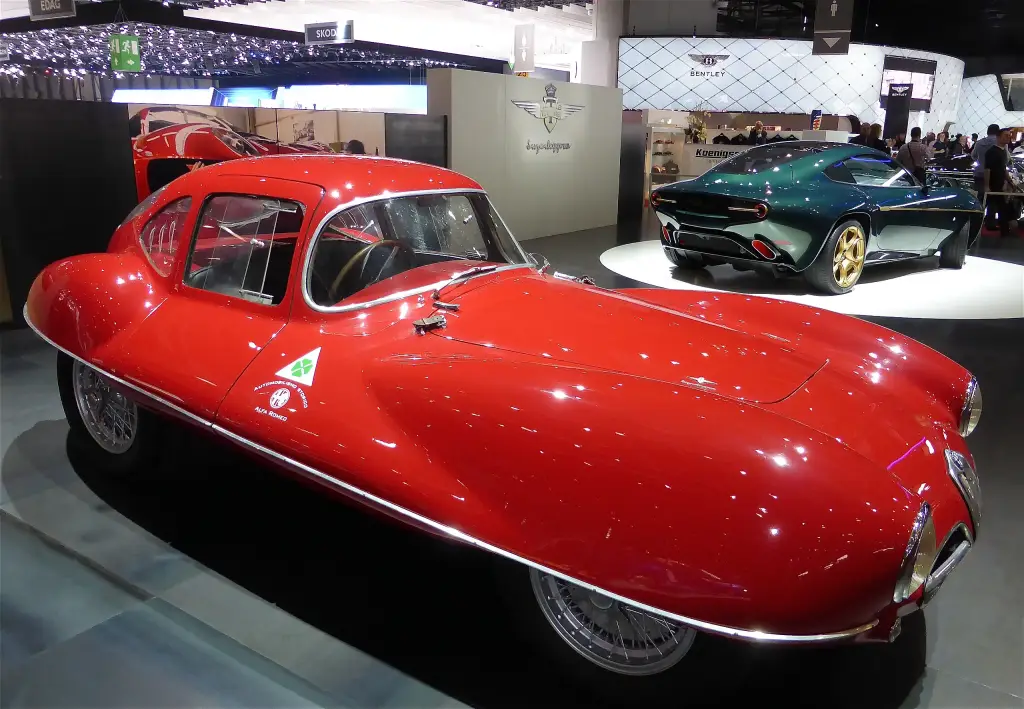
Three 2.0-litre cars were built. In 1953 two of them were modified for further aerodynamic tests: one got a fixed roof and became a coupé, the other lost its bulging wings for more conventional ones and became the “fianchi stretti” (“narrow hips”) spider. The latter was the only Disco Volante raced in period, in some competitions in 1953, since the programme did not progress past the experimental stage. Two more cars with the original spider body were built with the 3.5-litre six-cylinder engine of the 6C 3000 CM.
Design and features
- Frame: an all-new tubular space frame using lightened components from the Alfa Romeo 1900.
- Engine: a development of the 1900 inline four with an aluminium block and sleeves, fed by two twin-choke sidedraught carburettors.
- Suspension: double wishbones at the front and a solid rear axle with an upper triangle and two lower reaction arms, as on other Alfa Romeos of the time.
- Aerodynamics: lenticular body shape and a fully faired underbody, designed to keep drag low even in crosswinds.
Alfa Romeo Disco Volante versions
- Spider: the original 1952 body with bulging wings.
- Coupé: a spider converted in 1953 with a fixed roof.
- “Fianchi stretti” spider: the 1953 car with more conventional wings, the only one raced in period.
- 3.5-litre spiders: two cars with the 3,495 cc six-cylinder engine of the 6C 3000 CM.
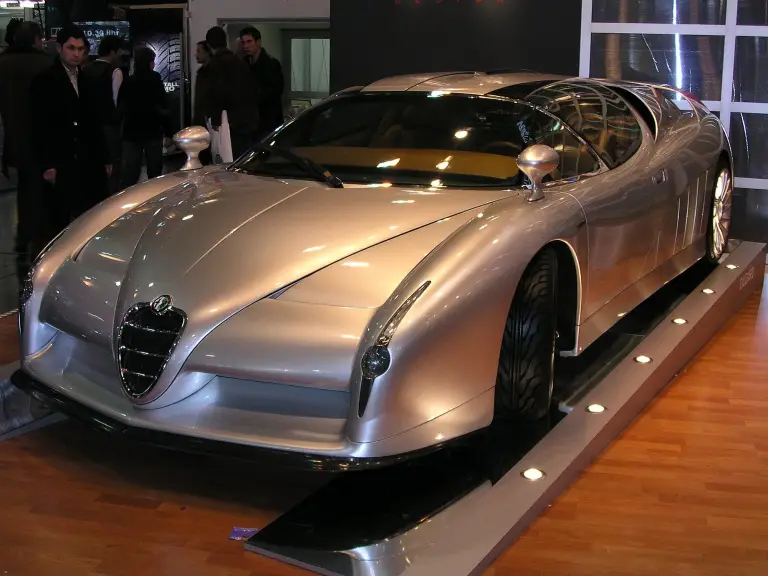
- Disco Volante by Touring (2012–2013): a modern tribute car shown by Touring Superleggera.
More Alfa Romeo sports cars of the era are in our Alfa Romeo collection, for example the Alfa Romeo 1900 and the BAT concepts.
Alfa Romeo Disco Volante questions and answers
What does Disco Volante mean?
“Flying saucer” in Italian, after the shape of the streamlined body.
Who built the Disco Volante?
Alfa Romeo, with the Milanese coachbuilder Carrozzeria Touring.
How many were built?
Five in total, and four of them survive today.
What engine does it have?
A 2.0-litre twin-cam four-cylinder with 158 PS in the first three cars; two more had a 3.5-litre six-cylinder engine.
How fast was it?
About 220 km/h (140 mph) thanks to its aerodynamic shape.
Sources
- Alfa Romeo Disco Volante, English Wikipedia: history, engine, versions