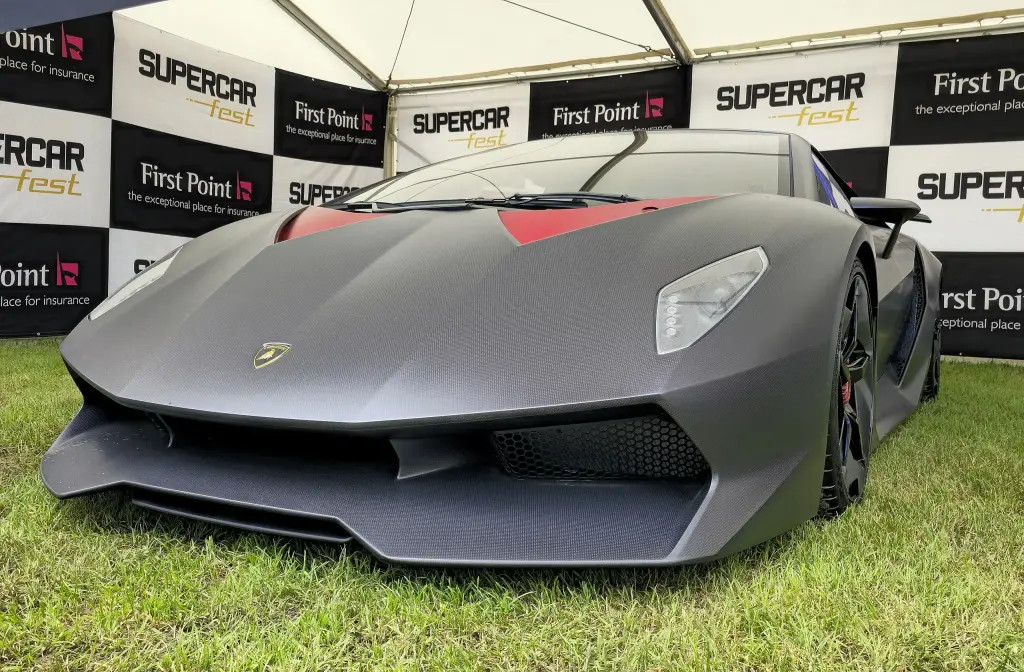
The Lamborghini Sesto Elemento was a track-only limited edition shown at the Paris motor show in 2010. Named after carbon, the sixth element in the periodic table, it was built largely from the material and weighed just 999 kg — a figure closer to a small hatchback than to a supercar — with 570 PS from the Gallardo’s V10.
Lamborghini Sesto Elemento at a glance
| Shown | Paris Motor Show, 2010 |
|---|---|
| Type | track-only limited edition, two seats |
| Engine | 5.2-litre V10 from the Gallardo Superleggera |
| Power | 570 PS (419 kW) |
| Torque | 540 N·m |
| Gearbox | six-speed e-gear automated manual |
| Drive | all-wheel drive |
| Weight | 999 kg |
| Carbon content | about 80 per cent |
| Power to weight | 1.75 kg per PS |
| 0–100 km/h | 2.5 seconds |
| Planned production | 20 cars at $2.92 million |
The top speed is given as 387 km/h on the English page and 350 km/h on the German; the figure is uncertain for a track-only car, so the table leaves it out.
History of the Lamborghini Sesto Elemento
The sixth element
The Sesto Elemento takes its name from the atomic number of carbon, because carbon fibre is what the car is made of. Eighty per cent of it, by Lamborghini’s own estimate, including the chassis, body, drive shafts, wheels and suspension components. That brought the weight down to 999 kg. The car was also the first to use forged carbon fibre, in the tub and suspension arms, a composite developed with the Callaway Golf Company, and the engine cover vented heat through ten hexagonal openings.
Mechanicals
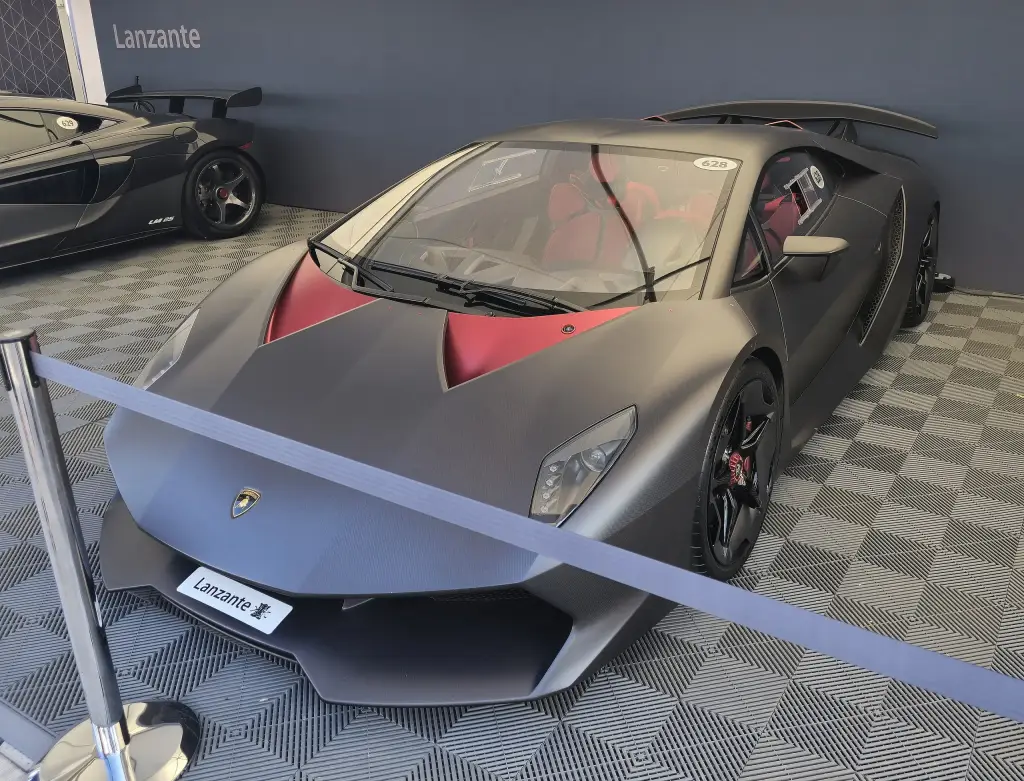
The engine was the familiar 5.2-litre V10 of the Gallardo Superleggera, producing 570 PS and 540 N·m, driving all four wheels through a six-speed e-gear automated manual. The combination of a very light body and a big engine gave a power-to-weight ratio of 1.75 kg per PS. Lamborghini claimed 0–100 km/h in 2.5 seconds and 0–200 km/h in 8.0 seconds. The cabin was stripped of comfort: no air conditioning, no stereo, and no separate seats — foam padding was bonded directly to the carbon-fibre chassis. Boeing helped with the carbon-fibre development, and a demonstration chassis has been displayed at its Everett factory.
Production
In mid-2011 Lamborghini announced twenty cars for track use only, at $2.92 million each, which at the time made the Sesto Elemento the most expensive Lamborghini ever built. Demand for a car that was not road legal was weaker than expected, and vehicle identification records suggest that only about ten were completed, although the company never confirmed this publicly. Singapore received four cars in 2014, more than any other country, while the United States received none. Two of the cars have since been converted by their owners for road use.
Design and features
- Carbon-fibre construction: about 80 per cent of the car, including the chassis, wheels and suspension.
- 999 kg: exceptionally light for a four-wheel-drive supercar, giving 1.75 kg per PS.
- Forged carbon: used for the first time in a car, in the tub and suspension arms.
- Track only: no air conditioning, no stereo and no seats, just foam bonded to the chassis.
Lamborghini Sesto Elemento versions
- Sesto Elemento (2010–2012): the only version, built for track use in a small series.
The Sesto Elemento took its V10 from the Gallardo, its carbon-fibre ideas from the Reventón, and its name from the sixth element that also gave the Aventador its monocoque. More cars are in the Lamborghini collection.
Video: Lamborghini Sesto Elemento at Imola
Video by Top Gear on YouTube.
Sources
- Lamborghini Sesto Elemento, English Wikipedia: design, specifications, production
- Lamborghini Sesto Elemento, German Wikipedia: presentation, weight, power-to-weight ratio