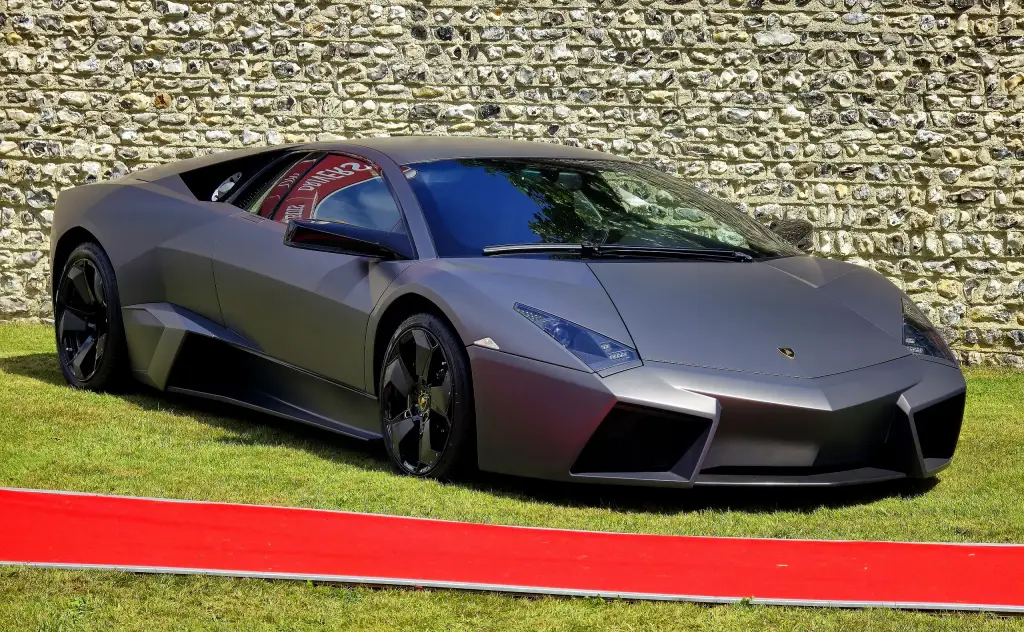
The Lamborghini Reventón was a limited edition built on the Murciélago LP 640 and shown at the Frankfurt motor show in 2007. Only twenty cars were sold, plus one for the factory museum, each with an all-carbon body, a single grey finish and styling that Lamborghini said was inspired by the fastest aeroplanes.
Lamborghini Reventón at a glance
| Maker | Lamborghini, Sant’Agata Bolognese |
|---|---|
| Built | 2007, twenty cars plus one for the museum |
| Debut | Frankfurt Motor Show, 2007 |
| Based on | Murciélago LP 640 |
| Engine | 6,496 cc V12, 650 PS at 8,000 rpm |
| Torque | 660 N·m at 6,000 rpm |
| 0–100 km/h | 3.4 seconds |
| Top speed | over 340 km/h |
| Body | carbon fibre, one grey colour only |
| Lighting | seven LEDs per headlamp |
| Distribution | 10 United States, 7 Europe, 1 Canada, 2 Asia |
The car is a restyled Murciélago: the engine, chassis and most mechanical parts come directly from the LP 640, with output raised from 640 to 650 PS.
History of the Lamborghini Reventón
A flagship as a showpiece
The Reventón appeared at Frankfurt in 2007 as the most extreme road-going Lamborghini of its time. It was mechanically a Murciélago LP 640 — the same 6,496 cc V12, the same chassis and most of the same parts — with output lifted to 650 PS at 8,000 rpm and torque to 660 N·m. The body, however, was entirely new and made of carbon fibre, finished in a single colour Lamborghini described as mid opaque grey without the usual shine. The official press release said the shape was inspired by the fastest aeroplanes, and the angular, faceted surfaces made the connection easy to see. The name, as usual, came from a fighting bull: this one, raised by Don Heriberto Rodriguez, was famous for killing the Mexican matador Felix Guzman in 1943.
Inside and outside
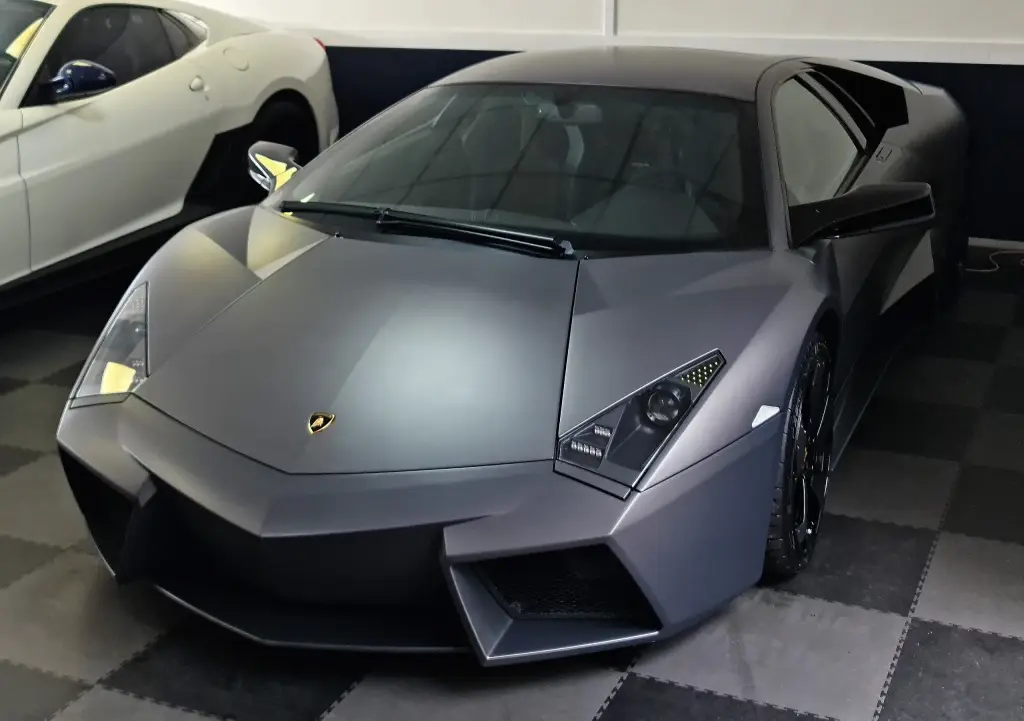
The cabin was built around three TFT screens with two display modes, mounted in a structure milled from a solid aluminium block and cased in carbon fibre. Among the instruments was a g-force meter showing the magnitude and direction of the forces acting on the car, and the seats were trimmed in black leather and brown Alcantara. On the outside, the Reventón was the first Lamborghini to combine daytime running lamps with the headlamps: seven LEDs on each side flanked the bi-xenon main beam and stayed lit whenever the car was moving. Because the lower rear of the car runs very hot, special heatproof LEDs were used for the indicators, hazard lights and tail lights, the last with a triple-arrow effect. The active rear wing and shoulder intakes deployed only at high speed, as on the Murciélago.
The Roadster and the legacy
A Roadster version followed at Frankfurt in 2009, using the engine of the Murciélago LP 670-4 SuperVeloce. Production was set at fifteen cars with a list price of €1,100,000, but demand pushed the actual price to about $2,100,000. The Roadster had 670 PS, the same torque, a slightly lower top speed of 330 km/h and 25 kg of extra chassis stiffening to compensate for the missing roof, plus roll hoops that deployed in a rollover. Of the twenty coupés, ten went to the United States, seven to Europe, one to Canada and two to Asia. The Reventón’s exterior design then formed the basis of the Aventador, the next flagship.
Design and features
- Carbon-fibre body: an all-new shape over Murciélago mechanicals, in one grey colour only.
- Fighter-jet cockpit: three TFT screens in a milled aluminium housing, with a g-force meter.
- LED lighting: the first Lamborghini with daytime running lamps built into the headlamps.
- Rarity: twenty cars sold, each stamped with its number between the seats.
Lamborghini Reventón versions
- Reventón coupé (2007): twenty cars plus the 00/20 museum car.
- Reventón Roadster (2009): fifteen cars, 670 PS, about $2,100,000 each.
The Reventón was based on the Murciélago and its design led to the Aventador; its carbon-fibre work was taken further in the Sesto Elemento. More cars are in the Lamborghini collection.
Sources
- Lamborghini Reventón, English Wikipedia: design, interior, performance, Roadster