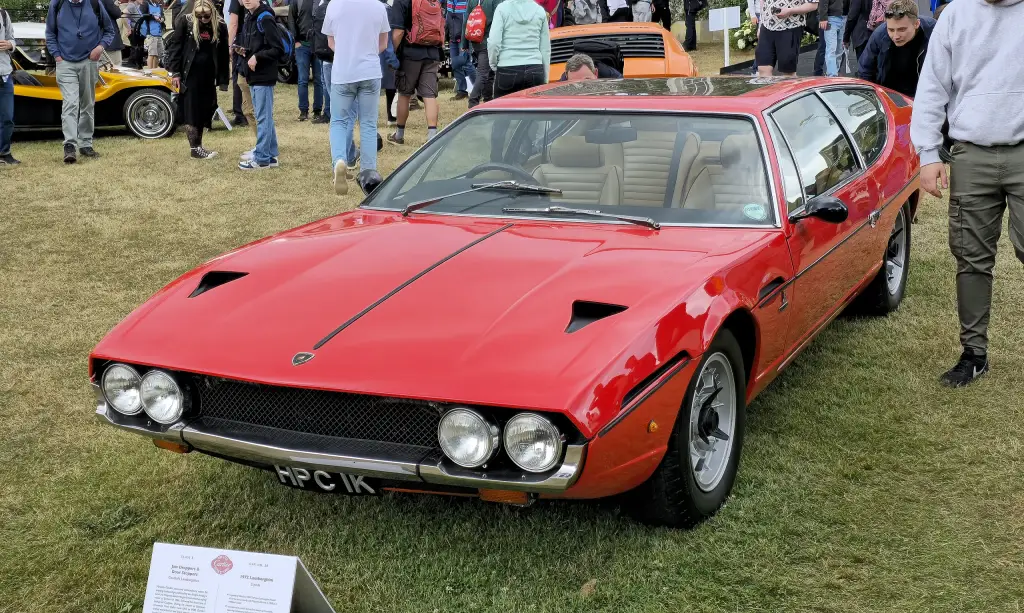
The Lamborghini Espada was the first full four-seater built by the company and, for a decade, its most successful model. Designed by Marcello Gandini at Bertone, it combined the 4-litre V12 of the 400 GT with a long fastback body and four individual seats, and it stayed in production from 1968 until 1978.
Lamborghini Espada at a glance
| Maker | Lamborghini, Sant’Agata Bolognese |
|---|---|
| Production | 1968–1978 |
| Debut | Geneva Motor Show, 1968 |
| Designed by | Marcello Gandini, Bertone |
| Engine | 3,929 cc V12, six Weber 40 DCOE carburettors |
| Power | 325 PS (S1), 350 PS (S2 and S3) |
| Top speed | 245 to 260 km/h |
| Gearbox | five-speed manual; three-speed automatic from 1974 |
| Chassis | semi-monocoque steel, aluminium bonnet |
| Fuel | twin tanks, 93 litres |
| Built | 1,217 |
Production totals vary between sources: 1,217 in the English and German articles, 1,226 in the Italian one. Series figures also differ slightly, with the English page giving 186 Series I cars against 176 in the Italian.
History of the Lamborghini Espada
From show car to production
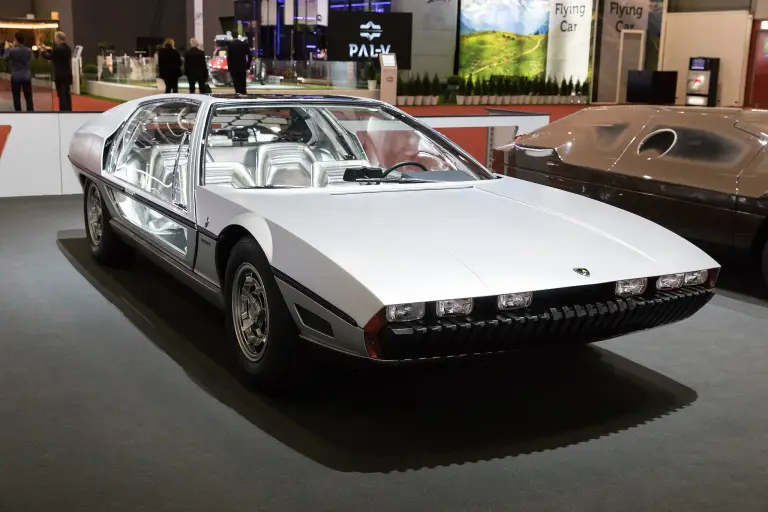
The Espada grew out of two Bertone show cars of 1967: the Marzal, a four-seat concept with gullwing doors and a six-cylinder engine, and the Pirana, a front-engined coupé built on a Jaguar E-Type. The Marzal had been a sensation when Prince Rainier of Monaco drove it around the circuit before the 1967 Monaco Grand Prix with Princess Grace beside him, and Ferruccio Lamborghini decided that the idea deserved production. Gandini kept the low, glassy fastback profile but conventional doors, moved the engine to the front to free space for rear seats and a boot, and used the 400 GT floorpan, lengthened by 15 cm with work by Dallara and Stanzani.
Three series
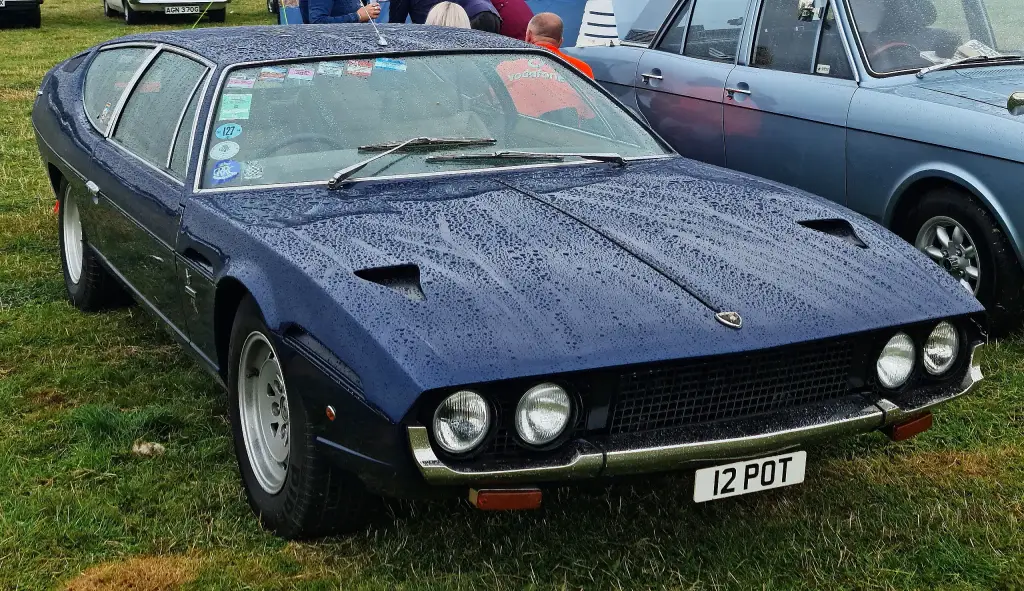
The Espada was launched at Geneva in 1968 beside the Islero. Series I cars had 325 PS, a dashboard inspired by the Marzal with octagonal instrument housings, Campagnolo knock-off wheels of the Miura pattern and tail lights borrowed from the Fiat 124 Sport Coupé. Series II arrived at Brussels in 1970 with a new dashboard, console and steering wheel, a higher compression ratio lifting output to 350 PS, vented Girling discs and constant-velocity joints on the rear half-shafts; it became the volume version. Series III of 1972 brought an aluminium-trimmed instrument panel, five-stud wheels, a square-mesh grille, Alfa Romeo 1750 tail lights, standard ZF power steering and air conditioning.
Building and reputation
The Espada was assembled across three factories: Marchesi of Modena built the chassis, Bertone of Turin fitted the body and trim, and Lamborghini installed the engine, gearbox and suspension in Sant’Agata. The car was roomier and more comfortable than the Miura or the 400 GT, with leather, wood and thick carpet, and its rear screen doubled as the boot lid, with a second vertical window behind it to help rearward vision. Rust was a real problem on the steel bodies. Production ended in 1978 as Lamborghini ran into financial trouble, and Bertone’s four-door study and Pietro Frua’s one-off Faena of 1978 never reached series production.
Design and features
- Four real seats: the first full four-seater Lamborghini, with individual front seats and a roomy cabin.
- Fastback body: a low roof, a huge rear screen that opens as the boot lid and a second vertical window behind it.
- Big V12: the 3,929 cc engine from the 400 GT, with six twin-choke Weber carburettors.
- Grand touring equipment: air conditioning and electric windows from the start, ZF power steering on Series III.
Lamborghini Espada versions
- Series I (1968–1970): 325 PS, Marzal-style dashboard, knock-off wheels.
- Series II (1970–1972): 350 PS, new interior, vented brakes; the most numerous version.
- Series III (1972–1978): aluminium-trimmed dash, five-stud wheels, standard power steering.
- US-specification cars (1975 on): impact bumpers, air injection and detuned engines.
- Faena (1978): a four-door one-off by Pietro Frua on a lengthened Espada chassis.
The Espada shared its engine with the 400 GT and its cabin idea with the Marzal show car; it was sold alongside the Islero. More cars are in the Lamborghini collection.
Sources
- Lamborghini Espada, English Wikipedia: series changes, specification, production
- Lamborghini Espada, German Wikipedia: design origins, assembly, Faena
- Lamborghini Espada, Italian Wikipedia: Marzal and Pirana, interior, market context