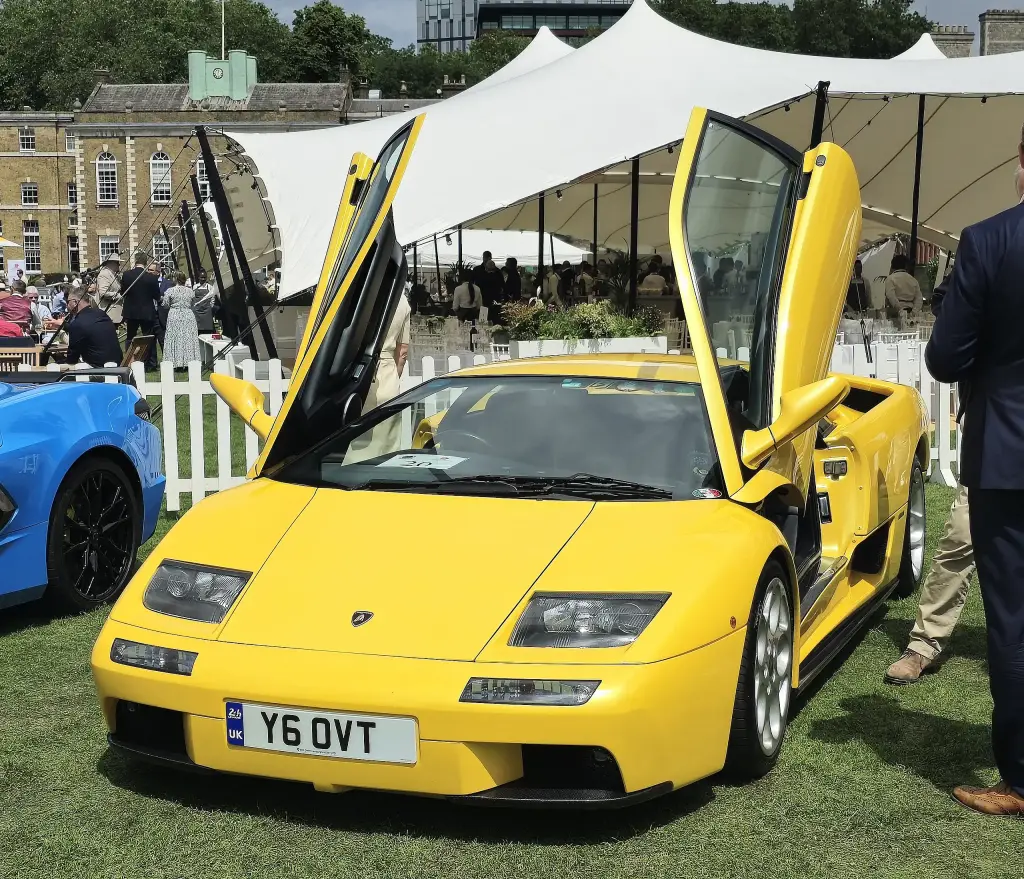
The Lamborghini Diablo took over from the Countach in 1990 and stayed in production until 2001, longer than any Lamborghini flagship before it. It was the first series Lamborghini to pass 200 mph, the first to offer all-wheel drive, and the last flagship developed before Audi took control of the company.
Lamborghini Diablo at a glance
| Maker | Lamborghini, Sant’Agata Bolognese |
|---|---|
| Production | 1990–2001 |
| Project code | P132, begun June 1985 |
| Designed by | Marcello Gandini, revised by Chrysler’s studio |
| Engine | 5,707 cc V12, 492 PS (362 kW) |
| Torque | 580 N·m |
| Gearbox | five-speed manual |
| Top speed | 325 km/h |
| 0–100 km/h | 4.5 seconds (Auto Motor und Sport) |
| Drive | rear-wheel drive, all-wheel drive from the VT of 1993 |
| Brakes | discs all round, anti-lock brakes added later in the run |
None of the sources used here gives a total production figure for the Diablo, so the page leaves it out.
History of the Lamborghini Diablo
Project 132
Development began in June 1985, when Lamborghini was owned by the Mimran brothers, under the code P132. The brief was blunt: the new car had to reach at least 315 km/h. Marcello Gandini, who had drawn the Miura and the Countach, produced a typically sharp design, but when Chrysler bought Lamborghini in 1987 its Detroit studio was unhappy with the result and restyled the car more smoothly — a compromise Gandini later revisited in the Cizeta-Moroder V16T. The work is said to have cost six billion lire.
The car
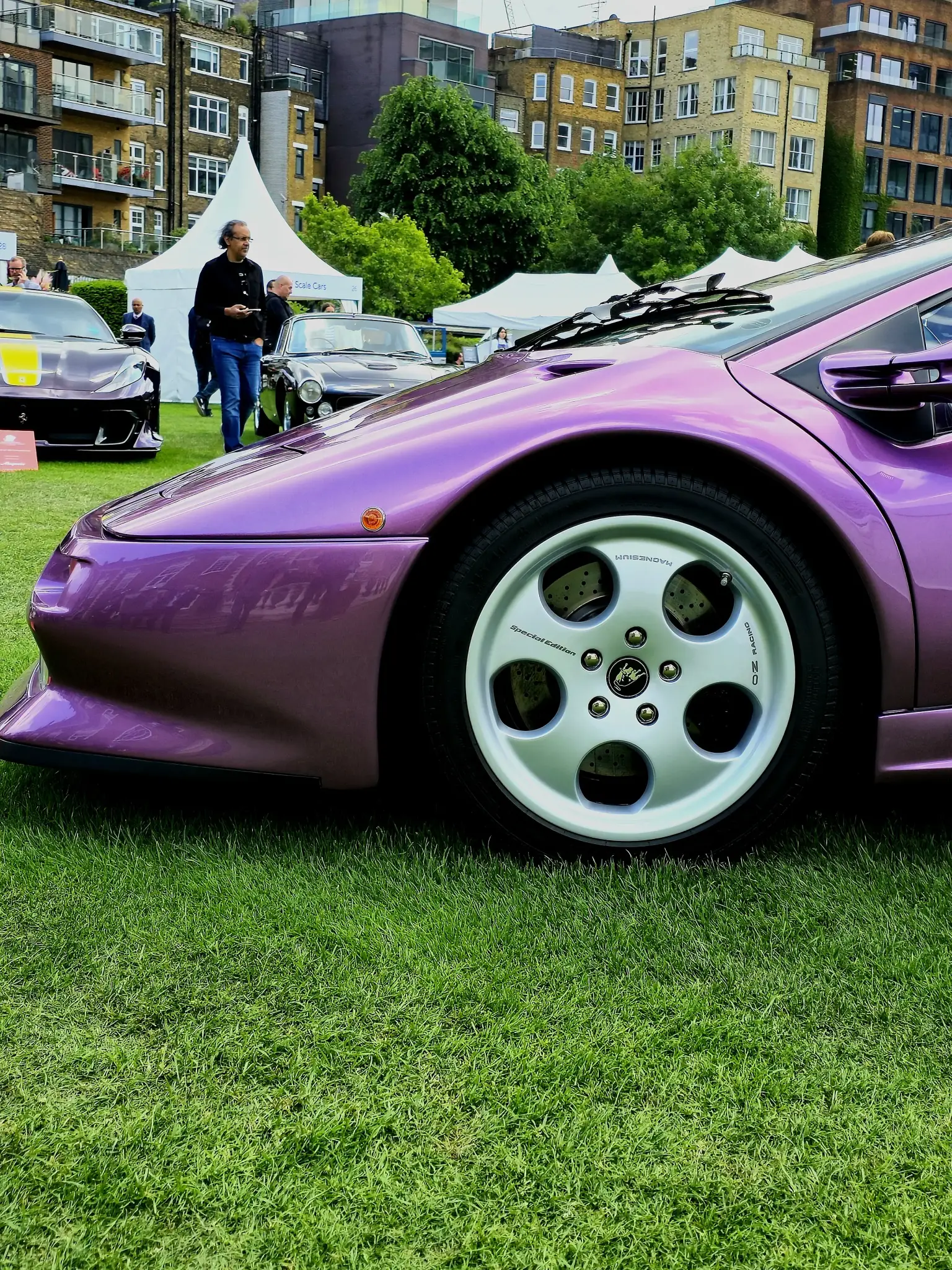
The Diablo was presented to customers in January 1990. Its V12 grew to 5,707 cc and, for the first time on a Lamborghini, all versions used factory fuel injection rather than carburettors. Output was 492 PS, enough for 325 km/h — comfortably past the 200 mph barrier — with 0–100 km/h in 4.5 seconds. Equipment was far better than the Countach’s: adjustable seats and steering wheel, electric windows, an Alpine stereo and, from 1993, power steering. Anti-lock brakes were not available at first. Options included a custom-moulded driver’s seat, a luggage set at $2,600 and a Breguet clock at $10,500.
All-wheel drive and the end
The Diablo VT of 1993 added viscous traction: a computer-controlled centre differential that could send up to 25 per cent of torque to the front wheels when the rear lost grip, using a development of the LM002’s four-wheel-drive system. It also brought four-piston brakes, electronically adjustable dampers and a revised interior, most of which soon filtered down to the rear-drive car. A roadster followed in 1995, and the special editions came thick and fast: the SE30 for the company’s thirtieth anniversary with 525 PS, its Jota conversion with 596 PS, the rear-drive SV of 1995 with 510 PS and a race-ready SV-R. In 1999 the pop-up headlights gave way to fixed units taken from the Nissan 300ZX. The Murciélago replaced the Diablo in 2001.
Design and features
- Over 200 mph: 325 km/h from a 5.7-litre injected V12 with 492 PS.
- Viscous traction: the VT’s all-wheel-drive system could send a quarter of the torque forward.
- Mixed-material body: steel roof, aluminium doors and wings, carbon-fibre spoilers and panels.
- Better equipped: electric windows, proper seats and optional air conditioning, a change from the spartan Countach.
Lamborghini Diablo versions
- Diablo (1990–1998): the original rear-drive coupé with pop-up headlights.
- Diablo VT (1993–1999): all-wheel drive, larger brakes and a revised cabin.
- SE30 and SE30 Jota (1993–1995): 150 anniversary cars with 525 PS, and a 596 PS Jota conversion.
- Diablo SV (1995): rear-wheel drive with 510 PS and a three-piece adjustable wing.
- VT Roadster (1995–1999): Lamborghini’s first open V12 production car.
- 1999 facelift: fixed headlights from the Nissan 300ZX and a redesigned interior.
The Diablo succeeded the Countach and was replaced by the Murciélago; its all-wheel-drive system came from the LM002. More cars are in the Lamborghini collection.
Sources
- Lamborghini Diablo, English Wikipedia: development, original model, VT
- Lamborghini Diablo, German Wikipedia: project history, versions, 1999 facelift
- Lamborghini Diablo, Italian Wikipedia: technical data, VT Roadster, body materials