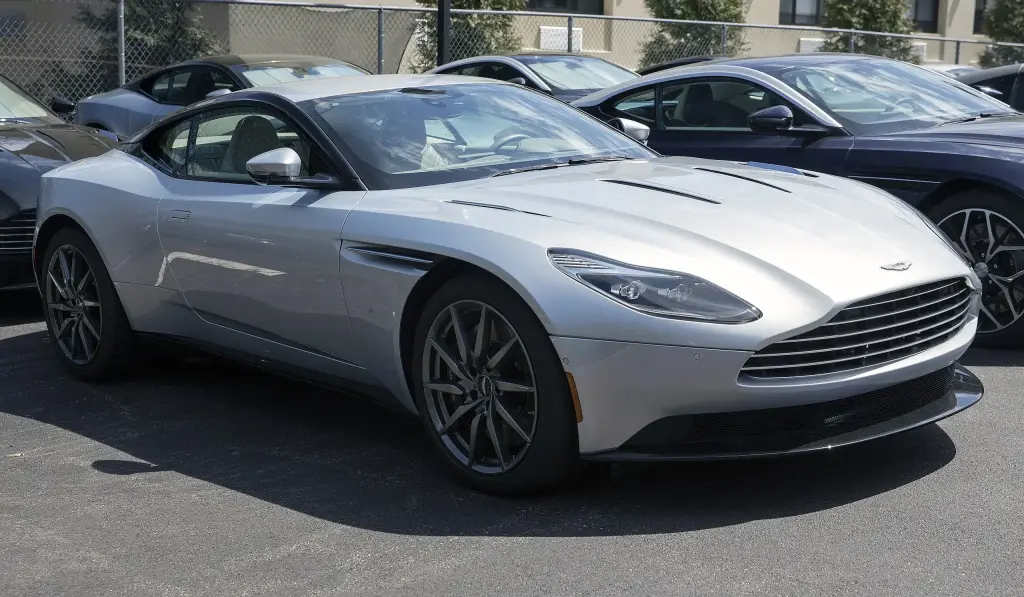
The Aston Martin DB11 is a two-door grand tourer that Aston Martin built at Gaydon, Warwickshire, from 2016 to 2023 as the successor to the DB9. It was sold as a coupé and as the Volante convertible, with either Aston Martin’s own 5.2-litre twin-turbo V12 or a 4.0-litre twin-turbo V8 from Mercedes-AMG, and was replaced in 2023 by the DB12.
Designed under Marek Reichman, the DB11 was the first car of Aston Martin’s “second century” plan. It brought a new bonded-aluminium platform, the first V12 developed entirely by the company itself and an aerodynamic trick, the AeroBlade, that does the work of a rear wing without one. Over seven years it grew into a family of four versions: V12, V8, Volante and the faster AMR.
Aston Martin DB11 at a glance
| Maker | Aston Martin, Gaydon, Warwickshire |
|---|---|
| Production | September 2016 – June 2023 |
| Design | Marek Reichman |
| Body | two-door coupé with four seats; Volante convertible |
| Layout | front-mid engine, rear-wheel drive, eight-speed ZF automatic mounted at the rear |
| V12 engine | 5,204 cc twin-turbo V12 (AE31): 608 PS, 700 Nm; AMR: 639 PS, 700 Nm |
| V8 engine | 4.0-litre twin-turbo V8 by Mercedes-AMG: 510 PS, 675 Nm; 535 PS from 2021 |
| 0–62 mph (100 km/h) | 3.9 s (V12), 3.7 s (AMR), 4.0 s (V8), 4.1 s (Volante) |
| Top speed | 200 mph (V12), 208 mph / 334 km/h (AMR), 301 km/h (V8), 309 km/h (V8 from 2021) |
| Weight | 1,760 kg (V8 coupé) |
| Boot | 270 litres |
| Launch price | £154,900 (V12, 2016); £174,995 (AMR, 2018) |
| Predecessor and successor | DB9 (2004–2016), DB12 (2023) |
Aston Martin quotes the V12 at 600 bhp and the AMR at 630 bhp; the figures above are the metric PS. The V12 top speed is given as 200 mph, which sources convert to 320 or 322 km/h. Acceleration figures are the official 0–62 mph times; US sources quote slightly quicker 0–60 mph times. The 2021 figures for the V8 come from English Wikipedia only.
History of the Aston Martin DB11
From the DB9 to the “second century”
Aston Martin built the DB9 at Gaydon from January 2004. It was the first car on the company’s bonded-aluminium VH platform, which later carried the Vantage, DBS, Rapide, Vanquish and Lagonda Taraf. By the time production ended in July 2016, after twelve years, 16,500 DB9s had been made.
In 2015 Aston Martin confirmed that the successor would be called DB11, continuing the DB name, the initials of David Brown. The car was to open the “second century plan”: a new range with a fresh design approach led by Marek Reichman, Aston Martin’s chief designer since 2005, and with clearer differences between the individual models. Some of its design elements were taken from the DB10.
Geneva 2016 and the first V12
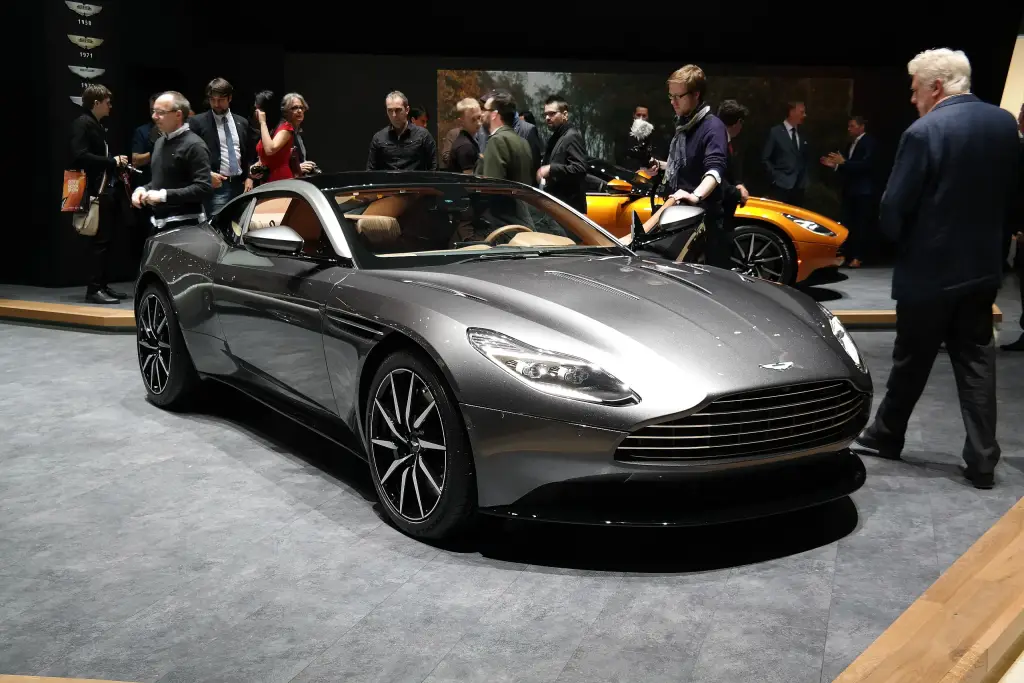
The DB11 was unveiled at the 86th Geneva Motor Show in March 2016. Under the bonnet was a new 5.2-litre twin-turbo V12, developed by Aston Martin itself rather than derived from the Ford-era 5.9-litre unit. Work on the engine had started in the summer of 2012; it first ran in October 2012 and was approved for production in January 2013. It produces 608 PS at 6,500 rpm and 700 Nm, enough for 0–62 mph in 3.9 seconds and 200 mph. It kept port fuel injection, which Aston Martin preferred over direct injection because of concerns about particulate emissions.
Prices started at £154,900 in the UK, $211,995 in the USA and €204,900 in Germany. Series production began at Gaydon on 28 September 2016, and the then chief executive Andy Palmer personally inspected the first 1,000 cars to underline the new standard of quality.
The V8 arrives (2017)
In June 2017 the V12 was joined by a cheaper DB11 V8, shown at the Goodwood Festival of Speed. Its 4.0-litre twin-turbo V8, the Mercedes-AMG M177, comes from the Mercedes-Benz group, like the car’s infotainment system, and produces 510 PS and 675 Nm. The V8 coupé weighs 1,760 kg, 115 kg less than the V12, reaches 62 mph in 4.0 seconds and has a top speed of 301 km/h. In Germany it went on sale in October 2017 from €184,000. With the lighter engine the weight distribution swapped from 51 per cent at the front on the V12 to 49 per cent at the front on the V8.
The Volante convertible (2017–2018)
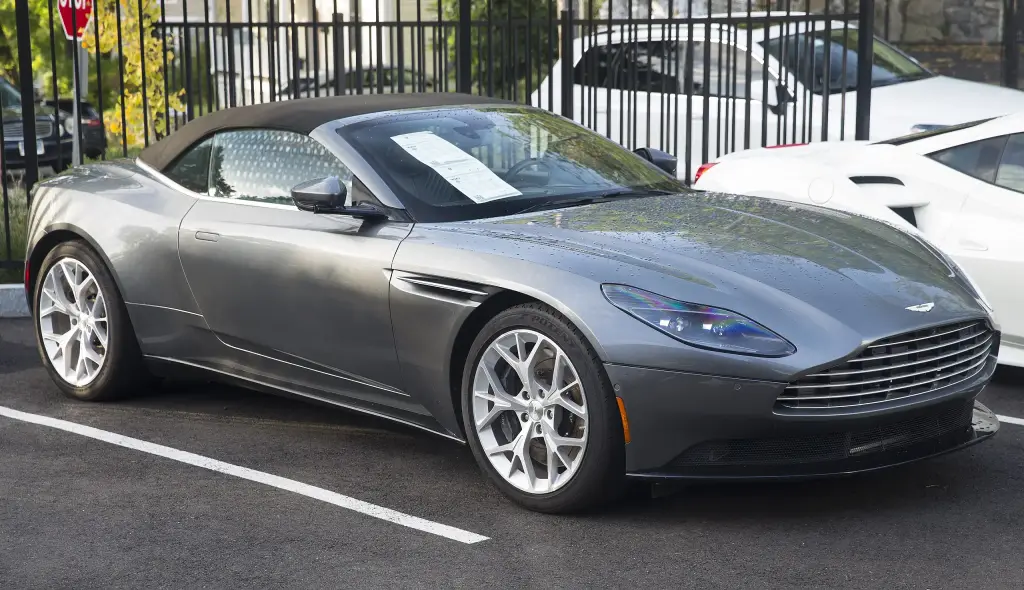
The convertible DB11 Volante was presented in October 2017 and went on sale in 2018. It was offered only with the V8. The fabric roof is built from eight layers of acoustic and insulating material; it lowers in 14 seconds and rises in 16, at speeds of up to 50 km/h. Extra strengthening of the lower body plus the electric roof mechanism add about 110 kg. The Volante reaches 62 mph in 4.1 seconds; its top speed is 187 mph, about 300 km/h.
DB11 AMR (2018)
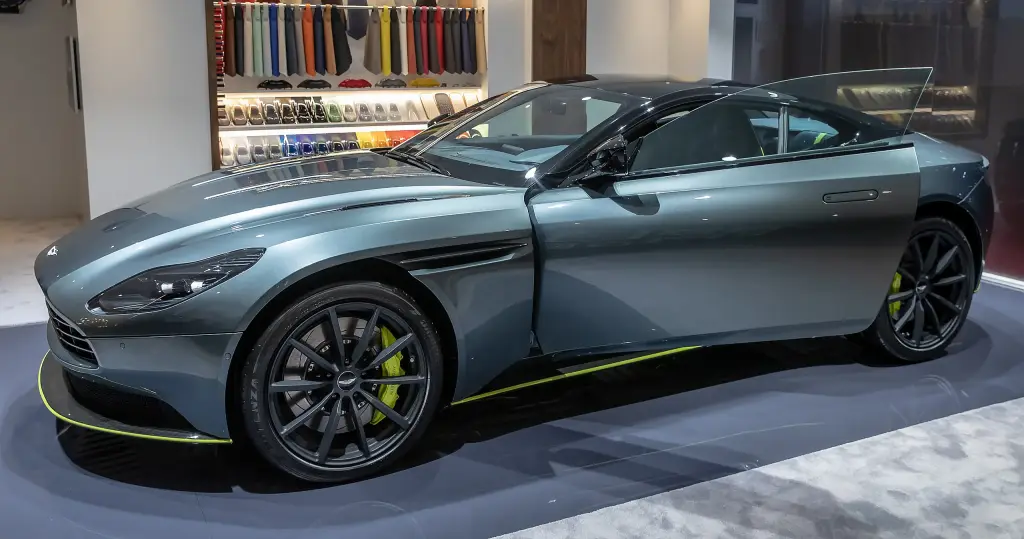
After eighteen months the original V12 was replaced by the DB11 AMR, named after the company’s racing arm, Aston Martin Racing. It was revealed on 11 May 2018 at the opening of Aston Martin’s new AMR Performance Centre at the Nürburgring. According to the company, close to 4,200 V12 DB11s had been sold by then.
The AMR’s V12 produces 639 PS at 6,500 rpm, 30 bhp more than before, with the same 700 Nm. It reaches 62 mph in 3.7 seconds and has a top speed of 208 mph (334 km/h). The chassis team under chief engineer Matt Becker reworked the handling: adaptive dampers with GT, Sport and Sport+ modes, a firmer rear suspension, a new shift calibration for the gearbox and lighter 20-inch forged wheels. A Signature Edition of 100 cars was painted Stirling Green with lime accents. In the UK the AMR cost £174,995, the Signature Edition £201,995.
The 2021 update and the end of production
In July 2021 Aston Martin revised the range. The V8 was raised to 535 PS, lifting the top speed to 309 km/h, and the AMR name was dropped from the V12 car. Production at Gaydon ended in June 2023. Its successor, the DB12, was unveiled in May 2023 at the Cannes Film Festival.
Design and engineering
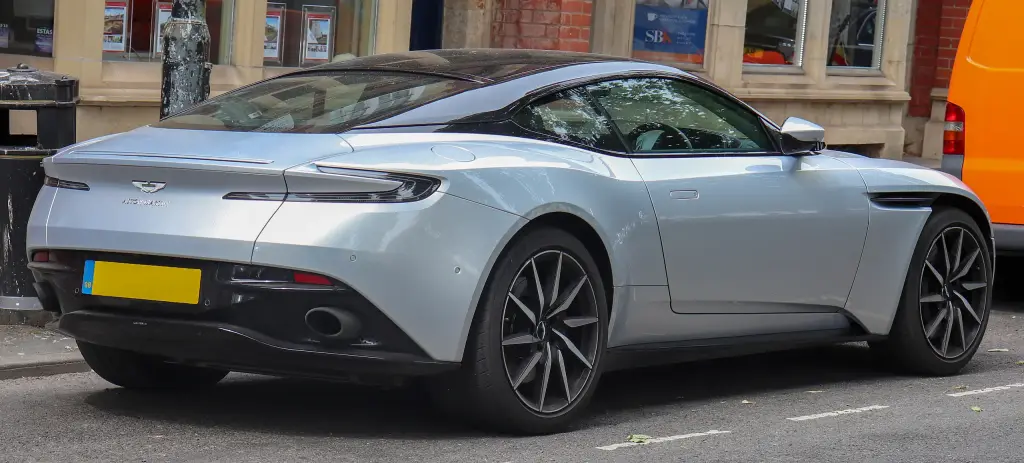
- Platform: a new bonded-aluminium structure, lighter and stiffer than the DB9’s, later shared with the 2018 Vantage and the DBS Superleggera. Body panels are aluminium and composite; the bonnet is a single piece.
- AeroBlade: intakes at the base of the C-pillars take in fast-moving air and send it through ducts inside the bodywork to a slot in the boot lid. The jet of air acts like a large rear spoiler without the drag of one. A small active spoiler rises at high speed to help.
- Underbody: a flat floor, a rear diffuser and a large front splitter keep lift down.
- Drivetrain: front-mid engine, rear-wheel drive and an eight-speed ZF automatic gearbox at the rear axle.
- Suspension: double wishbones at the front and a multi-link rear axle, with coil springs and anti-roll bars at both ends; three driving modes for both drivetrain and chassis.
- Doors and cabin: swan-hinged doors, four seats, a 12-inch digital instrument display and an 8-inch central screen; the infotainment system comes from Mercedes-Benz.
- Craft: each car was built by hand in around 250 hours.
Aston Martin DB11 versions
| Version | Years | Engine | Power | 0–62 mph |
|---|---|---|---|---|
| DB11 V12 | 2016–2018 | 5.2-litre twin-turbo V12 | 608 PS | 3.9 s |
| DB11 V8 | 2017–2023 | 4.0-litre twin-turbo V8 (Mercedes-AMG) | 510 PS, 535 PS from 2021 | 4.0 s |
| DB11 Volante | 2018–2023 | 4.0-litre twin-turbo V8 | 510 PS | 4.1 s |
| DB11 AMR | 2018–2021 | 5.2-litre twin-turbo V12 | 639 PS | 3.7 s |
| DB11 V12 (without the AMR name) | 2021–2023 | 5.2-litre twin-turbo V12 | – | – |
How the DB11 was received
Most reviews were warm. Jeremy Clarkson of The Sunday Times called it “phenomenally good” and praised it as the car for crossing a continent overnight and arriving fresh. Top Gear saw it as a solid start to the new range and the model best suited to everyday use. Autocar noted that the door sills are slimmer than the DB9’s, so getting in is easier. Car magazine liked how the AMR looked and drove at speed but criticised details of the cabin, including the infotainment and the satellite navigation. In 2017 the DB11 won the Golden Steering Wheel (Goldenes Lenkrad) as the most beautiful car of the year.
More from the same marque is in our Aston Martin archive: the predecessor DB9, the Vantage and the DBS. The story of the earlier DB cars is told in our guide Aston Martin in six cars, and the archive holds more DB11 photographs, such as the white DB11 Volante, a maroon DB11 coupé and a grey DB11 on a mountain road.
Aston Martin DB11 questions and answers
When was the Aston Martin DB11 made?
From September 2016 to June 2023, at Aston Martin’s factory in Gaydon, Warwickshire. It was unveiled at the Geneva Motor Show in March 2016.
Which engines did the DB11 have?
Aston Martin’s own 5.2-litre twin-turbo V12 with 608 PS (639 PS in the AMR), and a 4.0-litre twin-turbo V8 from Mercedes-AMG with 510 PS, raised to 535 PS in 2021.
What does DB stand for?
The initials of David Brown. The DB11 continued the DB series of Aston Martin grand tourers after the DB9.
How fast is the DB11?
The V12 coupé reaches 200 mph, the AMR 208 mph (334 km/h) and the V8 301 km/h, or 309 km/h after the 2021 update. The AMR reaches 62 mph in 3.7 seconds.
What is the AeroBlade?
A system of ducts that takes air in at the C-pillars and releases it through a slot in the boot lid, giving the downforce of a rear spoiler without a visible wing.
What replaced the DB11?
The Aston Martin DB12, unveiled in May 2023.
Sources
- Aston Martin DB11, English Wikipedia: history, design, versions, reception
- Aston Martin DB11, German Wikipedia: the DB name, V8 launch and price, Volante sales, Golden Steering Wheel
- All-new DB11 opens new chapter, Carscoops, March 2016: launch specifications and prices
- DB11 AMR, new performance flagship of the DB11 range, Aston Martin, May 2018: AMR specifications, prices, Signature Edition
- Aston Martin opens up with DB11 Volante, GoAuto: the Volante roof and performance