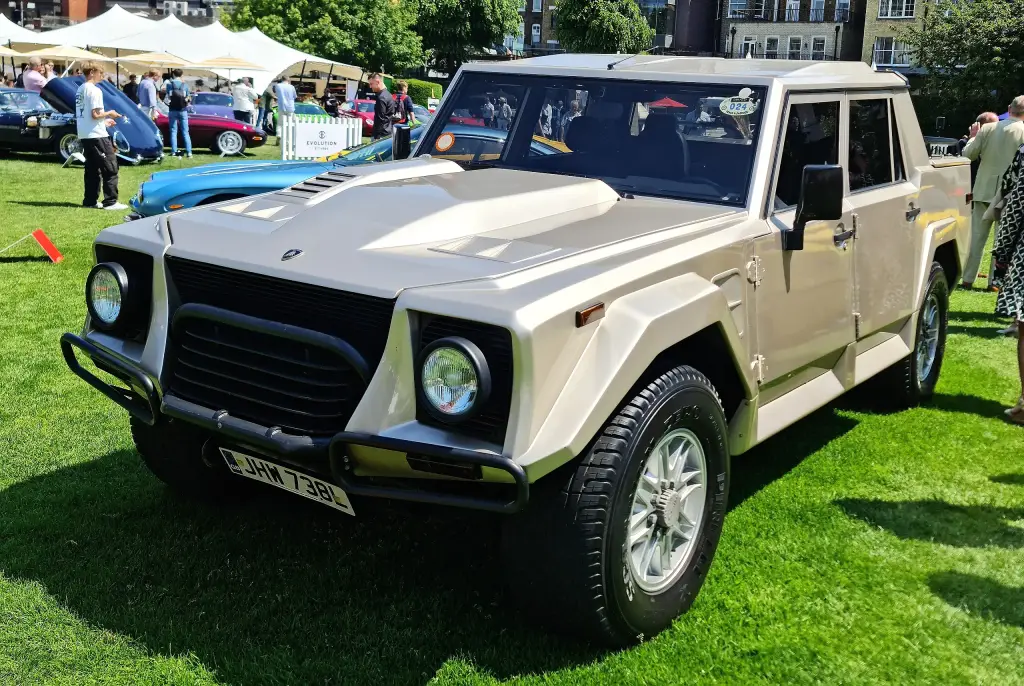
The Lamborghini LM002 was a military project that became a luxury toy. The first Lamborghini off-roader to reach production, it carried the Countach’s V12 at the front, weighed about 2.6 tonnes and was nicknamed the Rambo-Lambo. Between 1986 and 1993, 301 were built.
Lamborghini LM002 at a glance
| Maker | Lamborghini, Sant’Agata Bolognese |
|---|---|
| Production | 1986–1993 |
| Debut | Brussels Motor Show, 1986 |
| Engine | 5,167 cc V12 from the Countach, 420 PS |
| Gearbox | six-speed manual with low-range transfer box |
| Drive | permanent four-wheel drive, three differentials |
| Top speed | 208 km/h |
| 0–100 km/h | 7.8 seconds |
| Weight | about 2,600 kg |
| Fuel tank | 169 litres |
| Tyres | Pirelli Scorpion, run-flat |
| Built | 301 |
The Italian article gives a 160-litre tank and the English one 169 litres; the table follows the English figure. Production totals agree at 301 cars.
History of the Lamborghini LM002
From Cheetah to LM002
The story began in 1977 with the Cheetah, a prototype with a rear-mounted Chrysler V8 intended for oil exploration companies and, it was hoped, the US Army. Only one was finished and it was never tested by the military. Lamborghini then built the LM001, essentially the same idea with an AMC V8, but testing showed that a rear engine made an off-roader handle badly. The answer was the LMA002, with a new chassis and the engine — now the Countach’s V12 — moved to the front. After further development it received a serial number and became the first LM002, shown in production form at Brussels in 1986.
What it was like
The LM002 was 4.9 metres long, two wide and 1.8 tall, with a permanent four-wheel-drive system and three differentials. Its 5,167 cc V12 produced 420 PS, enough for 208 km/h and 0–100 km/h in 7.8 seconds — saloon-car performance from a vehicle weighing 2.6 tonnes. Fuel consumption was its weak point: around five kilometres per litre, and worse off-road, from a tank of 160 to 169 litres. Pirelli designed special Scorpion tyres that could run almost flat and cope with desert heat, in two tread patterns, one for mixed use and one for sand. Civilian cars came with leather trim, tinted electric windows, air conditioning and a stereo in a roof console, and the body was built by the Basque coachbuilder Irizar.
Versions and afterlife
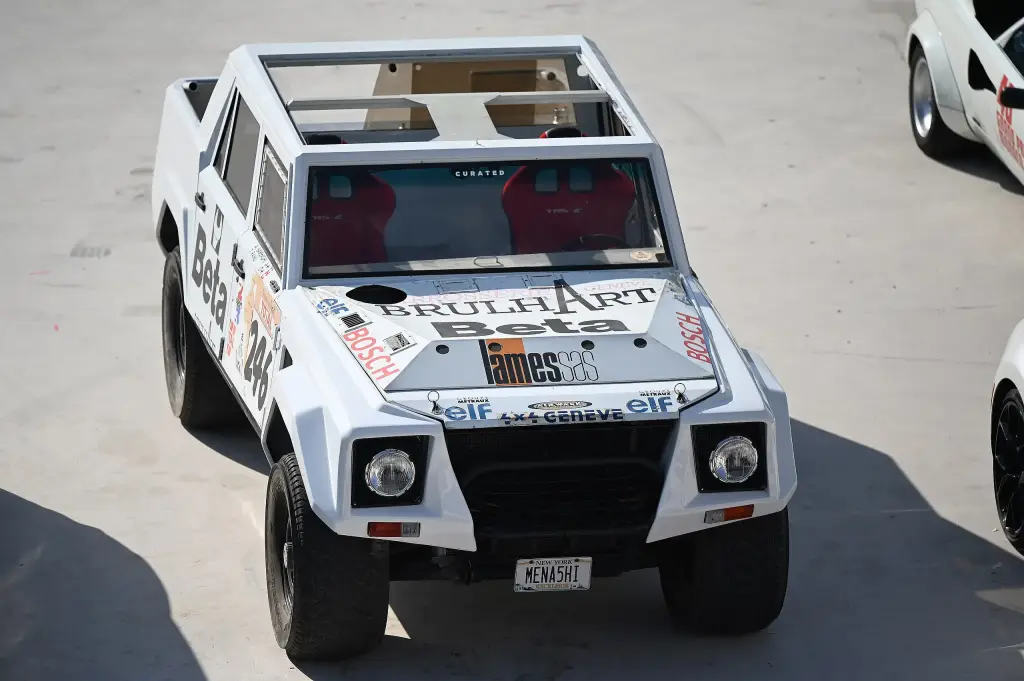
Of the 301 cars, the last sixty were the LM/American special edition, shown at Detroit in 1992 with OZ wheels, chromed bumpers and a special interior. Buyers who wanted more could order the 7.2-litre L804 marine V12 used in offshore powerboats. Two prototypes explored other routes: the LM003 with a 3.6-litre VM turbodiesel that could not move 2.7 tonnes convincingly, and the LM004 with the big marine engine, built for a Saudi interest in a fast desert patrol vehicle. Two LM002s were also prepared for the Paris–Dakar rally with 600 PS and plexiglass windows; one ran in the Rallye des Pharaons and in Greece with Sandro Munari driving. Production ended in 1993, although Lamborghini claimed orders for some 800 cars.
Design and features
- Countach V12: a 5.2-litre twelve-cylinder at the front, 420 PS in a vehicle built for deserts.
- Three differentials: permanent four-wheel drive with a low-range transfer box and a six-speed manual.
- Purpose-built tyres: Pirelli Scorpions that could run almost flat, in road and sand patterns.
- Luxury cabin: leather, air conditioning, electric windows and a roof-console stereo on civilian cars.
Lamborghini LM002 versions
- LM002 (1986–1993): the standard car, with the 5.2-litre V12.
- LM/American (1990–1993): the last sixty cars, built for the United States.
- LM003: a one-off prototype with a 3.6-litre turbodiesel V5.
- LM004: a prototype with the 7.2-litre L804 marine V12.
- LM002 Evoluzione: two Paris–Dakar cars with 600 PS, one white and one orange.
The LM002 borrowed its engine from the Countach and its four-wheel-drive know-how later helped the Diablo VT; the idea of a tall Lamborghini returned with the Estoque concept. More cars are in the Lamborghini collection.
Sources
- Lamborghini LM002, English Wikipedia: history, equipment, versions
- Lamborghini LM 002, Italian Wikipedia: dimensions, performance, prototypes