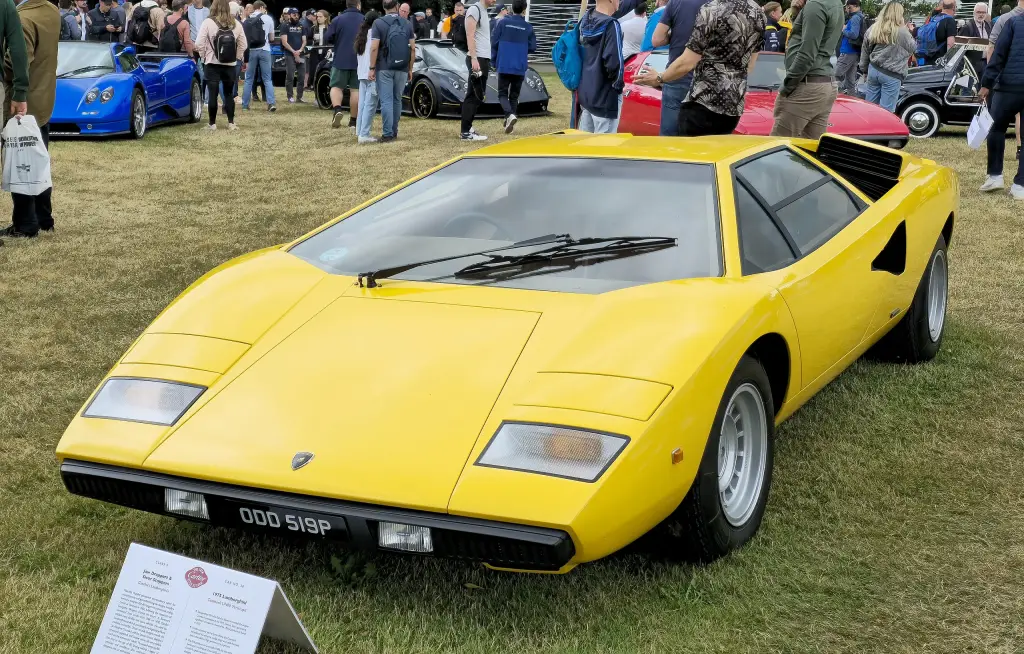
The Lamborghini Countach was the company’s flagship for sixteen years, from 1974 until 1990. Designed by Marcello Gandini at Bertone and engineered under Paolo Stanzani, it introduced the sharp wedge shape and the upward-opening doors that came to define what a supercar looked like, and it kept Lamborghini alive through the financial crises of the 1970s and 1980s.
Lamborghini Countach at a glance
| Maker | Lamborghini, Sant’Agata Bolognese |
|---|---|
| Production | 1974–1990 |
| Designed by | Marcello Gandini, Bertone |
| Chief engineer | Paolo Stanzani |
| First shown | LP500 concept, Geneva 1971 |
| Engine | V12, 3,929 cc to 5,167 cc, mounted longitudinally behind the cabin |
| Power | 375 to 455 PS over the production run |
| Gearbox | five-speed manual, ahead of the engine |
| Chassis | round steel tube frame, aluminium panels |
| Doors | scissor, hinged at the front |
| Built | about 2,000, all versions together |
The production figure is approximate and comes from the German article, which counts all versions together.
History of the Lamborghini Countach
The LP112 project
Work on a Miura successor began in 1970 under the project name LP112, with Stanzani, test driver Bob Wallace, engineer Massimo Parenti and Gandini. Lamborghini wanted more than a faster Miura: the new car had to fix the transverse-engine layout’s problems — poor high-speed stability, lift-off oversteer, awkward servicing and cooling. The answer was a V12 turned through ninety degrees and mounted longitudinally behind the cabin, with the gearbox in front of the engine and a shaft running through the sump to the differential, concentrating mass towards the centre of the car.
From show car to production
The LP500 concept appeared on Bertone’s stand at Geneva in 1971, painted yellow, with a 4,971 cc engine. It was meant only as a demonstration of what Bertone could do, but the reaction was strong enough for Ferruccio Lamborghini to authorise testing and, in May 1972, series production. The five-litre engine was dropped for emissions reasons and replaced with the proven 3,929 cc unit, and three years of development turned the concept into the LP400, first delivered to a customer on 11 April 1974. The car the journalists saw at Paris in 1973 still had teething problems, and Lamborghini kept improving it during production.
Name and survival
The name broke with the bullfighting tradition. It comes from contacc, a Piedmontese exclamation of astonishment, used constantly by a Bertone craftsman working on the car at night; Gandini suggested it as a joke and it stuck. While the Urraco failed commercially and projects such as the BMW M1 and the Cheetah came to nothing, the Countach sold well enough to keep the company afloat, through bankruptcy in 1980 and two changes of ownership. It was replaced by the Diablo in 1990, and its shape set the template for the Diablo, Murciélago and Aventador that followed.
Design and features
- Wedge styling: a shape derived from the 1968 Alfa Romeo Carabo and the 1970 Lancia Stratos Zero, both by Gandini.
- Scissor doors: hinged at the front and rotating upwards — practical in tight parking as well as dramatic.
- Longitudinal V12: the engine sits behind the cabin with the gearbox ahead of it, putting weight near the centre.
- Light structure: a round-tube steel frame with 1 mm aluminium panels riveted on, and glassfibre below the waistline.
Lamborghini Countach versions
- LP400 (1974–1978): the original 3,929 cc car, with the cleanest body and a periscope rear-view mirror.
- LP400 S (1978–1982): wider wheels, flared arches and an optional rear wing.
- LP500 S (1982–1985): the engine enlarged to 4,754 cc.
- LP5000 Quattrovalvole (1985–1988): 5,167 cc and four valves per cylinder, 455 PS.
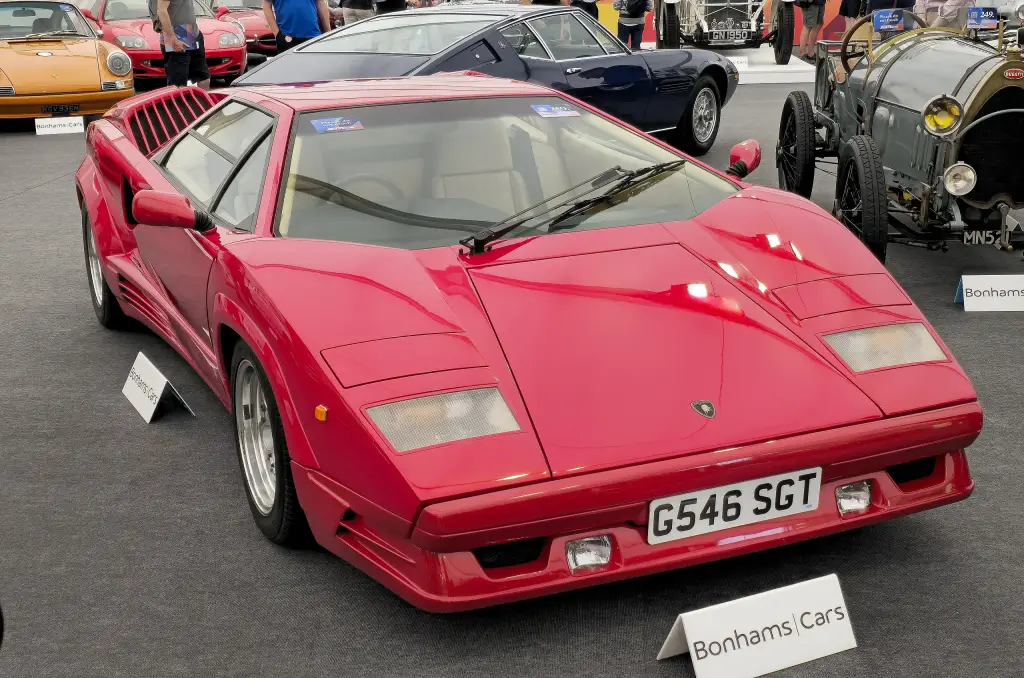
- 25th Anniversary (1988–1990): restyled by Horacio Pagani with wider sills, new wheels and vents.
The Countach succeeded the Miura and was replaced by the Diablo; its angular style was previewed by the Bravo. More cars are in the Lamborghini collection.
Sources
- Lamborghini Countach, English Wikipedia: development, naming, design
- Lamborghini Countach, German Wikipedia: engineering, chassis, production
- Lamborghini Countach, Italian Wikipedia: prototype history, body construction, doors