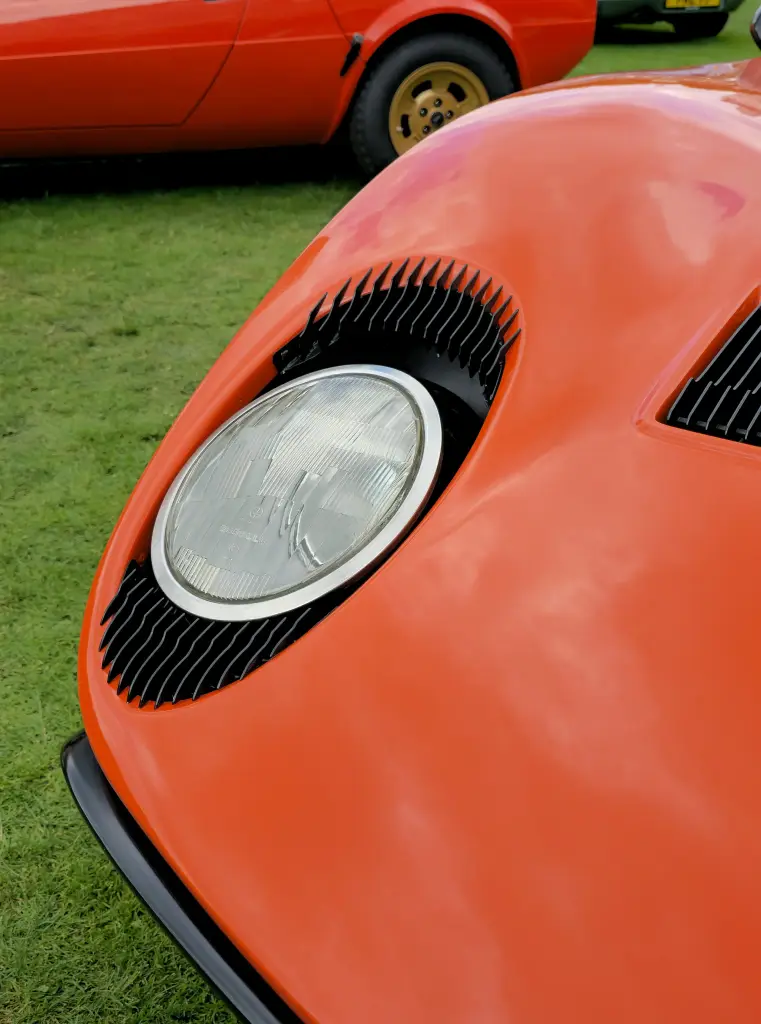
The Lamborghini Miura changed what a road car could be. Shown at Geneva in 1966 with its 3.9-litre V12 mounted sideways behind the seats, it was the first high-performance production car with a mid-engine layout, the fastest production car in the world at the time, and a design by a 27-year-old Marcello Gandini that made Lamborghini famous.
Lamborghini Miura at a glance
| Maker | Lamborghini, Sant’Agata Bolognese |
|---|---|
| Production | 1966–1973 |
| Debut | Geneva Motor Show, 1966 |
| Designed by | Marcello Gandini, Bertone |
| Engine | 3,929 cc V12, transverse, mid-mounted |
| Power | 350 PS in the P400, 370 PS in the S |
| Gearbox | five-speed, combined with the engine and differential |
| Drive | rear-wheel drive |
| Chassis | steel platform, steel and aluminium body |
| Built | 275 P400 and 338 P400 S |
The Miura was built in several versions over seven years; the figures in the table cover the two most numerous, the P400 and the P400 S.
History of the Lamborghini Miura
Built in secret
The Miura began as an unofficial project. In 1965 three of Lamborghini’s engineers — Giampaolo Dallara, Paolo Stanzani and test driver Bob Wallace — worked at night on a prototype known as the P400, a road car with racing pedigree. Ferruccio Lamborghini preferred comfortable grand tourers to the race-derived cars Ferrari was building, but when he saw the finished mule he let the work continue, convinced at least that it would be valuable publicity. The rolling chassis went to the Turin show in 1965, where visitors placed orders without seeing a body.
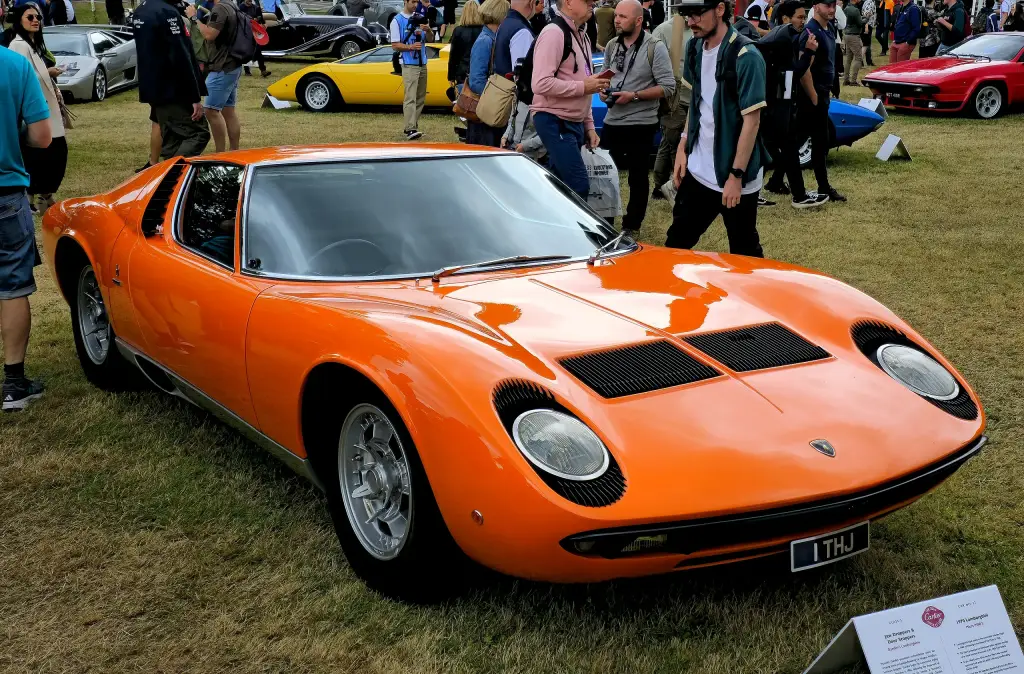
The 1966 Geneva show
Bertone was given the styling job and Gandini, then 27, finished it days before the Geneva show in March 1966. The engine had never been trial-fitted: there was no room in the bay, so the engineers filled it with ballast and kept the bonnet locked throughout the show, just as they had with the 350 GTV three years earlier. The car was still the star of the salon, and production was authorised for the following year. The name came from Don Eduardo Miura, the bull breeder, and the Miura was the first Lamborghini to wear the charging bull badge.
Engineering and versions
The layout was new for Lamborghini: the V12 sat transversely behind the cabin, combined with the gearbox and differential in one casting — an idea borrowed from the Mini — because there was no space for separate units. Suspension was independent all round on double wishbones with anti-roll bars, steering was rack and pinion, and the brakes were unassisted discs. The P400 had 350 PS and 275 were built between 1966 and 1969; the P400 S of 1968 added power windows, chrome trim, larger intake manifolds, different camshafts and 20 PS more, with 338 cars built to 1971. Later SV versions had a separate engine and gearbox casting so each could use the right oil. The Miura became a household image after appearing in the opening sequence of the 1969 film The Italian Job. Production ended in 1973, a year before the Countach took over as the flagship.
Design and features
- Mid-mounted V12: the engine sits behind the seats for weight distribution, a first for a production road car of this class.
- Combined engine and gearbox: one casting for engine, gearbox and differential to save space.
- Gandini styling: a low, curved body quite unlike the angular cars that followed it.
- Speed: the fastest production car in the world when it appeared in 1966.
Lamborghini Miura versions
- P400 (1966–1969): 350 PS, 275 built, steel body with aluminium front and rear sections.
- P400 S (1968–1971): 370 PS, power windows and extra trim; 338 built.
- P400 SV (1971–1973): the later version, whose engine and gearbox castings were finally split so each could use its own oil.
The Miura was succeeded by the Countach and its chassis was stretched to make the Marzal show car; its engine also served in the Espada. More cars are in the Lamborghini collection.
Sources
- Lamborghini Miura, English Wikipedia: development, Geneva debut, production
- Lamborghini Miura, German Wikipedia: technical layout, naming, chassis