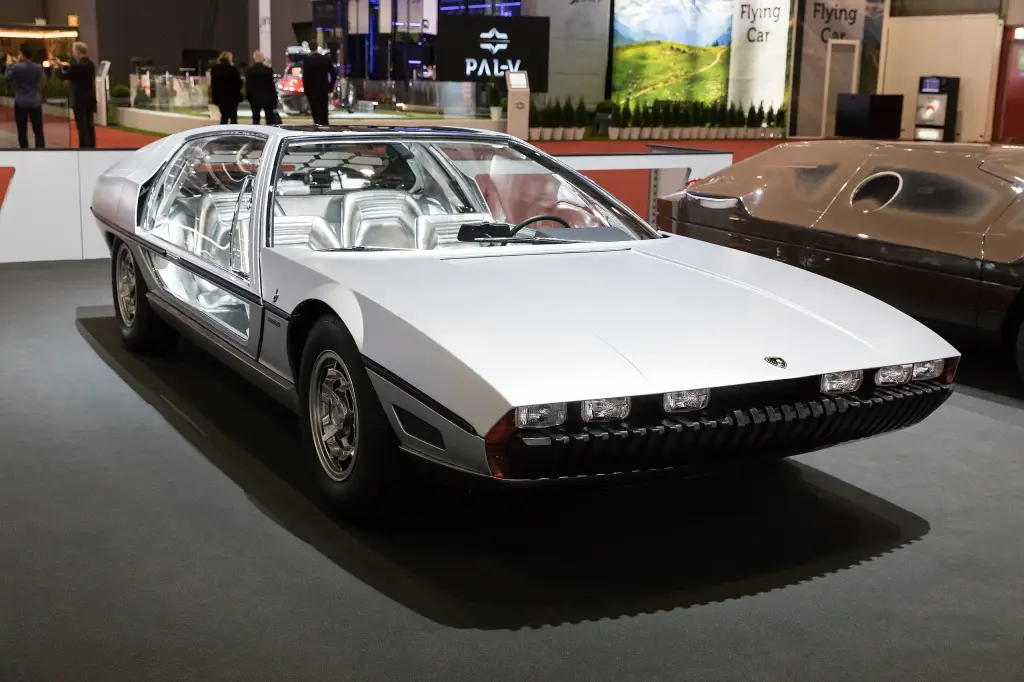
The Lamborghini Marzal is a concept car designed by Marcello Gandini at Bertone and shown at the Geneva motor show in 1967. Silver, low and almost entirely glazed, it was built to give Lamborghini a genuine four-seater — and although only one was made, its ideas shaped the Espada that followed a year later.
Lamborghini Marzal at a glance
| Designed by | Marcello Gandini, Bertone |
|---|---|
| Shown | Geneva Motor Show, 1967 |
| Chassis | Miura platform, extended by 120 mm |
| Wheelbase | 2,620 mm |
| Engine | 2.0-litre inline six, half of the V12 |
| Power | 175 bhp (130 kW) |
| Layout | transverse, behind the rear axle |
| Gearbox | five-speed transaxle from the Miura |
| Glass | 4.5 square metres, with glazed gullwing doors |
| Top speed | about 190 km/h, estimated |
| Weight | 1,220 kg |
The top speed of the Marzal was never tested; the figure in the table is the estimate given on the English page.
History of the Lamborghini Marzal
A four-seater for Lamborghini
By 1967 Lamborghini had the 400 GT 2+2 and the new Miura, but no car with real rear seats. Ferruccio Lamborghini asked Nuccio Bertone for one, and Bertone gave the job to Gandini, who had just drawn the Miura. The Marzal was the result: a four-seat coupé with a sharp wedge nose, gullwing doors that were almost entirely glass, and a hexagonal motif repeated in the louvred rear window, the interior trim and the Campagnolo magnesium wheels. Six narrow Marchal headlamps sat in the thin front edge, and the cabin was trimmed in silver.
Engineering
The chassis came from the Miura, lengthened by 120 mm and stiffened, giving a wheelbase of 2,620 mm. The engine was a 2-litre straight six designed by Giampaolo Dallara — effectively half of the 4-litre V12 — producing a claimed 175 bhp, mounted transversely and entirely behind the rear axle, with three Weber 40 DCOE carburettors breathing through intakes just behind the rear passengers’ heads. The five-speed transaxle came from the Miura with a lower final drive for better acceleration. Suspension, steering and brakes were also Miura parts. Some 4.5 square metres of glass came from Glaverbel, and air conditioning was fitted to cope with the heat that came with it. Journalists noticed that Bertone had loaded the front compartment with weights to level the car’s ride height.
Advertising, not production
Ferruccio Lamborghini was clear that the Marzal was never intended for production. A show car of this kind, he argued, put the company on the front page of every magazine for 100 million lire, far less than the billion lire the same coverage would cost as advertising. The car’s public career began at the 1967 Monaco Grand Prix, where Prince Rainier III drove it on his traditional parade lap with Princess Grace beside him, and continued at Villa d’Este in 2018, when Prince Albert II drove it again. The Marzal spent decades in Bertone’s museum before selling at RM Sotheby’s in May 2011 for €1,512,000. Its shape, lowered and civilised, became the Espada.
Design and features
- Glazed gullwing doors: almost the entire side of the car was glass, in doors that opened upwards.
- Hexagonal theme: repeated in the louvred rear window, the trim and the wheel design.
- Six-cylinder engine: half of the Lamborghini V12, mounted transversely behind the rear axle.
- Four seats: the point of the exercise — a Lamborghini that could carry passengers in the back.
Lamborghini Marzal versions
- Marzal (1967): the only car built, finished in silver and kept by Bertone until 2011.
The Marzal led directly to the Espada and used the chassis of the Miura; the Bravo followed it as another Bertone Lamborghini study. More cars are in the Lamborghini collection.
Sources
- Lamborghini Marzal, English Wikipedia: design, engineering, history, auction
- Lamborghini Marzal, German Wikipedia: presentation, Monaco appearance, auction