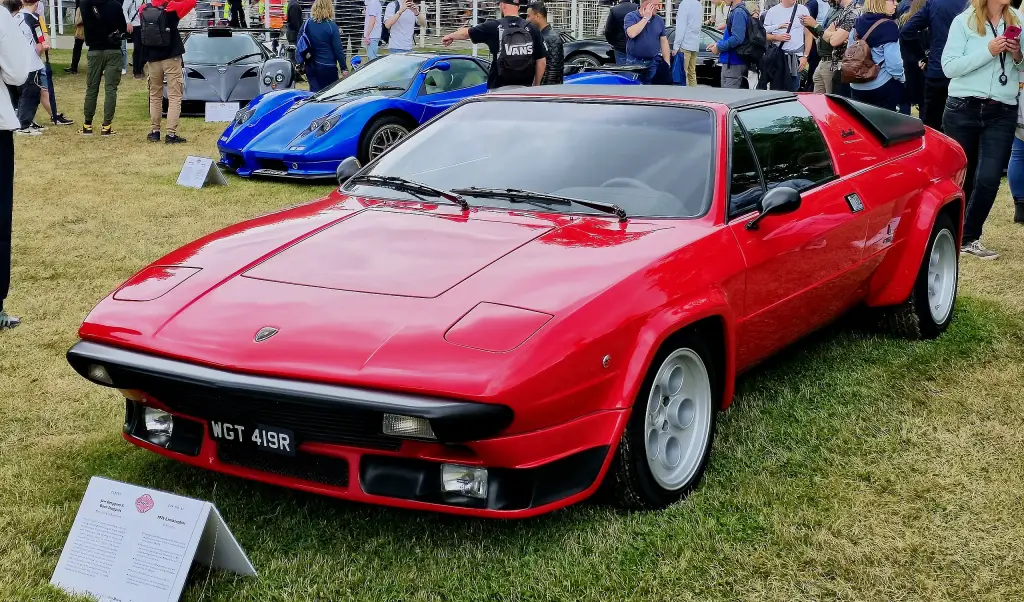
The Lamborghini Silhouette was the company’s first series-produced open car. Shown at Geneva in 1976, it was a targa-roofed two-seater derived from the Urraco, with a sharpened Bertone body and a 3.0-litre V8, and only a few dozen were built before Lamborghini’s finances brought it to an end.
Lamborghini Silhouette at a glance
| Maker | Lamborghini, Sant’Agata Bolognese |
|---|---|
| Production | 1976–1979 |
| Debut | Geneva Motor Show, 1976 |
| Designed by | Marcello Gandini, Bertone |
| Based on | Lamborghini Urraco |
| Engine | 2,996 cc V8, four overhead camshafts |
| Power | 260 PS (191 kW) |
| Gearbox | five-speed manual |
| 0–100 km/h | 6.5 seconds |
| Top speed | 260 km/h |
| Tyres | Pirelli P7, 195/50 front and 285/40 rear |
| Built | about 54, plus two prototypes |
Production figures differ slightly: the English article gives 54 cars, the German 52 plus two prototypes, and the Italian 53 plus two. The table gives an approximate figure.
History of the Lamborghini Silhouette
An open car made cheaply
By the mid-1970s Lamborghini was in serious financial trouble and could not afford a new model. The Urraco had been expensive to develop and had sold badly, so the only realistic route was to build a different car out of existing parts. The Silhouette, internally P118, used the Urraco platform and its 3.0-litre V8, with the roof removed and the chassis stiffened to compensate. It was developed during 1975 under new chief engineer Franco Baraldini and shown at Geneva in March 1976. The name broke with Lamborghini tradition: it did not come from bullfighting but from the FIA Silhouette championship for production sports cars, run between 1976 and 1980.
A sharper body
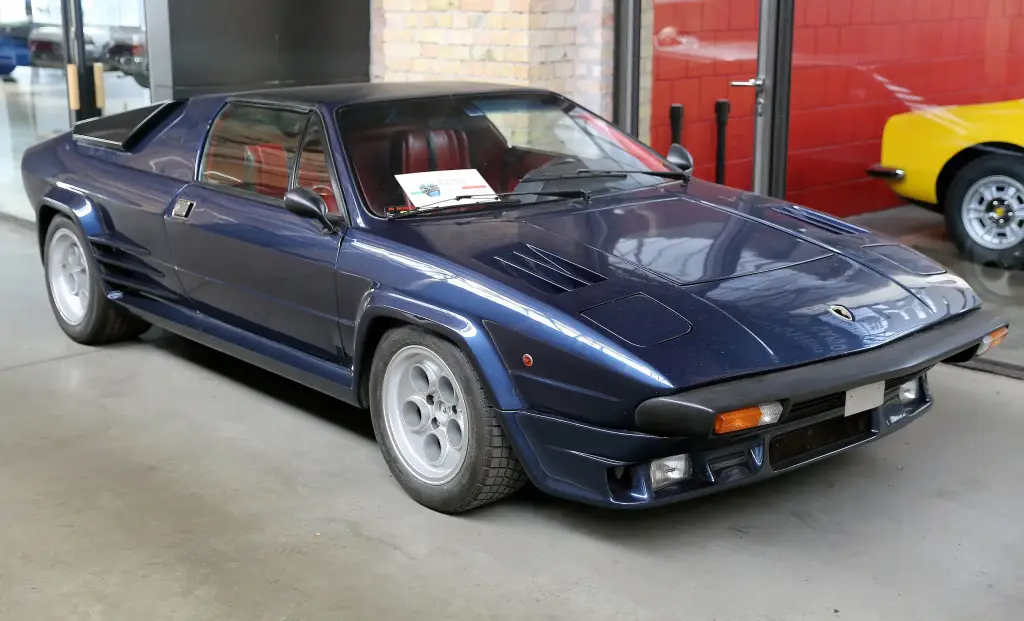
Marcello Gandini at Bertone kept the Urraco’s front, doors and rear but gave the Silhouette its own identity: a solid trapezoidal roll hoop behind the seats, black plastic additions flanking the sloping rear deck to feed cooling air to the engine, a near-vertical rear screen replacing the Urraco’s louvres, and flared trapezoidal wheel arches that echoed the shape of the roll hoop. The car ran on wide Pirelli P7 tyres, 195/50 at the front and 285/40 at the rear, on five-stud Campagnolo magnesium wheels. The removable plastic roof panel stored behind the seats. Inside, a completely new instrument carrier put every gauge in one housing behind the wheel, a layout generally thought far better than the Urraco’s. The suspension was stiffened, with firmer springs and dampers and stronger anti-roll bars, and the engine was raised to 260 PS.
Why so few were built
Lamborghini hoped the Silhouette would sell in America, where open sports cars like the Porsche 911 Targa and Ferrari 308 GTS were popular. It never obtained US homologation, however, and only four cars were built in US specification for owners who imported them privately, with detuned engines. Production lasted two years: the first car was completed in September 1976 and the last delivered in November 1978, when the Silhouette, Urraco and Jarama were all stopped for financial reasons. Roughly 52 cars were built for sale, nine of them right-hand drive, plus two prototypes that stayed at the factory. Poor build quality and uncertainty about the company’s future kept buyers away. The Silhouette was replaced by the Jalpa in 1981.
Design and features
- Targa roof: a removable panel stored behind the seats, the first series-built open Lamborghini.
- Sharper body: a roll hoop, black rear air intakes and flared arches over wide Pirelli P7 tyres.
- Better cabin: a new instrument binnacle grouping every gauge behind the steering wheel.
- Urraco V8: the 3.0-litre engine raised to 260 PS, mounted transversely behind the cabin.
Lamborghini Silhouette versions
- Silhouette (1976–1979): the standard targa, about 54 cars built.
- US-specification cars: four cars with detuned engines, imported privately.
- Prototypes: two cars of 1976 that remained with the factory.
The Silhouette was derived from the Urraco and was replaced by the Jalpa; its styling was anticipated by the Bravo concept, which used similar wheels. More cars are in the Lamborghini collection.
Sources
- Lamborghini Silhouette, English Wikipedia: production, performance, origin
- Lamborghini Silhouette, German Wikipedia: body, suspension, production history
- Lamborghini Silhouette, Italian Wikipedia: context, styling, engine