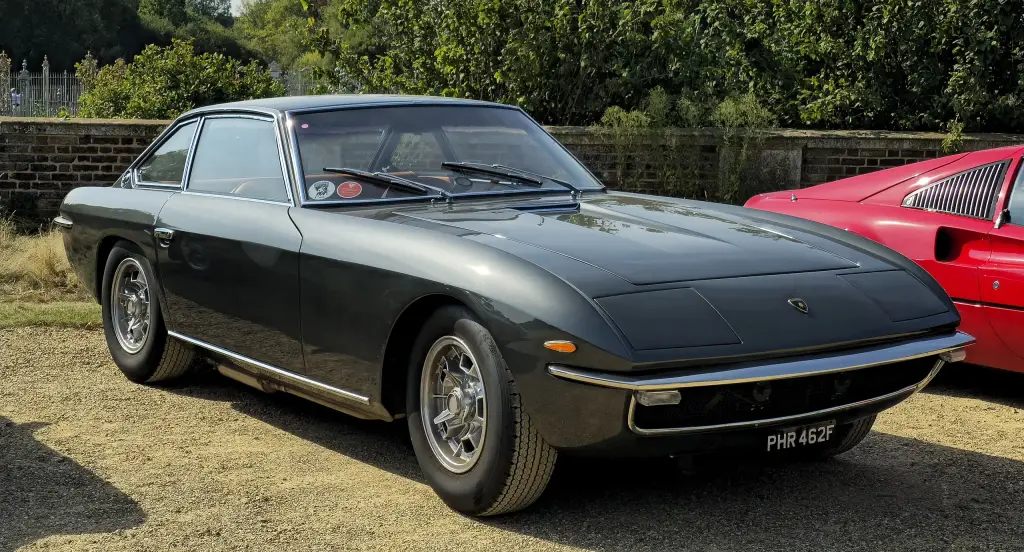
The Lamborghini Islero was the sober member of the 1968 range. Introduced at Geneva alongside the futuristic Espada, it replaced the 400 GT with a more angular but equally restrained 2+2 body built by Carrozzeria Marazzi, and it lasted only two years, until the Jarama took over.
Lamborghini Islero at a glance
| Maker | Lamborghini, Sant’Agata Bolognese |
|---|---|
| Production | 1968–1969 |
| Debut | Geneva Motor Show, 1968 |
| Body | 2+2 coupé by Carrozzeria Marazzi |
| Engine | 3,929 cc V12, six Weber 40 DCOE carburettors |
| Power | 325 bhp, 350 bhp in the Islero S |
| Gearbox | five-speed manual with synchromesh |
| Top speed | 248 km/h, 259 km/h in the S |
| 0–60 mph | 6.4 seconds |
| Tyres | Pirelli Cinturato 205VR15 |
| Built | 225, of which about 100 Islero S |
The English article gives 125 Isleros and 100 Islero S cars; the German page gives 225 in total but 70 of the S version. The production split therefore differs between sources, while the total agrees.
History of the Lamborghini Islero
A conservative replacement
By early 1968 the 400 GT was at the end of its life and Lamborghini needed a successor. The Miura had shown that the company could build an extreme car, so the new 2+2 could concentrate on elegance and comfort rather than outright speed. The Islero was presented at Geneva in March 1968 together with the Espada: two 2+2 coupés for the same buyers, one radical, one traditional. Where the Espada had a low fastback with a vast glass area, the Islero kept the three-box shape of the 400 GT, with a taller cabin, better visibility, more interior space and extra soundproofing. Some accounts claim Ferruccio Lamborghini dictated the design himself to the coachbuilder.
Marazzi instead of Touring
The body was built by Carrozzeria Marazzi, a firm founded by Carlo Marazzi, formerly of Touring, after Touring went bankrupt; its staff and the owner’s sons Mario and Serafino had all worked at Touring, which had built the 350 GT and 400 GT. Test driver Bob Wallace later said the quality problems that plagued the Islero — poor fit and finish in the body and interior — came from Marazzi’s lack of resources compared with Touring.
Islero S and the end
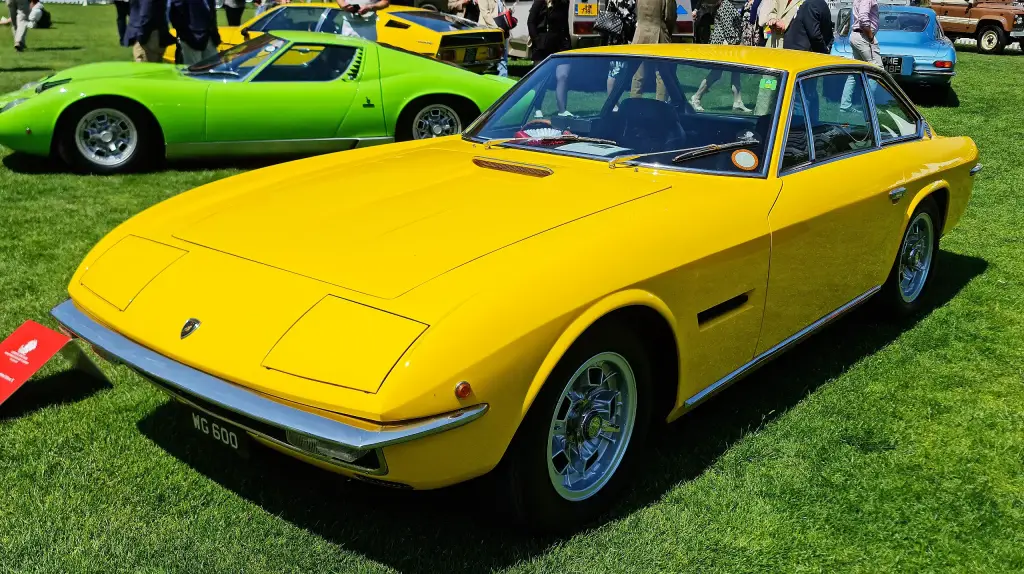
The Islero S, also called the GTS, arrived in 1969 with six cooling vents in each front wing, a larger bonnet scoop feeding the cabin rather than the engine, flared arches, tinted glass and fixed quarter lights. Power rose to 350 bhp thanks to Miura P400S camshafts and a compression ratio lifted from 9.5:1 to 10.8:1, larger brake discs went on and the rear suspension was revised towards the Espada’s layout. The car was never meant for racing, but in 1975 two French enthusiasts entered a modified Islero for Le Mans; it crashed in qualifying and the team went home. The Jarama replaced the Islero in 1970. Ferruccio Lamborghini and his brother Edmondo both drove one, and the car appears in the Roger Moore film The Man Who Haunted Himself.
Design and features
- Comfort first: more headroom, better visibility and extra sound insulation than the 400 GT.
- Conservative style: a three-box 2+2 body, deliberately less radical than the Espada shown beside it.
- Proven V12: the 3.9-litre engine of the 400 GT, with six twin-choke Weber carburettors.
- Marazzi bodywork: built by former Touring staff, quick to produce but weaker on finish.
Lamborghini Islero versions
- Islero (1968–1969): 325 bhp, the original car.
- Islero S / GTS (1969): 350 bhp, wing vents, flared arches, larger brakes, revised rear suspension.
The Islero replaced the 400 GT and was replaced by the Jarama; it shared its engine with the Espada. More cars are in the Lamborghini collection.
Sources
- Lamborghini Islero, English Wikipedia: history, Marazzi, Islero S, racing
- Lamborghini Islero, German Wikipedia: production figures, position in the range
- Lamborghini Islero, Italian Wikipedia: context and naming