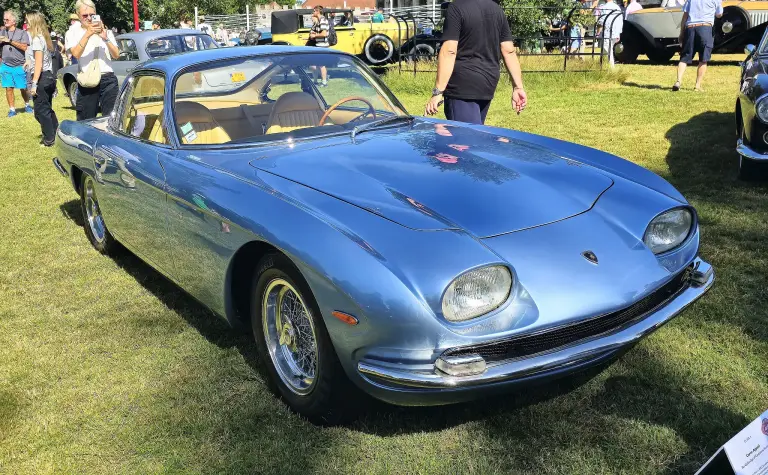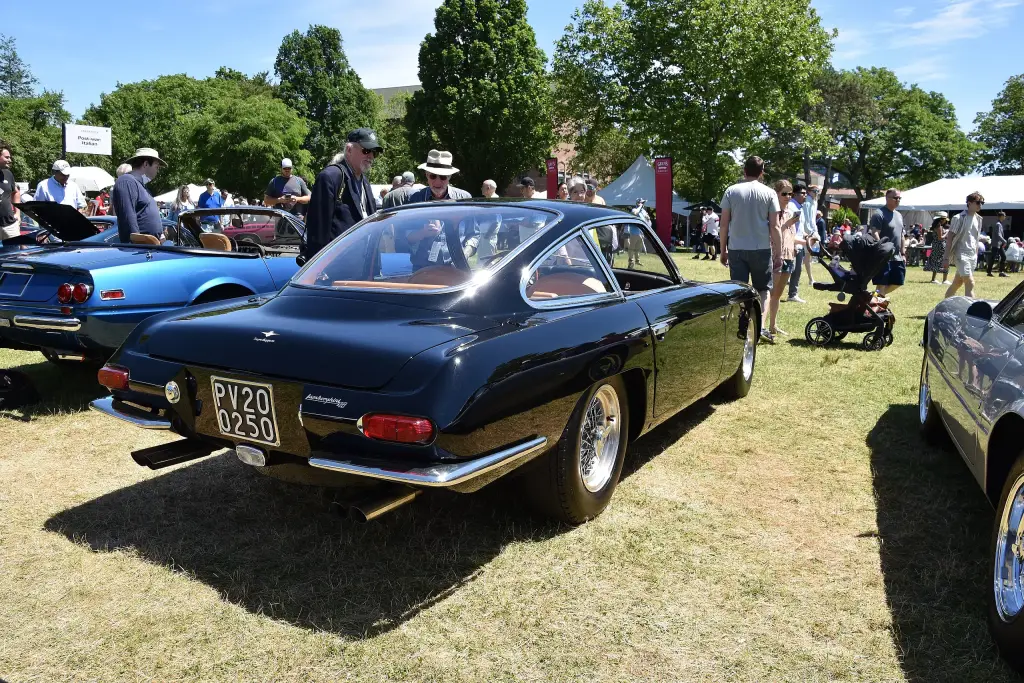
The Lamborghini 400 GT was the 350 GT with a bigger engine — and, in its 2+2 form, with a body that finally offered two usable rear seats. Presented at Geneva in 1966, it stayed in production until 1968 and was the last Lamborghini designed around the front-mounted V12 grand-touring layout.
Lamborghini 400 GT at a glance
| Maker | Lamborghini, Sant’Agata Bolognese |
|---|---|
| Production | 1965–1968 |
| Debut | Geneva Motor Show, March 1966 |
| Body | two-door coupé by Touring, steel on the 2+2 |
| Engine | 3,929 cc V12, four overhead camshafts |
| Power | 320 hp (235 kW) |
| Gearbox | five-speed manual with Porsche-type synchromesh |
| Top speed | 260 km/h |
| Wheelbase | 2,550 mm |
| Tyres | Pirelli Cinturato 205VR15 |
| Built | 23 Interim and 224 2+2 |
The German page gives a total of 273 cars for the model; the English and Italian pages split that figure into 23 ‘Interim’ cars and about 224–250 of the 2+2, which agree on the total.
History of the Lamborghini 400 GT
Interim and 2+2
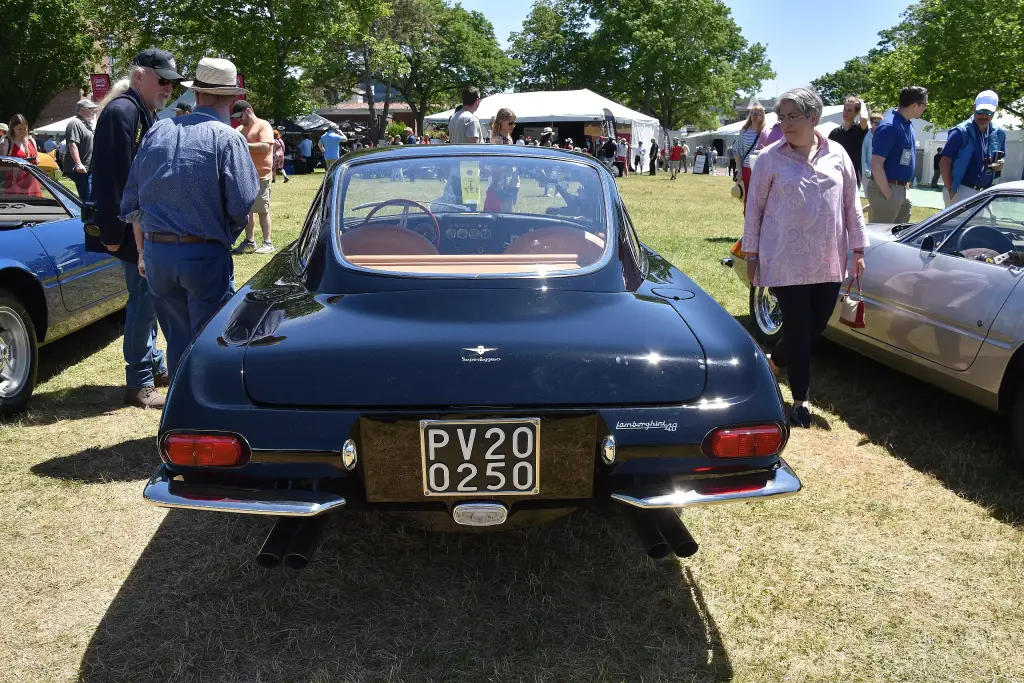
Two cars carried the 400 GT name. The first, usually called the 400 GT or 400 GT Interim, was a 350 GT with the V12 enlarged to 3,929 cc and 320 hp; 23 were built, three of them with aluminium bodies. The second, the 400 GT 2+2, appeared at the Geneva show in 1966 with a completely different upper body: the roofline was raised, the side windows grew, the rear screen shrank, the beltline rose by 66 mm and the floorpan sat slightly lower. The larger cabin made room for two occasional rear seats where the 350 GT had only a luggage shelf or a rarely ordered third seat.
Built by Touring, finished by Marazzi
The bodywork was again by Carrozzeria Touring, which built the first cars before going bankrupt in 1967; Marazzi completed the remaining examples. Mechanically the 400 GT kept the 350 GT’s five-speed gearbox layout but gained a Lamborghini-designed unit with Porsche-style synchromesh on every gear, a change that transformed the drivetrain. Suspension, disc brakes and the 2,550 mm wheelbase were unchanged.
The one-off Monza
In 1966 the Modenese coachbuilders Neri and Bonacini built a single two-seater on a 350 GT chassis (number 01030) with the 400 GT engine. The 400 GT Monza was probably ordered by an American customer for Le Mans, but homologation problems stopped it from racing and the buyer never took delivery. It was shown at Barcelona in 1967, bought by a Spanish collector and stayed in his family; in 2005 it sold at Bonhams in London for £177,500.
Design and features
- Bigger V12: 3,929 cc and 320 hp, a useful step up from the 350 GT’s 270 hp.
- Real 2+2 seating: a taller roof and a longer cabin gave the model two occasional rear seats.
- Better gearbox: Porsche-type synchromesh on all gears made the five-speed far easier to use.
- Two bodies: the light aluminium Interim cars and the steel-bodied 2+2 for everyday buyers.
Lamborghini 400 GT versions
- 400 GT Interim (1965–1966): 350 GT bodywork with the enlarged engine; 23 built, three in aluminium.
- 400 GT 2+2 (1966–1968): the steel-bodied four-seater, 224 built; the only version most buyers chose.
- 400 GT Monza (1966): a one-off fastback by Neri and Bonacini with a Kamm tail, never raced.
- 400 GT Flying Star II (1966): a Touring shooting-brake concept on the 2+2 chassis, shown at Turin.
- 400 GTS (1966): one of Touring’s last designs, effectively a 350 GTS with the 4.0-litre engine.
The 400 GT followed the 350 GT and was replaced by the Islero; its cabin layout carried over to the four-seat Espada. More cars are in the Lamborghini collection.
Video: 1967 Lamborghini 400 GT 2+2
Video by Jay Leno’s Garage on YouTube.
Sources
- Lamborghini 400 GT, English Wikipedia: versions, 2+2 body changes, Monza
- Lamborghini 400 GT, German Wikipedia: production total, technical details, specials
- Lamborghini 350/400 GT, Italian Wikipedia: 400 GT changes, production split