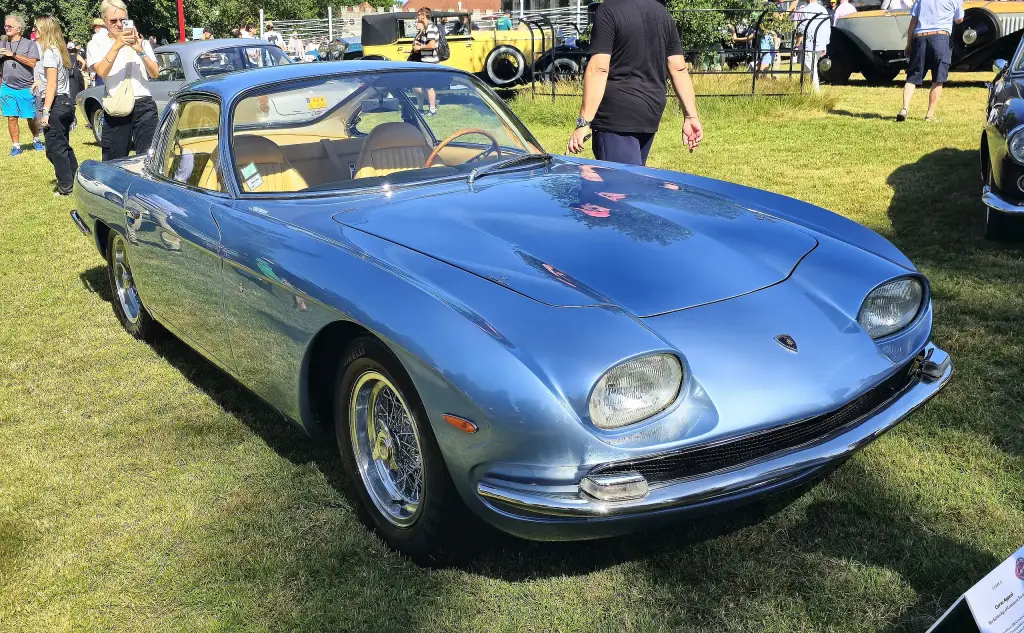
The Lamborghini 350 GT was the first production car built by Ferruccio Lamborghini’s young factory in Sant’Agata Bolognese. A two-seat grand tourer with an aluminium body by Carrozzeria Touring and a road-tuned version of the Bizzarrini V12, it went on sale in 1964 and proved that the tractor maker could take on Ferrari.
Lamborghini 350 GT at a glance
| Maker | Lamborghini, Sant’Agata Bolognese |
|---|---|
| Production | 1964–1966 |
| Debut | Geneva Motor Show, March 1964 |
| Body | two-door coupé by Carrozzeria Touring, Superleggera method |
| Engine | 3,464 cc V12, four overhead camshafts |
| Power | 270 hp (199 kW) at 7,000 rpm |
| Gearbox | five-speed ZF manual |
| Top speed | about 250 km/h |
| Brakes | Girling discs on all four wheels |
| Suspension | independent, double wishbones all round |
| Wheelbase | 2,550 mm |
| Built | about 120 |
Production totals differ slightly between sources: the English and German articles give 120 cars, the Italian page 135. The figure in the table follows the first two.
History of the Lamborghini 350 GT
From the 350 GTV prototype
The story starts with Giotto Bizzarrini’s racing V12, tested in May 1963. Bizzarrini then left the company, and Ferruccio Lamborghini handed the project to Gian Paolo Dallara, Paolo Stanzani and test driver Bob Wallace. They quickly concluded that the 350 GTV show car, first displayed at Turin in the autumn of 1963 without an engine, was not fit for series production. Dallara and Wallace de-tuned the engine for the road: a wet sump replaced the dry-sump racing system, the compression ratio came down from 11.0:1 to 9.4:1, the expensive racing Weber carburettors gave way to side-draft 40 DCOE units, and the camshafts were softened. The result was 270 hp instead of the prototype’s 400 hp, but an engine that could run long distances between services.
Into production
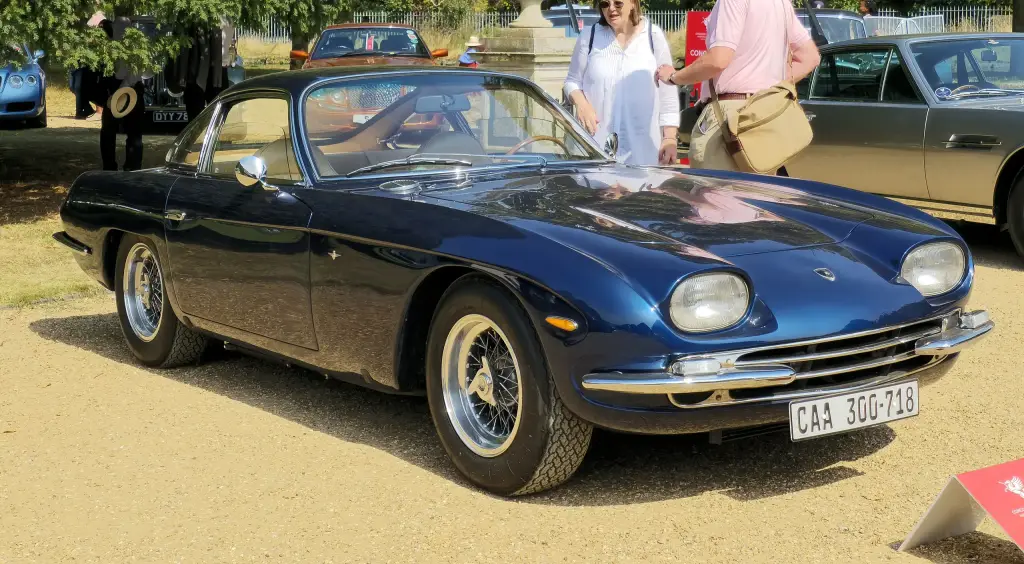
Touring of Milan restyled the body, replacing the pop-up headlights with fixed lamps while keeping the profile Scaglione had drawn. The chassis was built first by Neri and Bonacini in Modena and later by Marchesi; Touring fixed aluminium panels to a tubular frame using its patented Superleggera method and delivered complete cars, bumpers included, to Sant’Agata. The 350 GT made its debut at the Geneva Motor Show in March 1964 and production began that May. Deliveries were slow at first: fewer than 25 cars reached customers in 1964, against an original plan of ten a week.
Legacy
The 350 GT was replaced by the 400 GT in 1966, having secured the survival of a company that was barely a year old. Many 350 GTs were later fitted with the larger 4.0-litre engine for its extra power and easier parts supply — a swap that makes original 3.5-litre cars rarer today than the production figure suggests.
Design and features
- Road-going V12: the Bizzarrini racing engine calmed with a wet sump, softer cams and Weber 40 DCOE carburettors.
- Superleggera body: aluminium panels over a tubular frame, built by Touring of Milan.
- Independent suspension all round: double wishbones front and rear at a time when most rivals still used a live axle.
- Comfortable cabin: leather trim and a wooden steering wheel, in the grand-touring spirit Ferruccio preferred.
Lamborghini 350 GT versions
- 350 GT (1964–1966): the standard coupé with the 3.5-litre engine.
- 350 GTV (1963): the Turin show prototype by Scaglione, with pop-up headlights and no engine at its debut.
- 3500 GTZ (1965): two Zagato-bodied coupés on a shortened chassis; Ferruccio disliked the design and refused series production.
- 350 GTS (1965): two Touring convertibles, shown in Paris; the convertible only reached production with the Silhouette in 1976.
The 350 GT was replaced by the 400 GT and its engine lived on in the Miura and the Espada. More cars are in the Lamborghini collection.
Sources
- Lamborghini 350 GT, English Wikipedia: development, engine changes, production
- Lamborghini 350 GT, German Wikipedia: specifications, GTZ and GTS versions
- Lamborghini 350/400 GT, Italian Wikipedia: context, Touring body, production