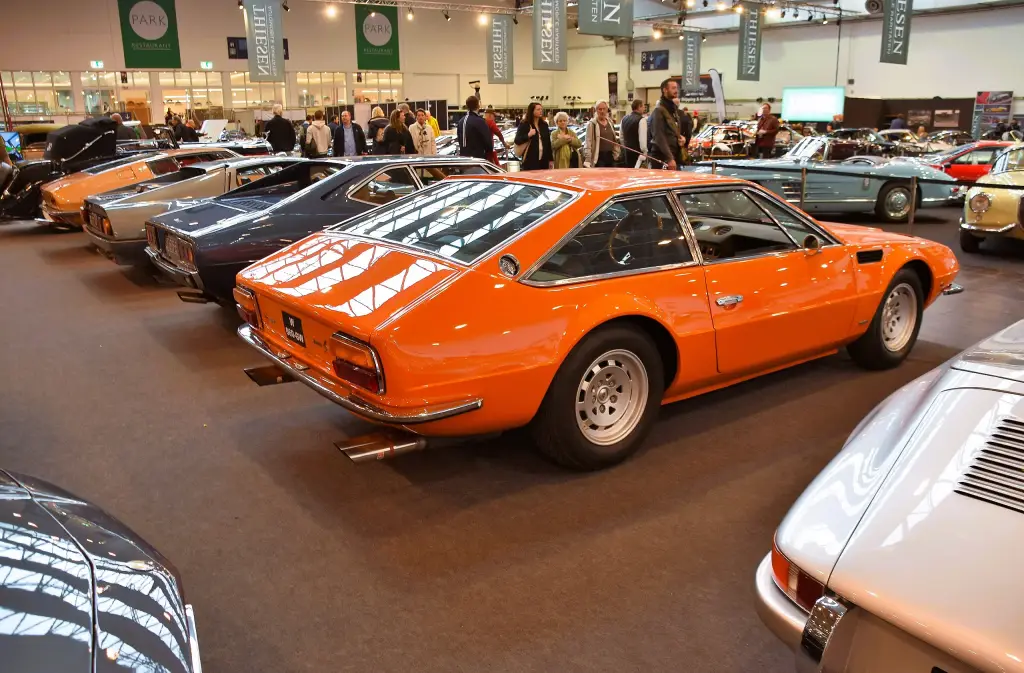
The Lamborghini Jarama was the last front-engined Lamborghini sports car before the Urus of 2018, and the model its founder liked best. Sold from 1970 to 1976 as a 2+2 coupé with the 4-litre V12, it replaced the Islero and shared its chassis with the Espada.
Lamborghini Jarama at a glance
| Maker | Lamborghini, Sant’Agata Bolognese |
|---|---|
| Production | 1970–1976 |
| Debut | Geneva Motor Show, 1970 |
| Designed by | Marcello Gandini, Bertone |
| Chassis | Espada platform, wheelbase shortened by 270 mm |
| Engine | 3,929 cc V12, six Weber 40 DCOE carburettors |
| Power | 350 bhp, 365 bhp in the Jarama S |
| Gearbox | five-speed manual; three-speed automatic from 1974 |
| Weight | 1,450 kg dry |
| Built | 328, including 150 of the S |
Ferruccio Lamborghini’s comparison of the Jarama with the Miura and the Espada comes from his 1991 interview quoted on the English page.
History of the Lamborghini Jarama
An American problem
Lamborghini had built the Islero in 1968 largely to satisfy the American market, and when the time came to replace it the company chose not to restyle the old car but to build a new one on the Espada’s platform, shortened by 10.7 inches (270 mm) so that the result was a 2+2 rather than a four-seater. The Jarama was introduced at Geneva in 1970, engineered for US standards and styled by Marcello Gandini, whose work here shows a clear family resemblance to the Iso Lele he also drew. The name refers to the Jarama river area north of Madrid, famous for breeding fighting bulls, not to the racing circuit.
The car
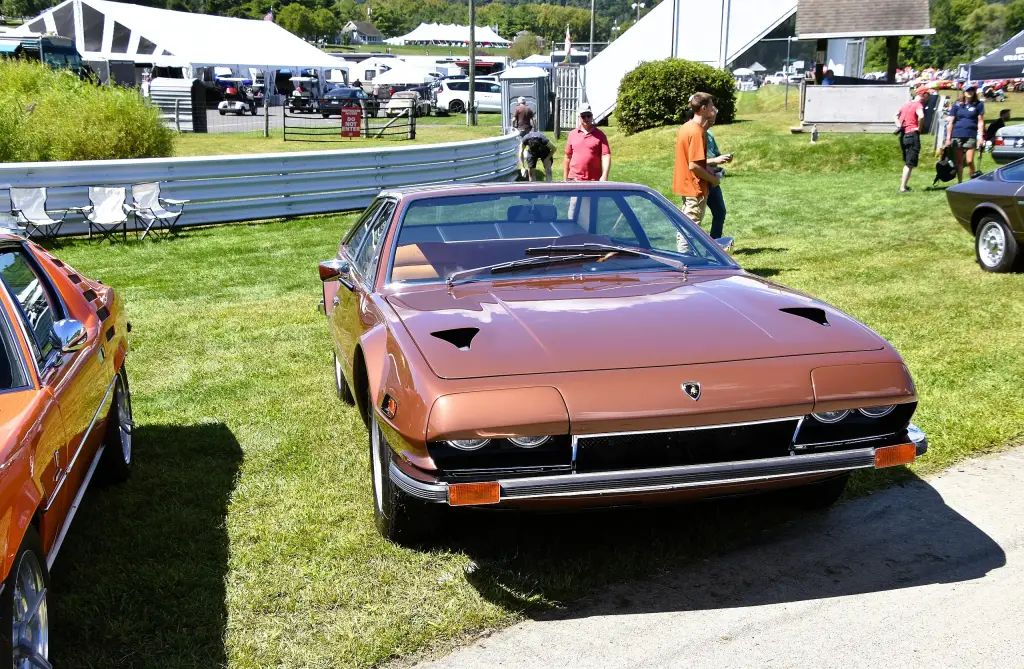
Unlike the tubular-framed Islero, the Jarama used a steel platform frame taken from the Espada, with independent suspension all round on double wishbones, coil springs, anti-roll bars and Koni dampers. The 3,929 cc V12 sat at the front, drove the rear wheels through a five-speed manual gearbox and produced 350 bhp in the original car. Early examples had centre-lock magnesium wheels of the Miura pattern. The Jarama was heavier than the Islero at 1,450 kg dry, and it offered a more comfortable, better-finished cabin, although it never attracted the attention of the Miura or the Countach.
Jarama S and the rally car
The Jarama S, also called the GTS, appeared in 1972 with revised exhaust, cylinder heads and carburettors lifting output to 365 bhp. It gained a bonnet scoop, wing vents, repositioned turn signals, five-bolt wheels from the Espada S3, an aluminium-trimmed dashboard and better insulation, with power steering standard early in production; 150 were built. Removable roof panels and a Chrysler TorqueFlite automatic were offered but rarely ordered — only a handful of cars are known with each. Test driver Bob Wallace also built a one-off Jarama Rally with the engine moved back for near 50/50 weight distribution, a 380 hp engine, an aluminium body some 300 kg lighter and a roll cage; it never raced. Ferruccio Lamborghini kept a Jarama S, now in the company museum, and called it the perfect compromise between the Miura and the Espada.
Design and features
- Shortened Espada chassis: a 2.4-metre wheelbase and a platform frame rather than the Islero’s tubes.
- Front-mounted V12: the proven 3.9-litre engine, driving the rear wheels through a five-speed gearbox.
- Comfort: a roomy 2+2 cabin with better trim and sound insulation than earlier Lamborghinis.
- Quiet character: a discreet GT in a range of extrovert cars, which is why it sold slowly.
Lamborghini Jarama versions
- Jarama 400 GT (1970–1973): 350 bhp, centre-lock magnesium wheels.
- Jarama S / GTS (1972–1976): 365 bhp, bonnet scoop, wing vents, five-bolt wheels; 150 built.
- Jarama Rally (1973): Bob Wallace’s one-off competition car, never raced.
The Jarama replaced the Islero and used the chassis of the Espada; its V12 also powered the Miura. More cars are in the Lamborghini collection.
Sources
- Lamborghini Jarama, English Wikipedia: history, versions, rally car
- Lamborghini Jarama, German Wikipedia: chassis, engine, position in the range