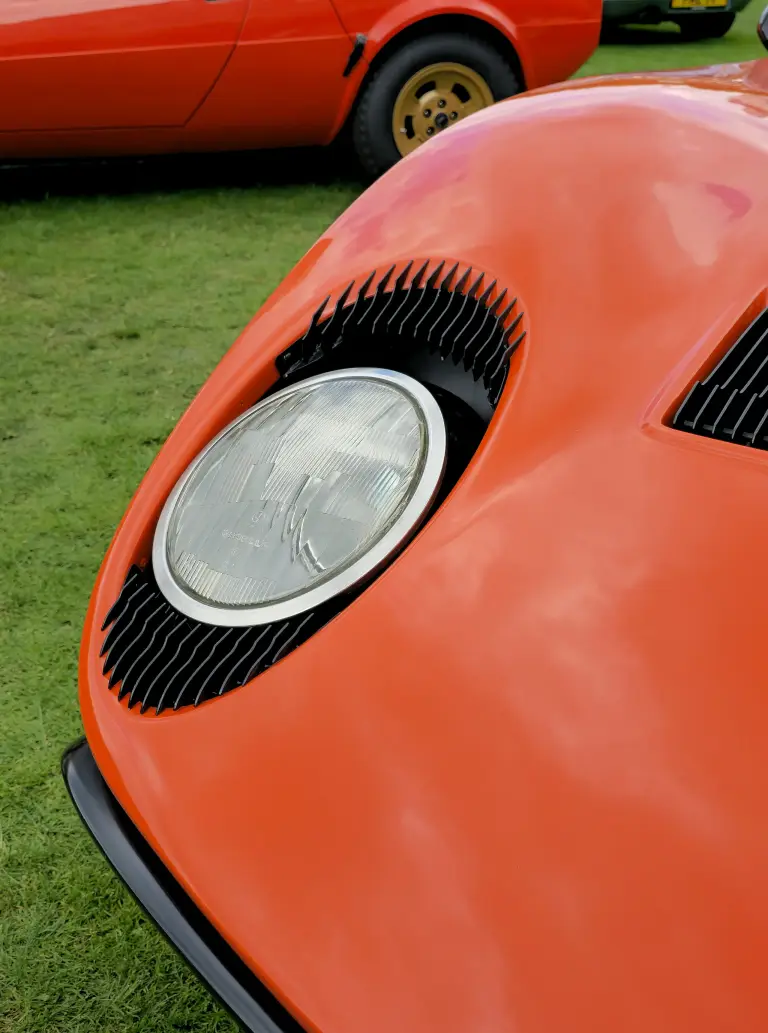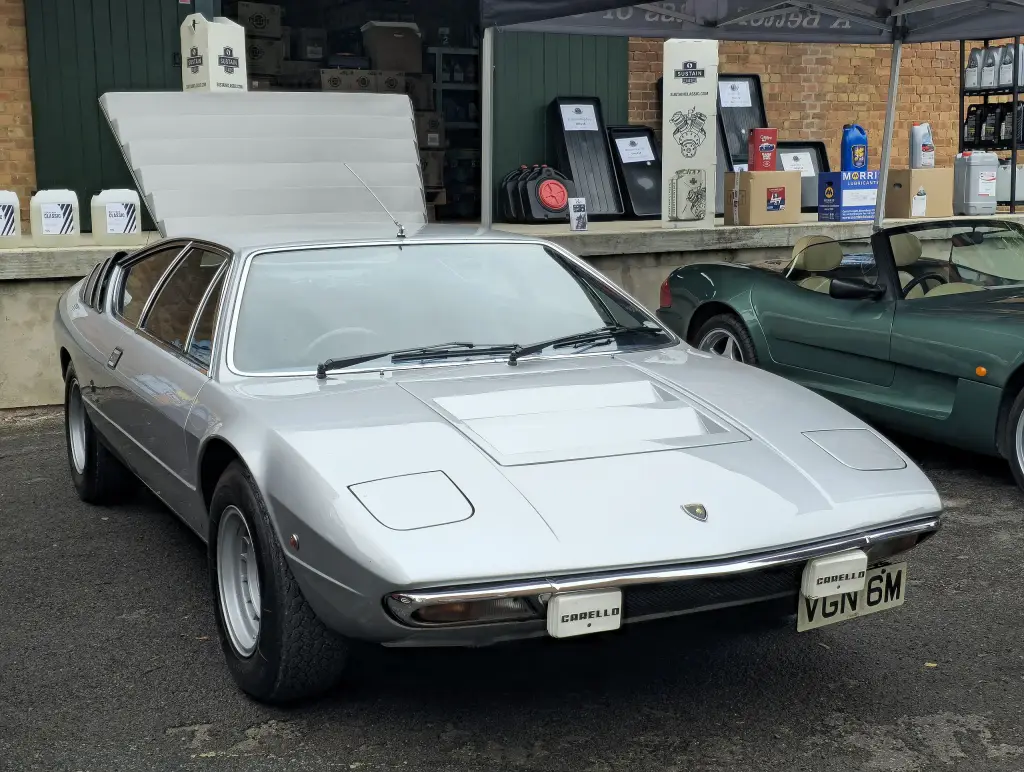
The Lamborghini Urraco was the company’s attempt to build a smaller, cheaper car below the Miura. A 2+2 coupé with a V8 mounted behind the cabin, it was shown as a prototype at Turin in 1970 and sold from 1972 to 1979. It was technically ambitious, often troublesome, and 791 were built.
Lamborghini Urraco at a glance
| Maker | Lamborghini, Sant’Agata Bolognese |
|---|---|
| Shown | Turin Motor Show, 1970 (prototype) |
| Sold | 1972–1979 |
| Designed by | Marcello Gandini, Bertone |
| Chassis | steel monocoque |
| Engine | V8 at 90 degrees, mounted transversely behind the cabin |
| Versions | P200 2.0 litres, P250 2.5 litres, P300 3.0 litres |
| Power | 182 PS (P200), 220 PS (P250), 265 PS (P300) |
| Gearbox | five-speed manual |
| Built | 791 in total |
Output figures follow the German article; the English page describes the same engines in terms of capacity and camshaft layout rather than giving numbers for each version.
History of the Lamborghini Urraco
A car for the middle market
Rather than another range-topping supercar like the Miura, the Urraco was meant to be affordable and to take on the Ferrari Dino, the Maserati Merak and the Porsche 911. It was designed by Marcello Gandini at Bertone and engineered mainly by Paolo Stanzani, and it introduced a new engine to the range: instead of twelve cylinders, a V8 of 90 degrees, with an aluminium block and heads, mounted transversely ahead of the rear axle as in the Miura. The first prototype appeared at Turin in 1970, but two more years passed before production began with the P250.
Three engines
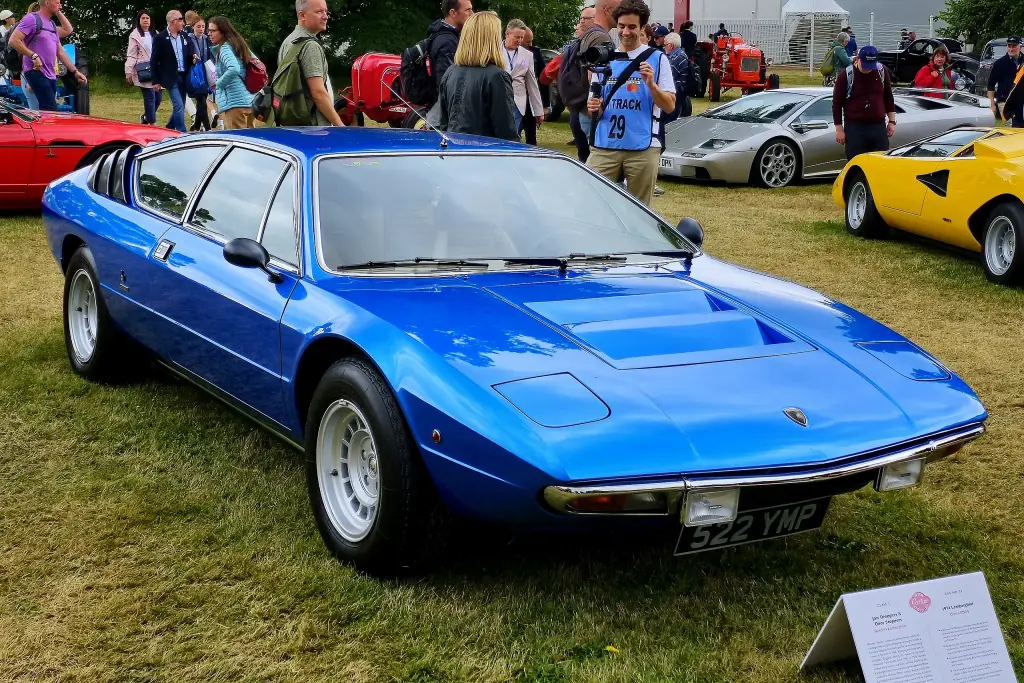
The range grew around Italy’s tax rules as much as around customer demand. The P250 of 1972 had a 2.5-litre engine with a single overhead camshaft per bank and toothed-belt drive, producing 220 PS; the P250 S of 1973 added full leather, tinted electric windows and optional metallic paint. In 1974 came the P300, with a longer stroke taking capacity to 3 litres, chain-driven double overhead camshafts, a revised cylinder head and 265 PS. At the same show Lamborghini presented the P200, a short-stroke two-litre version made for Italy, where cars over two litres carried 38 per cent VAT instead of 17 per cent; it produced 182 PS.
Sales and legacy
For the American market 21 of the P250 cars were built as the P111, with larger front bumpers and emission controls that cost power. Only about ten per cent of Urracos were right-hand drive. The car was praised for its looks — many consider it the best-proportioned mid-engined 2+2 of its era — and criticised for its ergonomics, with the speedometer and tachometer placed either side of the wheel where the driver’s hands hid them, while minor gauges sat directly in front. Production ended in 1979 after 791 cars: 77 P200, 520 P250 and 190 P300. Its platform and V8 went on to serve in the Silhouette and, with a larger engine, the Jalpa.
Design and features
- V8 engine: Lamborghini’s first eight-cylinder, at 90 degrees with aluminium block and heads.
- Mid-engine 2+2: the engine sat transversely behind the cabin, leaving room for two occasional rear seats.
- Gandini styling: a heavily glazed body with vents over the rear axle and louvres above the rear screen.
- Steel monocoque: the same construction principle as the Espada and Jarama, rather than a tubular frame.
Lamborghini Urraco versions
- Urraco P250 (1972–1976): 2.5-litre V8 with 220 PS; the most numerous version.
- Urraco P250 S (1973): leather trim, tinted electric windows and optional metallic paint.
- Urraco P111: 21 US-market P250 cars with emission controls and larger bumpers.
- Urraco P300 (1974–1979): 3.0-litre chain-driven four-cam engine with 265 PS.
- Urraco P200 (1974–1979): two-litre version for the Italian market with 182 PS.
The Urraco was replaced in spirit by the Silhouette and then the Jalpa; the Bravo concept was drawn as its possible successor. More cars are in the Lamborghini collection.
Sources
- Lamborghini Urraco, English Wikipedia: history, versions, production totals
- Lamborghini Urraco, German Wikipedia: engines, power outputs, body and interior
- Lamborghini Urraco, Italian Wikipedia: market context and versions