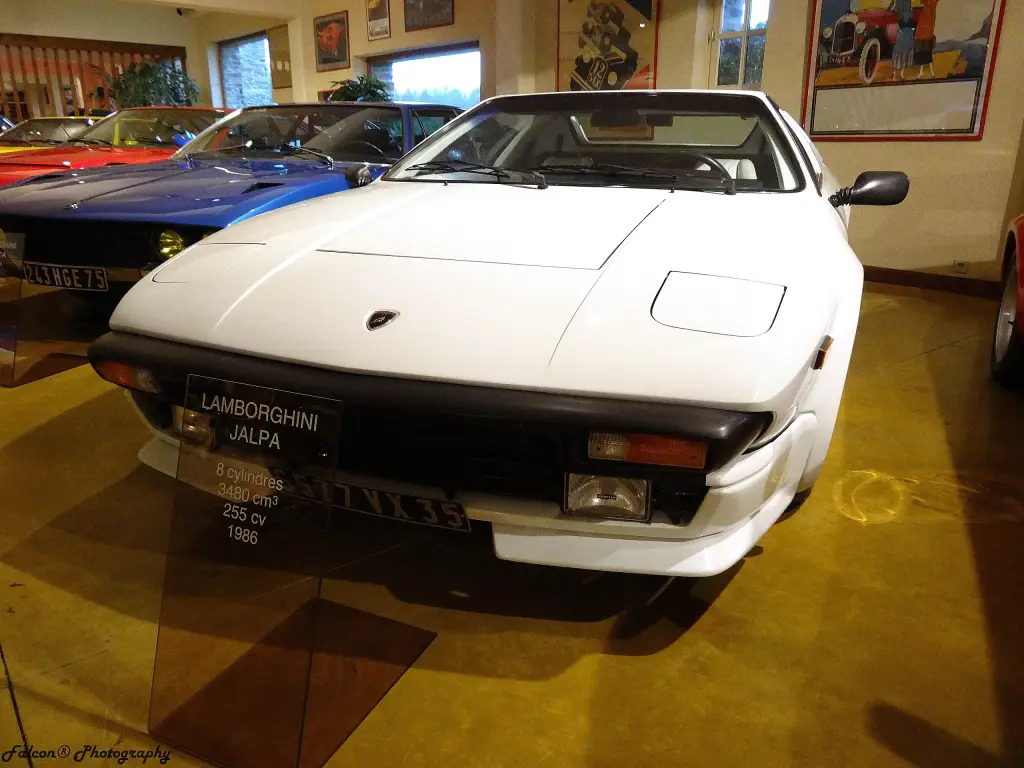
The Lamborghini Jalpa was the company’s cheaper model of the 1980s: a targa-roofed coupé with a 3.5-litre V8, easier to live with than the Countach and far less expensive. Built from 1981 to 1988, it was the last Lamborghini to use a V8 until the Urus arrived in 2018.
Lamborghini Jalpa at a glance
| Maker | Lamborghini, Sant’Agata Bolognese |
|---|---|
| Production | 1981–1988 |
| Debut | Geneva Motor Show, 1981 |
| Based on | Lamborghini Silhouette |
| Engine | 3,485 cc V8, four Weber 42 DCNF carburettors |
| Power | 255 PS (188 kW) |
| Torque | 305–319 N·m |
| Gearbox | five-speed manual |
| Top speed | 249 km/h |
| 0–100 km/h | 6.0 seconds claimed |
| Weight | about 1,500 kg |
| Built | 410 |
Published acceleration figures vary: Lamborghini claimed 6.0 seconds, the German article 5.8, and road tests rarely beat seven seconds. The table quotes the factory claim.
History of the Lamborghini Jalpa
Why it existed
The Urraco, launched in 1970 as Lamborghini’s small car, was meant to sell a thousand a year; in seven years only 674 were built. Its targa derivative, the Silhouette of 1976, did even worse with 52 cars before production ended with the company’s insolvency in 1979. When new investors led by Patrick Mimran took over in 1980, they needed a model below the Countach to keep the factory occupied, but there was no money for a clean-sheet design. The answer was to develop the Silhouette: the Jalpa used the same body shell, with only cosmetic changes by Marc Deschamps, Gandini’s successor at Bertone, and a reworked V8. Development was led by Giulio Alfieri, formerly technical director at Maserati, and the result has been described as the car the Urraco should have been from the start.
Engine and body
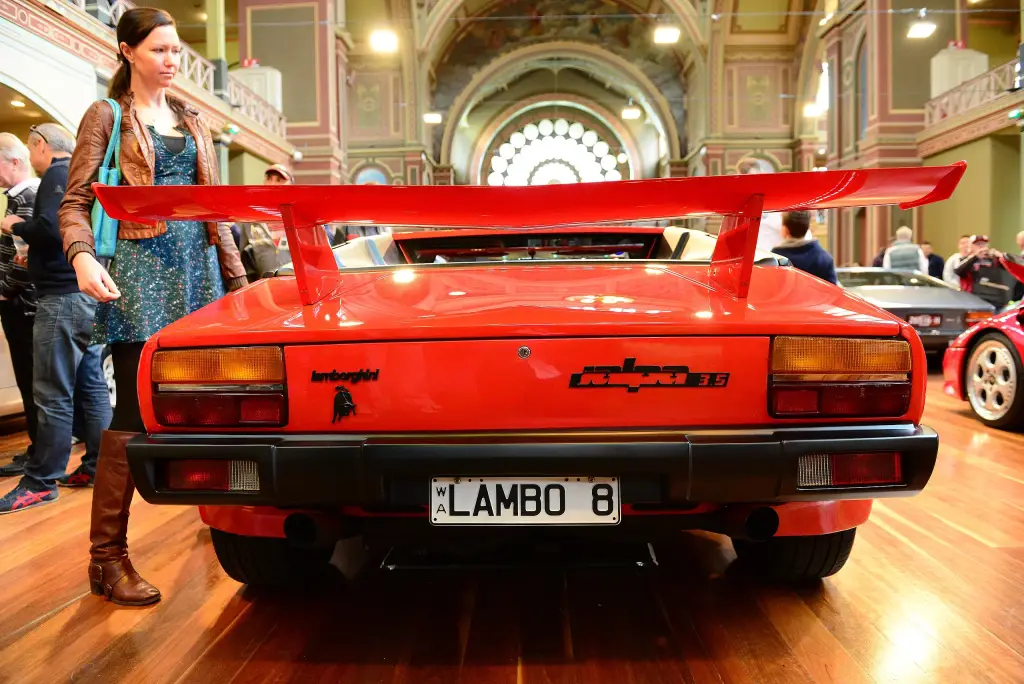
The engine was still the V8 Paolo Stanzani had designed for the Urraco in 1970, now designated L353. Alfieri kept the bore and increased the stroke, taking capacity to 3,485 cc; power rose only 5 PS to 255, but torque went up from 279 to 319 N·m, which made the car far more usable. The Jalpa was a two-seat targa, with a removable plastic roof panel that stowed behind the seats, and a traditional steel monocoque body. Early cars had black plastic bumpers, air intakes and engine cover, and the rectangular tail lights of the Silhouette, inherited from the Fiat 124 Coupé; in 1984 round lights and body-coloured trim replaced them, and a rear wing was an expensive option.
On the road and the end
The Jalpa was much easier to drive than the Countach, with better visibility and more tractable manners in traffic, although testers complained of heavy steering and a heavy throttle. Its performance was close to the Ferrari 328’s, but the Jalpa was heavier and less powerful, and by the mid-1980s it was showing its age. After 410 cars, Lamborghini’s new owner Chrysler stopped production in 1988, making the Jalpa the second most successful V8 Lamborghini after the Urraco.
Design and features
- Targa roof: a removable panel stored behind the seats, a rare body style for Lamborghini.
- Stronger mid-range: the longer-stroke V8 gained torque rather than top-end power.
- Everyday usability: better visibility and easier manners than the Countach.
- Bertone shape: the Urraco and Silhouette body carried over almost unchanged, with a 1984 facelift.
Lamborghini Jalpa versions
- Jalpa 3500 (1981–1984): black plastic trim, rectangular Silhouette tail lights.
- Jalpa 3500 (1984–1988): round tail lights and body-coloured bumpers and engine cover.
The Jalpa replaced the Silhouette and grew out of the Urraco; it was sold below the Countach. More cars are in the Lamborghini collection.
Sources
- Lamborghini Jalpa, English Wikipedia: engine, performance, revisions
- Lamborghini Jalpa 3500, German Wikipedia: history, body, technical changes