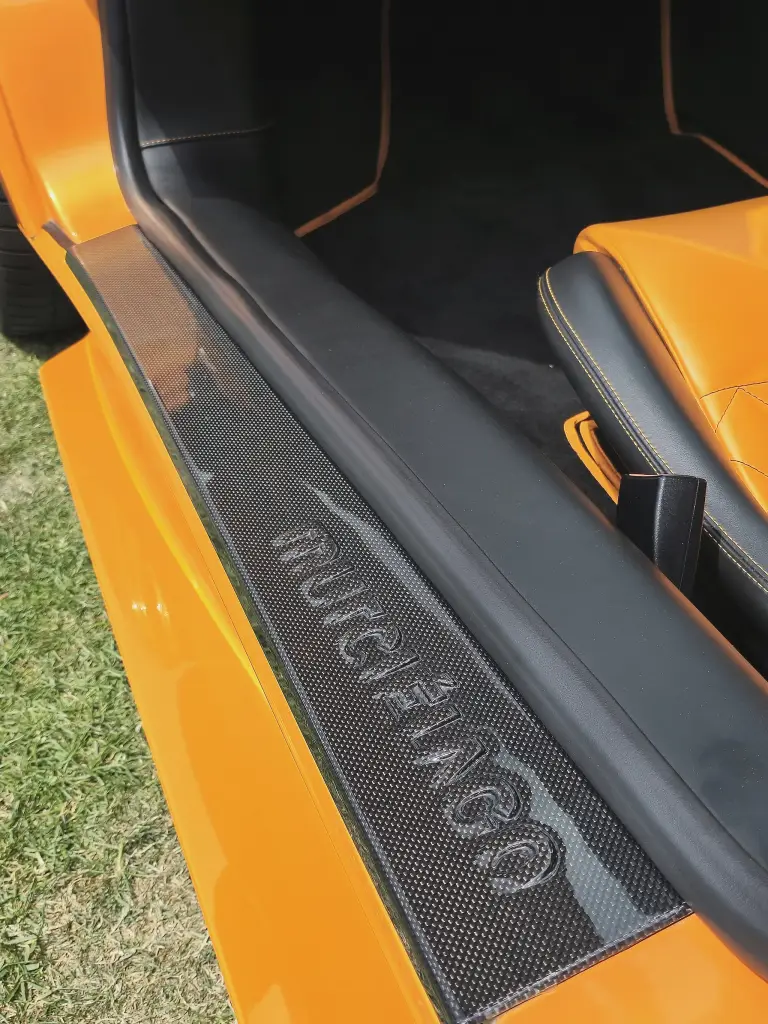
The Lamborghini Murciélago was the brand’s first new car after Audi took control, and the first in eleven years. Introduced in 2001 as the successor to the Diablo, it paired the V12 with all-wheel drive and scissor doors and stayed in production until 2010, when the Aventador replaced it.
Lamborghini Murciélago at a glance
| Maker | Lamborghini, Sant’Agata Bolognese |
|---|---|
| Production | 2001–2010 |
| Debut | Frankfurt Motor Show, 2001 |
| Designed by | Luc Donckerwolke |
| Engine | 6,192 cc V12 (2001), 6,498 cc in the LP 640 |
| Power | 580 PS, 640 PS in the LP 640 |
| Torque | 650 N·m |
| Gearbox | six-speed manual or six-speed e-gear |
| Drive | all-wheel drive, 70 per cent rear |
| 0–100 km/h | 3.8 seconds |
| Top speed | 333 km/h |
| Built | 4,099 |
Performance figures are those of the first-generation coupé; later LP 640 and SV versions were faster.
History of the Lamborghini Murciélago
A new start under Audi
The Murciélago replaced the Diablo in 2001 and was the first Lamborghini designed under German ownership: Audi, part of the Volkswagen Group, had taken over in 1998 and the new flagship was the first completely new design in eleven years. It was drawn by Luc Donckerwolke, Lamborghini’s head of design, who also styled the smaller Gallardo. The name came, as usual, from fighting bulls: the original Murciélago survived a famous fight in Córdoba in 1879 and became a leading sire, and the word means ‘bat’ in Spanish. Sales began in Europe in 2001 and in North America for the 2002 model year.
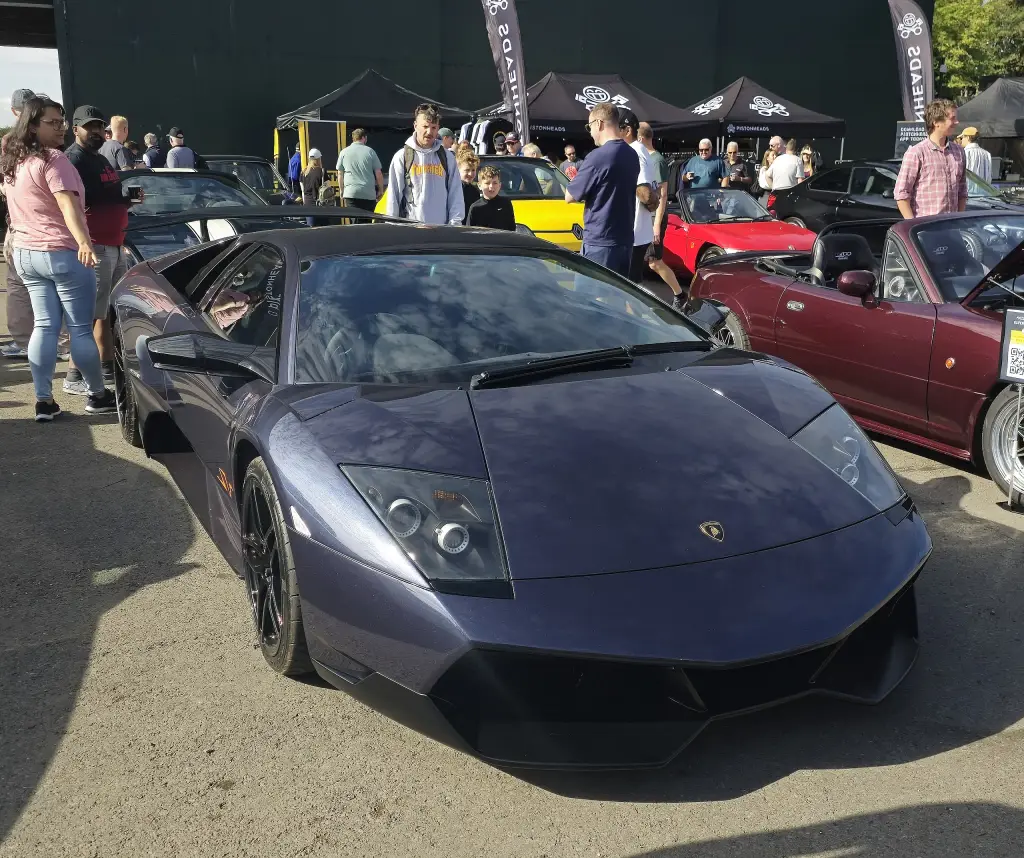
Engineering
The first cars carried a 6,192 cc version of the Lamborghini V12, an engine whose roots reach back to the 1960s, producing 580 PS. The rear differential was integrated with the engine and a viscous coupling centre differential sent power forward, splitting torque 70/30 between the rear and front axles. A six-speed manual was standard, with the e-gear automated manual optional. The body was mostly carbon fibre, with a steel roof and aluminium scissor doors retained from the Countach tradition, and both the rear wing and the shoulder air intakes deployed automatically at speed. The roadster followed in 2004, with a fabric roof that had to be fitted by hand and a warning not to exceed 100 mph with it in place; extra stiffening made it 29 kg heavier.
LP 640 and the end
In 2006 the Murciélago became the LP 640: capacity grew to 6.5 litres, output to 640 PS, and the body was facelifted with new front and rear ends and asymmetrical side intakes, the left one feeding an oil cooler. The e-gear gearbox gained launch control and revised software, the suspension was modified and carbon-ceramic brakes became an option. The final version was the LP 670-4 SuperVeloce, powered by the largest and last evolution of the original V12. Production ended on 5 November 2010 after 4,099 cars, and the Aventador was unveiled at Geneva in 2011.
Design and features
- V12 flagship: 6.2 litres and 580 PS at launch, 6.5 litres and 640 PS from 2006.
- All-wheel drive: a viscous centre differential sending up to 30 per cent of torque to the front.
- Scissor doors: the signature of every V12 Lamborghini since the Countach.
- Active aerodynamics: a rear wing and shoulder intakes that open only at high speed.
Lamborghini Murciélago versions
- Murciélago (2001–2006): 6.2-litre V12, 580 PS, coupé.
- Murciélago Roadster (2004–2006): manual fabric roof and extra chassis stiffening.
- LP 640 (2006–2010): 6.5-litre engine, 640 PS, restyled body, launch control.
- LP 650-4 Roadster: a limited-edition open car.
- LP 670-4 SuperVeloce: the final and most powerful version.
The Murciélago replaced the Diablo and was replaced by the Aventador; its V10-engined stablemate was the Gallardo. More cars are in the Lamborghini collection.
Sources
- Lamborghini Murciélago, English Wikipedia: design, versions, performance
- Lamborghini Murciélago, German Wikipedia: production total, naming, construction