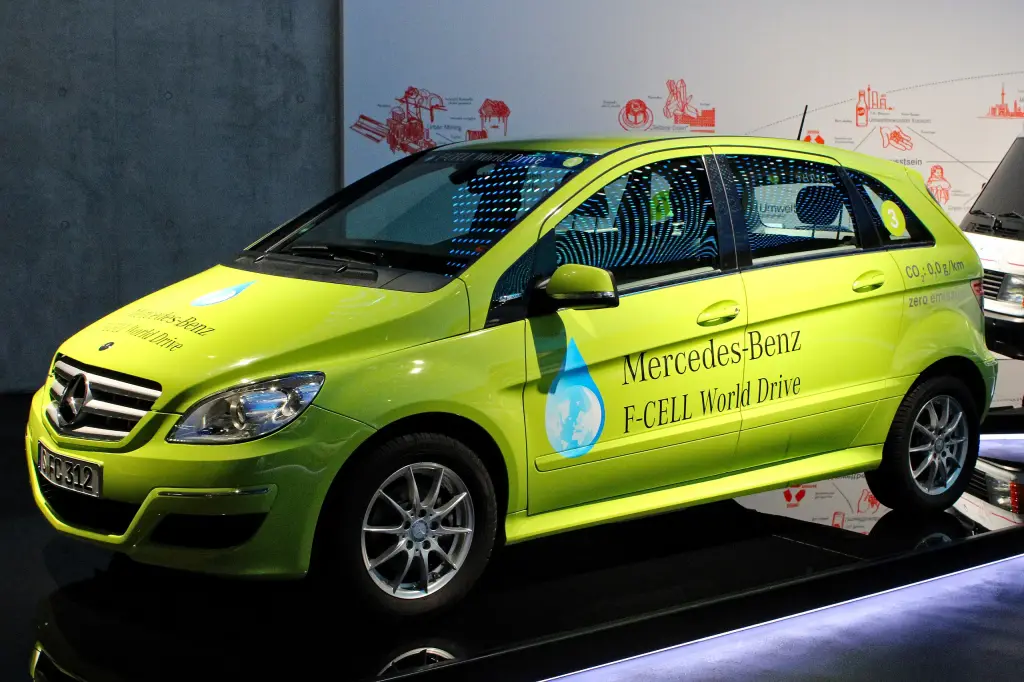
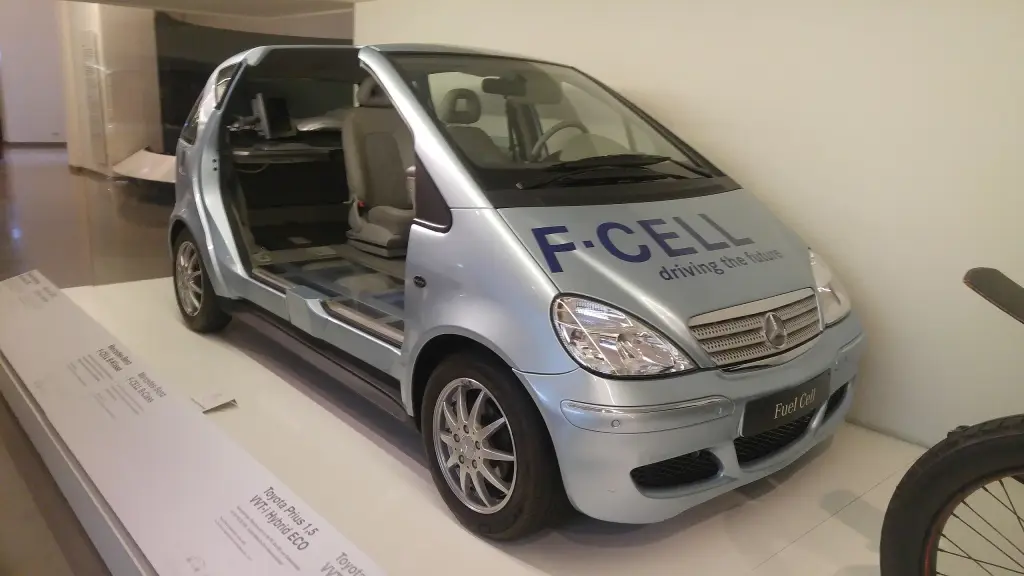
The F-Cell is a hydrogen fuel-cell electric vehicle developed by Daimler. The first version was based on the Mercedes-Benz A-Class and the later one on the B-Class.
Mercedes-Benz F-Cell at a glance
| First generation | 2002, based on the A-Class |
|---|---|
| First range | 100 miles (161 km) |
| First top speed | 82 mph (132 km/h) |
| Second generation | B-Class F-Cell |
| Second-generation motor | 100 kW (134 hp) |
| Second-generation range | about 250 miles (402 km) |
| Fuel cell type | proton exchange membrane, PEMFC |
| Fuel cell design | Automotive Fuel Cell Cooperation (AFCC) |
| Hydrogen tanks, 350 bar | range of 248 miles (399 km) |
| Hydrogen tanks, 700 bar | range of 421 miles (678 km) |
| Cars leased | 60 in the USA, Europe, Singapore and Japan |
This article is based on one source, the English Wikipedia article on the Mercedes-Benz F-Cell.
History of the Mercedes-Benz F-Cell
The first F-Cell was introduced in 2002 on the A-Class, with a range of 100 miles and a top speed of 82 mph. Both generations used the sandwich floor idea of the A- and B-Class, which leaves room for passengers and for the propulsion components in the same footprint. The fuel cell is a proton exchange membrane type designed by the Automotive Fuel Cell Cooperation.
The B-Class F-Cell followed with a 100 kW (134 hp) electric motor and a range of about 250 miles, helped by more space for compressed hydrogen tanks, higher storage pressure and better fuel-cell technology. The 350-bar tanks gave a range of 248 miles, and 700-bar tanks extended it by 70 per cent to 421 miles. In December 2010 Daimler began leasing the B-Class F-Cell, with the first car delivered to Vince Van Patten and a further 69 planned for California.
By then 60 F-Cell vehicles were leased to customers in the United States, Europe, Singapore and Japan. Daimler reported in May 2006 that its fuel-cell fleets had covered more than two million kilometres together, and in 2011 three F-Cell cars set off on a 125-day journey around the world. The B-Class F-Cell was a finalist for the 2012 Green Car Vision Award.
Design and features
- Hydrogen fuel cell: a PEMFC stack turning hydrogen into electricity.
- Sandwich floor: room for the technology under the passenger cell.
- Longer range: the B-Class version reached about 400 km.
- Higher pressure tanks: 700-bar storage added 70 per cent to the range.
Mercedes-Benz F-Cell versions
- A-Class F-Cell (2002): 100 miles of range and 82 mph.
- B-Class F-Cell: 100 kW and about 250 miles of range.
- 350-bar cars: 248 miles of range.
- 700-bar cars: 421 miles of range.
The F-Cell used the A-Class and B-Class bodies, and its ideas returned in later hydrogen cars such as the F125. More in the Mercedes-Benz collection.
Video: Mercedes-Benz B-Class F-Cell
Video by YouTube on YouTube.
Sources
- Mercedes-Benz F-Cell, English Wikipedia: generations, range, tanks, leasing