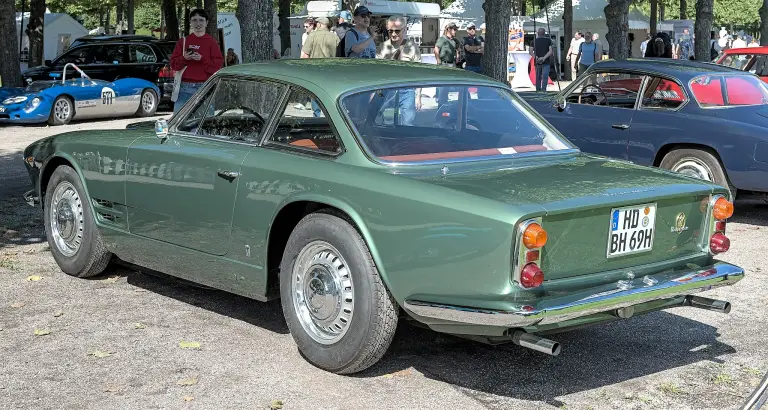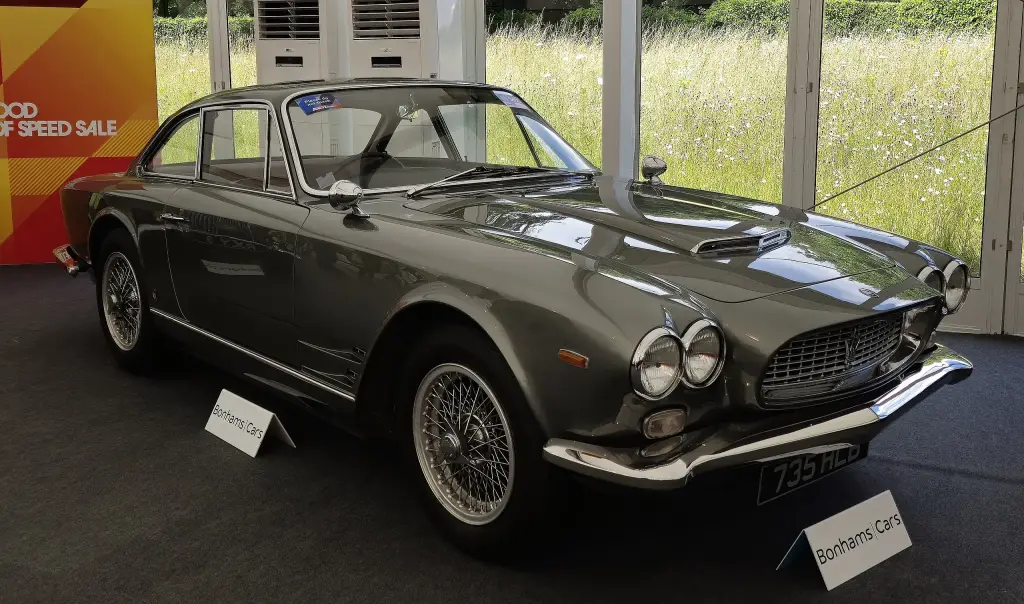
The Maserati Sebring was a two-door 2+2 coupé manufactured from 1962 until 1968. Based on the Maserati 3500, it was aimed at the American Gran Turismo market and named after Maserati’s 1957 racing victory at the 12 Hours of Sebring. A single two-seat Spyder was built by Vignale in 1963 but did not enter production.
Maserati Sebring at a glance
| Maker | Maserati, Modena |
|---|---|
| Production | 1962–1968 |
| Series I code | Tipo AM 101/S |
| Series II code | Tipo AM 101/10 |
| Base | Maserati 3500 GT |
| Engines | 3.5, 3.7 and 4.0 litres, inline six |
| Series I power | 235 PS after the 1963 update |
| 4000 GTiS | 4,012 cc, 255 PS at 5,200 rpm, later 265 PS |
| Top speed | 220 km/h (Series I) |
| 0–97 km/h | 8.5 seconds (Series I) |
| Built | 348 Series I; 247 Series II; about 446 in total |
Based on one source: the English Wikipedia article on the Sebring.
History of the Maserati Sebring
The Series I, Tipo AM 101/S, was shown at the Salon International de l’Auto in 1962 and again at the Turin Motor Show in 1963. It employed all but the 3500’s coachwork, could reach 220 km/h and accelerated from 0 to 97 km/h in 8.5 seconds. A Borg-Warner automatic transmission was available as an option, a first for Italian automobiles. A total of 348 Series I Sebrings were built between 1962 and 1965. The engine was updated in 1963, gaining 15 PS for a total of 235 PS. The 3,700 engine first appeared in 1964, although only a handful of Series I cars were so equipped.
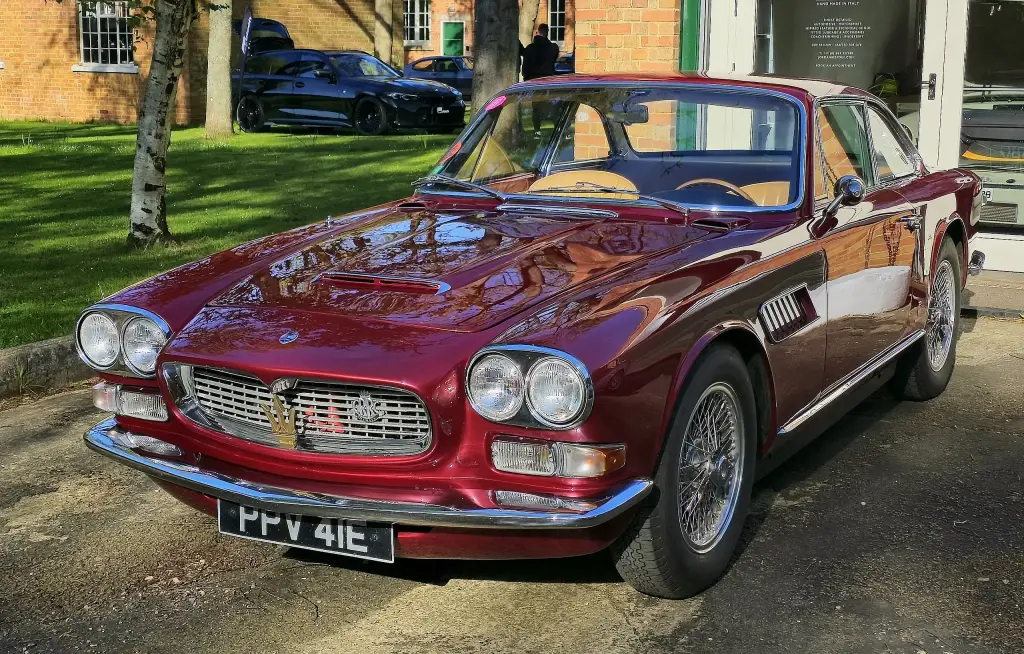
Series II
In 1965 the modified Series II, Tipo AM 101/10, was introduced. It had lightly redesigned headlamps, modernised bumpers, new front turn signals and new side grilles replacing the lower extraction vents used before, taking minor design cues from the contemporary Quattroporte. At the rear the bumpers were squared off, the tail lights were mounted horizontally instead of vertically and the boot lid opening was narrowed somewhat, and the car rode on larger 205×15 Pirelli Cinturato tyres. A run of 247 units was made from 1964 until 1968. Along with the 3,500 engine, the 3,700 with a lengthened stroke giving 3,694 cc, and the even larger 4,000 were added. The 4000 GTiS had a 4,012 cc engine producing 255 PS at 5,200 rpm and remained in production until 1968, when financial constraints forced Maserati to drop its older models. No major updates took place over the last three years except a slight power gain for the 4,000, up to 265 PS.
Production numbers
It is believed that around 446 Sebrings were made in total between 1962 and 1969, with 348 of the Sebring 3.5 and an estimated 98 of the 3.7 and 4.0 combined. Anecdotal evidence suggests that, according to Maserati’s practice of marking interior panels and wooden parts, the actual model number was written only in yellow grease marker on the rear surfaces of the interior bodywork: parts from the assumed car number 69 carry the marking “69 di 96”, suggesting only 96 cars were produced, making them the rarest of the Series II cars. Jeremy Clarkson named the Sebring number 77 on his Top 100 Cars list.
Design and features
- 3500 GT basis: the Sebring used the 3500’s chassis and mechanicals with new coachwork.
- American target: a 2+2 layout and an optional Borg-Warner automatic, a first for Italy.
- Three engines: 3.5, 3.7 and 4.0 litres, the last with 265 PS.
- Series II updates: new headlamps, squared bumpers and horizontal tail lights.
- Rare Series II: 247 built, possibly fewer with the larger engines.
Maserati Sebring versions
- Sebring Series I (1962–1965): Tipo AM 101/S, 348 built.
- Sebring Series II (1964–1968): Tipo AM 101/10, 247 built.
- Sebring 4000 GTiS: 4,012 cc engine with 255, later 265 PS.
- Vignale Spyder (1963): a single two-seat convertible, not produced.
The Sebring was based on the Maserati 3500 GT and shared the 2+2 market with the Maserati Mexico; it was replaced by the Maserati Indy. More cars are in the Maserati collection.
Sources
- Maserati Sebring, English Wikipedia: history, series, engines, production