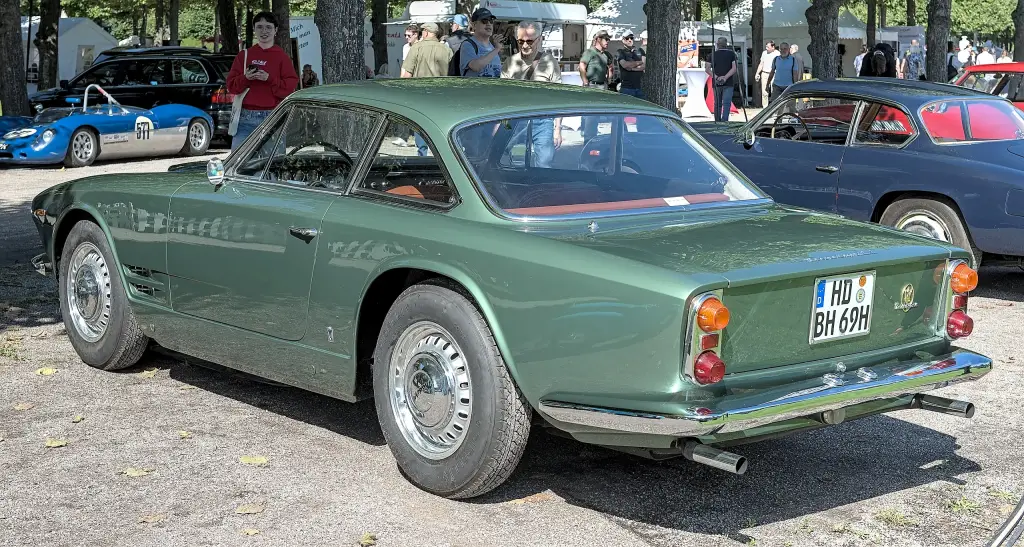
The Maserati 3500 GT, internally Tipo 101, was a two-door coupé grand tourer made from 1957 to 1964, with a convertible Spyder version. It was the company’s first successful attempt at the Gran Turismo market and at series production. In total 2,226 coupés and Spyders were built.
Maserati 3500 GT at a glance
| Maker | Maserati, Modena |
|---|---|
| Project code | Tipo 101; Spyder Tipo 101/C |
| Production | 1957–1964 |
| Engine | 3.5-litre straight-six, designed for the 350S racing car |
| Coupé body | Carrozzeria Touring, Superleggera construction |
| Spyder body | Vignale, designed by Michelotti |
| Wheelbase | 2,600 mm coupé; Spyder 100 mm shorter |
| Brakes | Girling drums, front discs optional 1959, standard 1960, all-disc 1962 |
| Gearbox | four-speed, five-speed optional from 1960 and standard on the GTi |
| Built | 2,226 coupés and convertibles |
Based on one source: the English Wikipedia article on the 3500 GT.
History of the Maserati 3500 GT
By the early 1950s Maserati had racing success and international visibility thanks to cars such as the A6GCM, and its two-litre twin-cam straight-six had already been enlarged to three litres in the 300S. Chief engineer Giulio Alfieri felt the next step was an all-new 3.5-litre engine, a long-stroke six designed first for endurance racing in the 350S and ready in 1955. Maserati’s earlier grand tourers, the 1947 A6 1500, the 1951 A6G 2000 and the 1954 A6G/54, had shown that the business was feasible, but those cars were still built in about a dozen examples a year, hardly series production.
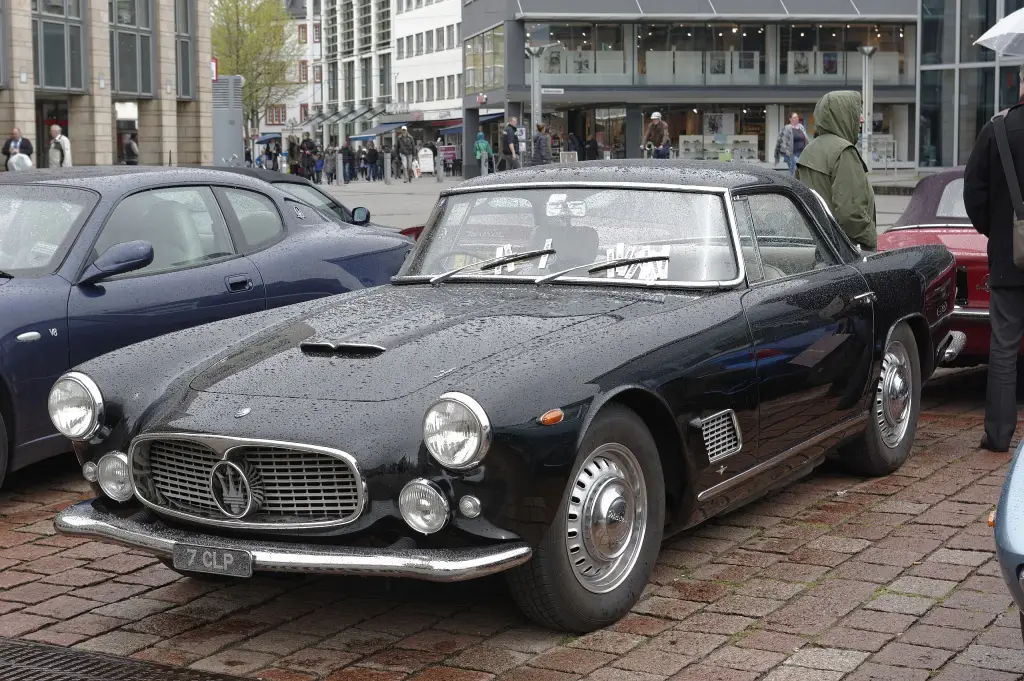
The main development work was carried out in 1956–1957. Alfieri modified the 350S engine for touring use, switching to a wet sump and changing the accessories. He travelled to the United Kingdom to find component suppliers, because Italian taxation and industry structure forced manufacturers to design every part in-house, a daunting task for a company the size of Maserati. The 3500 GT therefore used Italian Weber carburettors and Marelli ignition alongside British-made parts such as a Salisbury rear axle, Girling brakes and Alford & Alder suspension components.
Bodies and production
According to Carrozzeria Touring’s Carlo Felice Bianchi Anderloni, it was the Ferrari dealer Franco Cornacchia who introduced Maserati owner Omar Orsi to the Milanese coachbuilder. The first Touring prototype was a white 2+2 with Superleggera construction, nicknamed Dama Bianca. Two prototypes were shown at the Geneva salon in March 1957, one by Touring and one by Allemano, both on a 2,600 mm wheelbase with aluminium bodies; Touring’s proposal was chosen with few changes, mainly a more imposing grille. Production began in late 1957, with eighteen cars built that year, and all 3500 GTs had leather interiors and Jaeger instruments.
A first Touring convertible prototype appeared at the 1958 Turin Motor Show, but the Vignale proposal designed by Michelotti, shown in Paris in 1959, went into production as the 3500 GT Spyder. It had a steel body with aluminium bonnet and boot lid and an optional hard top, sat on a 10 cm shorter wheelbase and weighed 1,380 kg. Front disc brakes and a limited-slip differential became optional in 1959 and standard in 1960, and rear discs followed in 1962. The 3500 GTi was introduced at the 1960 Paris salon and became the first fuel-injected Italian production car the following year, with Lucas mechanical injection, 235 PS, a standard five-speed gearbox, a lowered roofline and detail changes including a new grille, rear lights and radial Pirelli Cinturato tyres.
Legacy and coachbuilt cars
In 1959 the V8-engined 5000 GT was introduced on the 3500 GT chassis, and the Sebring 2+2 coupé of 1962 was based on the same mechanicals. Sales reached 119 cars in 1958 and peaked at 500 in 1961. Of the 245 Vignale convertibles and nearly 2,000 coupés, 1,981 were Touring coupés; the rest were bodied by Allemano, Boneschi, Pietro Frua, Bertone and Moretti. Zagato proposed a coupé in the style of its rebodied A6G/54 Coupé Speciale in 1957, but no cars were built. The car sat on a tubular platform chassis of square, round and elliptic sections in Superleggera construction, with double-wishbone front suspension and a Salisbury live axle on semi-elliptic leaf springs at the rear.
Design and features
- First series-production Maserati: the model that turned a racing workshop into a GT manufacturer.
- Touring Superleggera body: a light 2+2 coupé with a more imposing grille than the prototype.
- British components: Salisbury axle, Girling brakes and Alford & Alder suspension parts.
- 3500 GTi: the first fuel-injected Italian production car, with 235 PS and a five-speed gearbox.
- Coachbuilt variety: bodies by Touring, Vignale, Allemano, Boneschi, Frua, Bertone and Moretti.
Maserati 3500 GT versions
- 3500 GT coupé (1957–1964): the Touring-bodied 2+2, almost 2,000 built.
- 3500 GT Spyder (1959–1964): Vignale convertible by Michelotti, 245 built.
- 3500 GTi (1961–1964): fuel-injected version with a standard five-speed gearbox.
- Coachbuilt one-offs: coupés by Allemano, Boneschi, Frua, Bertone and Moretti.
The 3500 GT followed the Maserati A6 road cars and its mechanicals were used for the Maserati Sebring. The 3200 GT took its name from it. More cars are in the Maserati collection.
Sources
- Maserati 3500 GT, English Wikipedia: development, bodies, production, specifications