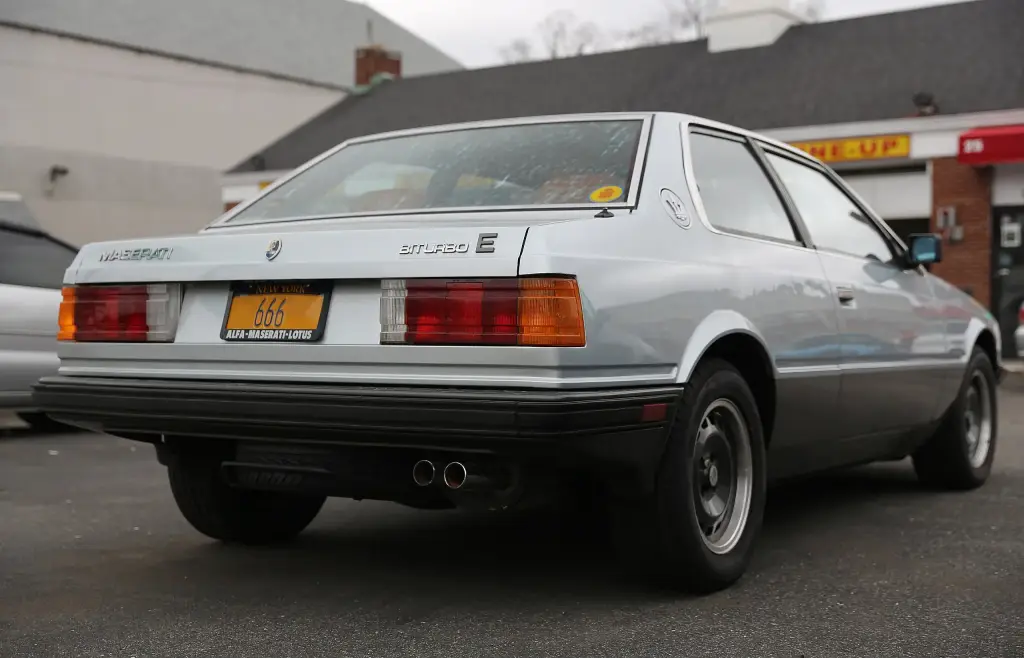
The Maserati Biturbo is a family of executive grand tourers produced between 1981 and 1994. The original Biturbo was a two-door, four-seater notchback coupé with a two-litre twin-turbocharged V6 and a luxurious interior, and it was the first production car in the world to use a twin-turbocharged engine. About 40,000 were sold, and every Maserati introduced between 1981 and 1997 was based on variants of its architecture.
Maserati Biturbo at a glance
| Maker | Maserati, Modena |
|---|---|
| Production | 1981–1994 |
| Design | Pierangelo Andreani, Centro Stile Maserati |
| Layout | front engine, rear-wheel drive, two-door four-seat coupé |
| Engine | two-litre 90-degree V6, twin turbochargers |
| Valves | three per cylinder at first, four later |
| Export engines | 2.5-litre V6, then 2.8-litre V6 |
| Suspension | MacPherson struts front, semi-trailing arms rear |
| Body | steel unibody, panels and assembly by Innocenti |
| Facelifts | Marcello Gandini in 1987–1989 and 1991 |
| Sold | about 40,000 |
Based on one source: the English Wikipedia article on the Biturbo, which covers the whole family.
History of the Maserati Biturbo
When Alejandro de Tomaso acquired Maserati in 1976 he had ambitious plans: to combine the prestige of the marque with a sports car that would be more affordable, replacing the higher-priced models that had traditionally made up the range, such as the Bora and Khamsin developed under Citroën ownership. The Biturbo, designed by Pierangelo Andreani, chief of Centro Stile Maserati until 1981, was somewhat influenced by the recent Quattroporte III penned by Italdesign’s Giorgetto Giugiaro. It was initially a strong seller and brought Italian prestige to a wide audience, but sales fell in later years as the car gained a reputation for poor quality and reliability. De Tomaso used another of his companies, Innocenti, to produce body panels and provide final assembly, and later sold Maserati to Fiat, which grouped it with Ferrari.
Reputation
The Biturbo is ranked number 28 in the BBC book Crap Cars, and in 2007 Time selected it as the worst car of 1984, although the magazine ranked the Chrysler TC by Maserati as a greater ignominy. It competed in the World Touring Car Championship in 1987 and the European Touring Car Championship in 1988 with the Marlboro Conquista Team without notable success. Until the carburettors were replaced by fuel injection the cars also had serious overheating problems. The WTCC cars were raced in Italian touring championships for a couple of years afterwards, and one car was rallied in Group A specification. The Biturbo was sold in the United States from 1981 to 1990, with some leftover Biturbo Spiders sold as 1991 models; Maserati then left the US market until the 2002 Coupé.
Gandini’s restyling
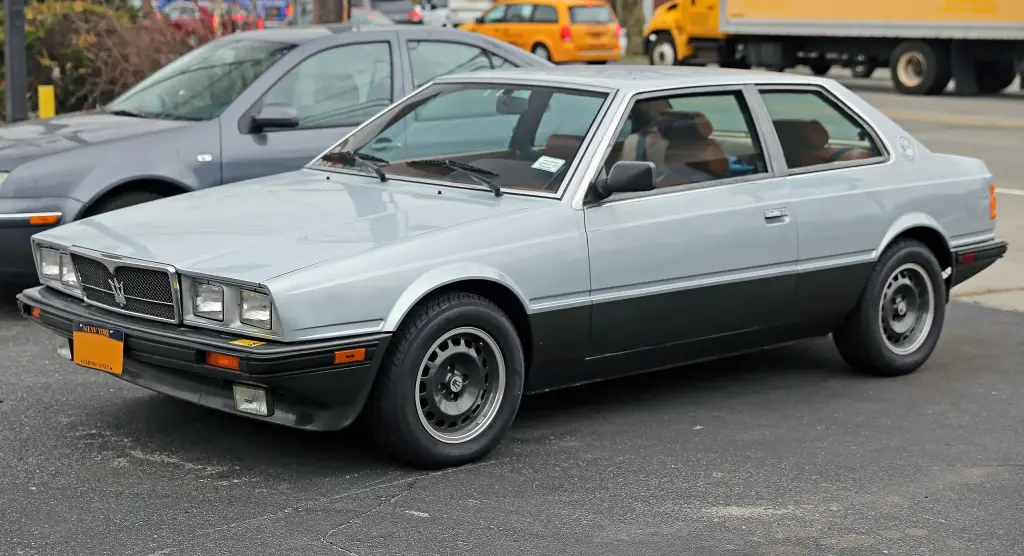
Between 1987 and 1989 a facelift designed by Marcello Gandini was phased in, softening the sharp bodylines of the original. It first appeared on the 1987 430 and brought a taller, more rounded grille with mesh, a new bonnet, aerodynamic wing mirrors and 15-inch disc-shaped alloy wheels on five-lug hubs. Some models received wraparound bumpers with integral foglights and the deep sills introduced with the 2.24v in early 1989, and mechanical upgrades from the 2.24v, including suspension and power steering improvements and ventilated front discs, filtered through the range. In 1991 the whole line-up was restyled again by Gandini, spreading the design features of the Shamal to the other models: an aerodynamic kit with a spoiler at the base of the windscreen hiding the wipers, a rear spoiler and side skirts. The new two-element headlights used poly-ellipsoidal projectors by Magneti-Marelli set in body-colour housings beside a slimmer grille integrated into the bonnet, and 16-inch seven-spoke wheels with a hubcap styled like a centre-lock nut replaced the 15-inch discs. The second facelift was called nuovolook.
Engineering and the model range
The cars were of steel unibody construction with a conventional front-longitudinal engine and gearbox. Suspension used MacPherson struts at the front and semi-trailing arms at the rear, with coil springs, double-acting dampers and anti-roll bars on both axles, and the differential and rear suspension arms were carried on a subframe. The all-aluminium 90-degree V6 was a new design roughly based on the V6 of the Merak, but used a timing belt for the camshafts where the Merak and Citroën SM used a chain. The two-litre version had wet aluminium sleeves coated with Nikasil and initially three valves per cylinder, two intake and one exhaust; later some engines received four-valve heads. Because Italy taxed cars over 2,000 cc at 38 per cent against 19 per cent below that limit, two ranges were made throughout production: two-litre cars for the domestic market and export versions with a 2.5-litre V6 and later a 2.8-litre V6. The carburetted 2.5-litre engine was rated at 185 hp and 282 N·m in North American specification and 192 PS and 298 N·m in Europe; in 1984 and 1985 the 2.5-litre models used a single Weber DCNVH carburettor under a smooth aluminium plenum fed by twin IHI turbochargers, one per bank of cylinders. The family grew to include the 222, 224, 228, 420, 422 and 430 models, and the Karif and Shamal were developed from the same architecture.
Design and features
- First twin-turbo production car: a two-litre V6 with one turbocharger per bank.
- Affordable Maserati: smaller than a BMW 3 Series of the time and about 40,000 sold.
- Two engine ranges: two-litre cars for Italy and 2.5- or 2.8-litre export versions.
- Gandini facelifts: a softer 1987–1989 design and the 1991 nuovolook.
- Unibody and struts: steel monocoque with MacPherson struts and a rear subframe.
Maserati Biturbo versions
- Biturbo (1981): the original two-door coupé with the two-litre V6.
- 222, 224 and 228: two- and four-door members of the family.
- 420, 422 and 430: the later four-door and two-door models, the 430 with the first Gandini facelift.
- Export cars: 2.5-litre V6 from the start and 2.8-litre V6 later.
- Shamal and Karif: grand tourers developed from the Biturbo architecture.
The Biturbo replaced the Maserati Bora and Khamsin at the bottom of the range, and its platform later underpinned the Shamal and Ghibli II. More cars are in the Maserati collection.
Sources
- Maserati Biturbo, English Wikipedia: history, facelifts, engines, model range