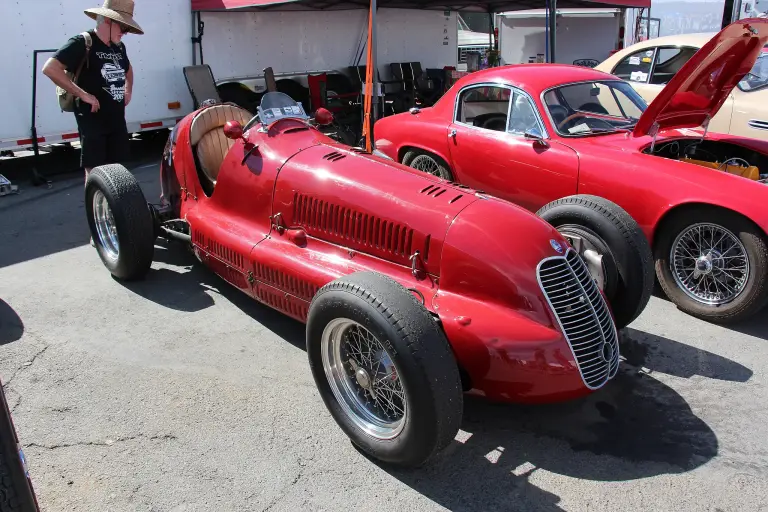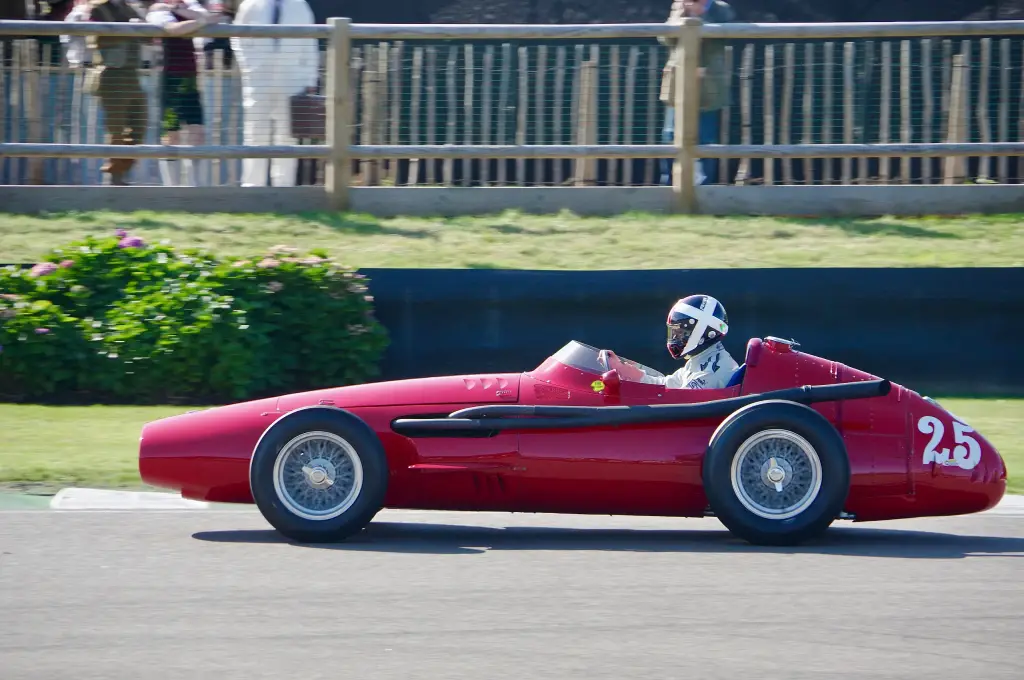
The Maserati 250F was a Formula One racing car built for the 2.5-litre formula and raced between January 1954 and November 1960. Twenty-six examples were made. Juan Manuel Fangio drove one to four championship wins in 1957, and Stirling Moss later called it the best front-engined Formula One car he had driven.
Maserati 250F at a glance
| Maker | Maserati, Modena |
|---|---|
| Racing class | Formula One, 2.5-litre formula |
| Racing years | 1954–1960 |
| Engine | 2,493 cc straight-six, 84 mm × 75 mm |
| Power | 220 bhp at 7,400 rpm; 240 bhp with fuel injection from 1955 |
| Designers | Gioacchino Colombo, Vittorio Bellentani, Alberto Massimino |
| Chassis | tubular frame by Valerio Colotti |
| Front suspension | independent, wishbones |
| Rear axle | de Dion tube |
| Brakes | ribbed 13.4-inch drums; Dunlop discs from 1955 |
| Wheels | Borrani 16- and 17-inch |
| Built | 26 |
Based on one source: the English Wikipedia article on the 250F.
History of the Maserati 250F
The 250F used the SSG version of Maserati’s 2,493 cc straight-six, giving 220 bhp at 7,400 rpm. The car had ribbed 13.4-inch drum brakes, independent front suspension with wishbones, a de Dion tube rear axle, Borrani 16- and 17-inch wheels and Pirelli Stella Bianca tyres. It was designed by Gioacchino Colombo, Vittorio Bellentani and Alberto Massimino, with the tubular frame built by Valerio Colotti. A streamlined version with bodywork partly enclosing the wheels, similar to the 1954 Mercedes-Benz W196 Monza, was used at the 1956 French Grand Prix.
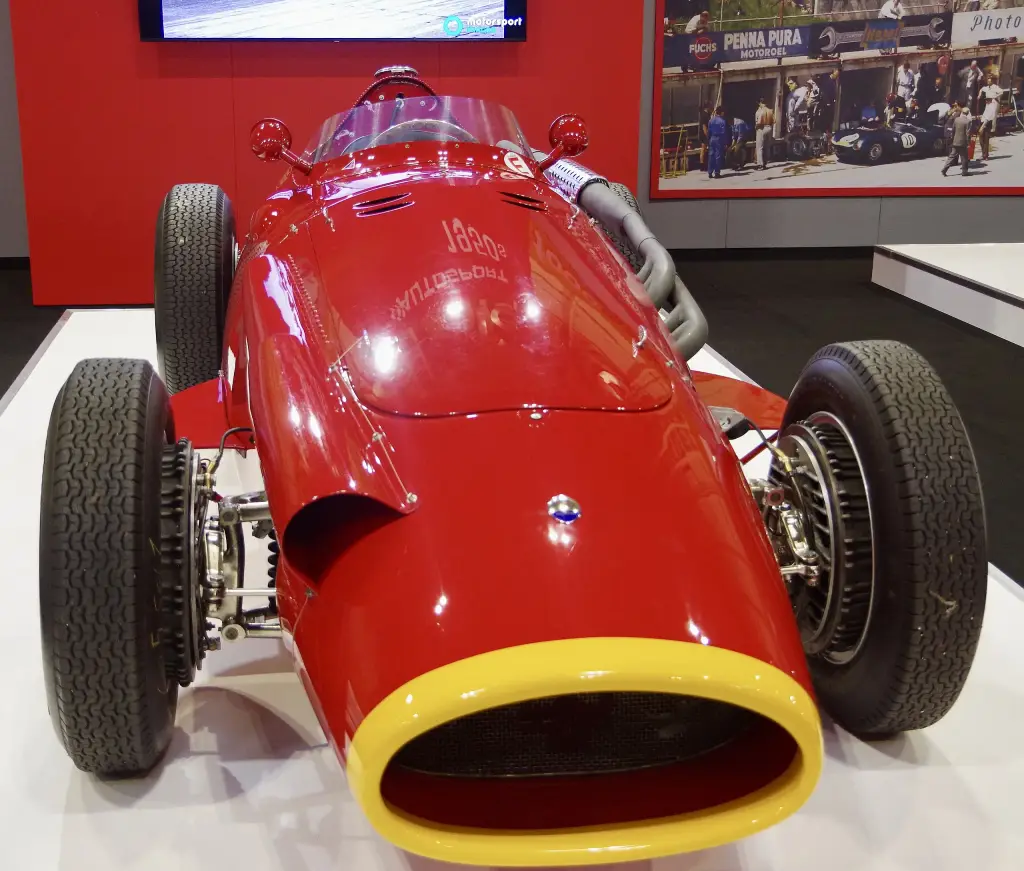
1954 and 1955
The 250F first raced at the 1954 Argentine Grand Prix, where Fangio won the first of his two victories before leaving for Mercedes-Benz. Fangio took the 1954 drivers’ championship with points from both Maserati and Mercedes, Stirling Moss raced his own 250F for the full season and Prince Bira was another devotee. For 1955 Maserati added a five-speed gearbox, SU fuel injection raising output to 240 bhp and Dunlop disc brakes; Jean Behra drove in a five-member works team that included Luigi Musso.
In 1956 Moss won the Monaco and Italian Grands Prix in works cars. Three 250F T2 cars appeared for the works drivers that year, developed by Giulio Alfieri with lighter steel tubes, a slimmer and stiffer body and sometimes a new 315 bhp 2,491 cc V12, which offered little real advantage over the straight six. That V12 was later developed into the three-litre unit that won races in Cooper T81 and T86 cars between 1966 and 1969.
1957 and after
Fangio took four more championship victories in 1957, including his last at the German Grand Prix at the Nürburgring on 4 August, where he overcame a 48-second deficit in 22 laps and passed Mike Hawthorn on the final lap, breaking the lap record ten times on the way. By 1958 the 250F was outclassed by the new rear-engined cars but remained a favourite with privateers, including Maria Teresa de Filippis, and was still used by back markers through the 1960 season, the last of the 2.5-litre formula. In total the 250F competed in 46 Formula One championship races with 277 entries and eight wins, and its drivers also won many non-championship events around the world.
Design and features
- Straight-six power: the SSG 2,493 cc engine with 220 bhp, raised to 240 bhp by fuel injection in 1955.
- Front-engined layout: wishbone front suspension and a de Dion rear axle.
- Disc brakes: Dunlop discs arrived in 1955 alongside the five-speed gearbox.
- Streamlined body: a wheel-enclosing version ran at the 1956 French Grand Prix.
- Long career: raced by privateers into 1960, three years after its championship peak.
Maserati 250F versions
- 250F (1954): the original car with drum brakes and a four-speed gearbox.
- 1955 specification: five-speed gearbox, fuel injection and Dunlop disc brakes.
- 250F T2 (1956): lighter frame, slimmer body and optional 315 bhp V12.
- Streamlined 250F: partly enclosed wheels for fast circuits such as Reims.
The 250F’s engine was related to the Maserati 300S sports car, and the six-cylinder line began with the Maserati A6. Its two-litre predecessor on the sports car side was the 200S. More cars are in the Maserati collection.
Sources
- Maserati 250F, English Wikipedia: technical details, racing history, records