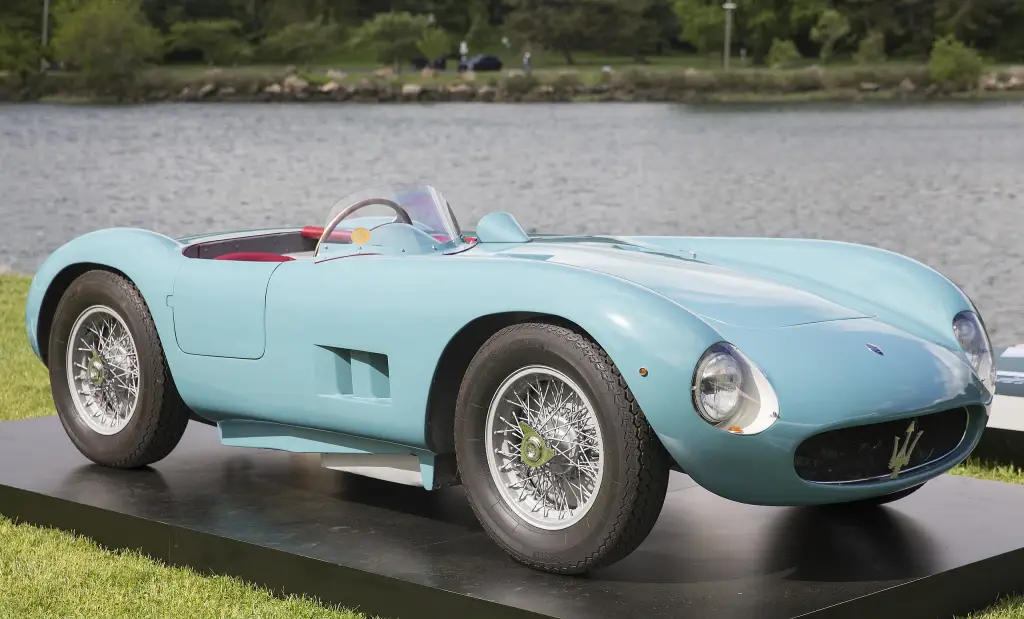
The Maserati 150S was a small sports racing car built by Maserati in 1955–1957 to take over from the aging A6GCS. Its 1.5-litre four-cylinder engine produced 140 hp, and the car was campaigned mainly by private entrants. Depending on the source, between twenty-four and twenty-seven examples were built, plus a single street version called the 150 GT.
Maserati 150S at a glance
| Maker | Maserati, Modena |
|---|---|
| Project code | Tipo 53 |
| Production | 1955–1957 |
| Engine | 1,484.1 cc inline-four, twin Weber 45 DCO3 carburettors |
| Power | 140 hp (103 kW) at 7,500 rpm |
| Chassis | tubular frame, de Dion rear axle |
| Wheelbase | 2,150 mm, then 2,250 mm from chassis #1656 |
| Gearbox | four-speed, five-speed ZF from 1956 |
| Body | aluminium spider by Celestino Fiandri, later Medardo Fantuzzi |
| Debut | Turin Motor Show, April 1955 |
| Built | 24–27, plus one 150 GT |
Based on one source: the English Wikipedia article on the 150S.
History of the Maserati 150S
The 150S grew out of Maserati’s four-cylinder racing programme. The project, coded Tipo 53, was designed by Vittorio Bellentani in 1953 around a 1,484.1 cc four-cylinder engine with twin Weber 45 DCO3 carburettors, rated at 140 hp at 7,500 rpm. The unit was developed from Alberto Massimino’s earlier two-litre engine, which had been conceived as a simpler design for private entrants in Formula 2 racing; the 1.5-litre version was first tested in a racing boat belonging to Liborio Guidotti in 1954–1955. Maserati showed the car at the Turin Motor Show in April 1955 and completed the last example in January 1957.
First and second series
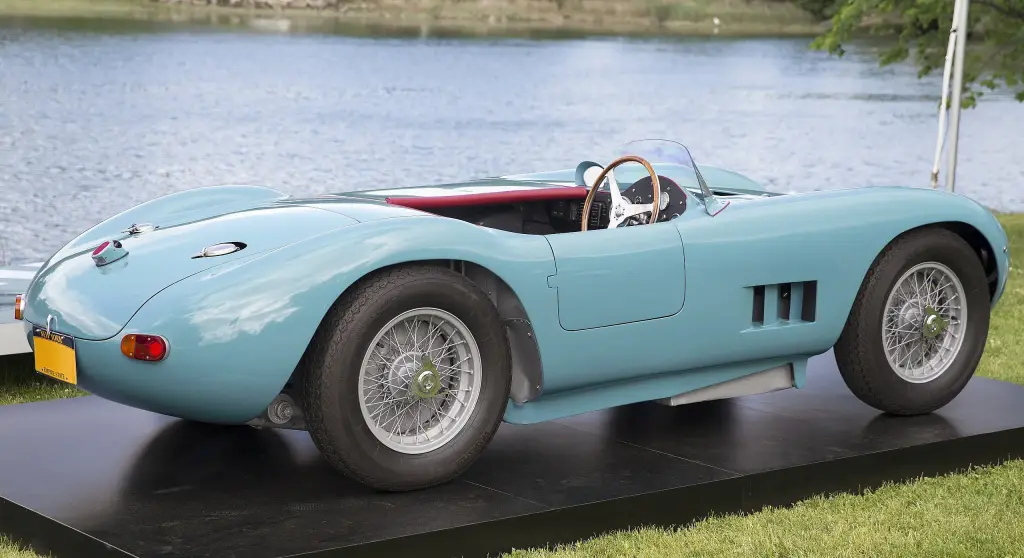
The first cars had a body inspired by the 300S, developed by Celestino Fiandri, who also assembled the first few chassis together with Malagoli before Gilco took over that part of the work. The tubular frame was similar to the A6GCS’s, but with an important difference: a de Dion rear axle on transverse leaf springs instead of the A6’s live axle. The wheelbase of the first four or five cars was 2,150 mm, increased to 2,250 mm from chassis #1656. Eight first-series cars were built in 1955, some possibly with the five-speed gearbox of the later cars.
The second series followed during 1956. It swapped the original four-speed transmission with Porsche-patent synchromesh for a five-speed ZF unit and received entirely new, more angular bodywork with a more aggressive nose and a truncated tail. The shape was developed by Giulio Alfieri with a new emphasis on aerodynamics, including a faired underbody, and built by Medardo Fantuzzi. A street version, the 1957 Maserati 150 GT, was a spider on an A6GCS chassis with a 150S engine at a lower compression ratio.
Racing and the Tipo 6
Most cars were sold to privateers. The best result came when Jean Behra won the half-sized 1000 km Nürburgring in 1955, beating thirteen Porsches among others, which helped fill the order books for the second series. Alejandro de Tomaso finished fourth overall at the 1956 1000 km Buenos Aires behind two works 300S cars and a Ferrari. Maserati stopped developing the 150S during 1956, partly because results were unsatisfying, and several cars were re-engined with two-litre units; Stirling Moss called the series 2 car “overbodied and a bit gutless”. The engine had a second life, however: when Formula One switched to 1.5 litres for 1961, Maserati restarted production as the Tipo 6 1500, lighter at 130 kg and giving 165 hp at 8,500 rpm. Ten were built, and Maurice Trintignant finished seventh with one at the 1961 Monaco Grand Prix.
Design and features
- Light four-cylinder engine: 1,484 cc with twin camshafts and twin Weber carburettors, 140 hp at 7,500 rpm.
- De Dion rear axle: a more sophisticated arrangement than the live axle of the A6 it replaced.
- Five-speed ZF gearbox: standard on the second series from 1956.
- Aerodynamic second body: angular shape with a faired underbody by Fantuzzi.
- Engines that outlived the car: the Tipo 6 version raced in Formula One until 1963.
Maserati 150S versions
- 150S first series (1955): 300S-inspired body, 2,150 mm wheelbase, eight cars.
- 150S second series (1956): new angular body, 2,250 mm wheelbase, five-speed ZF gearbox.
- 150 GT (1957): one road-going spider on an A6GCS chassis with a detuned 150S engine.
- Tipo 6 1500 (1961): Formula One version of the engine, 165 hp, ten built.
The 150S was built alongside the Maserati 200S and replaced the A6GCS racing variants of the Maserati A6. The bigger 300S used the same chassis thinking. More cars are in the Maserati collection.
Sources
- Maserati 150S, English Wikipedia: development, series, competition, Tipo 6