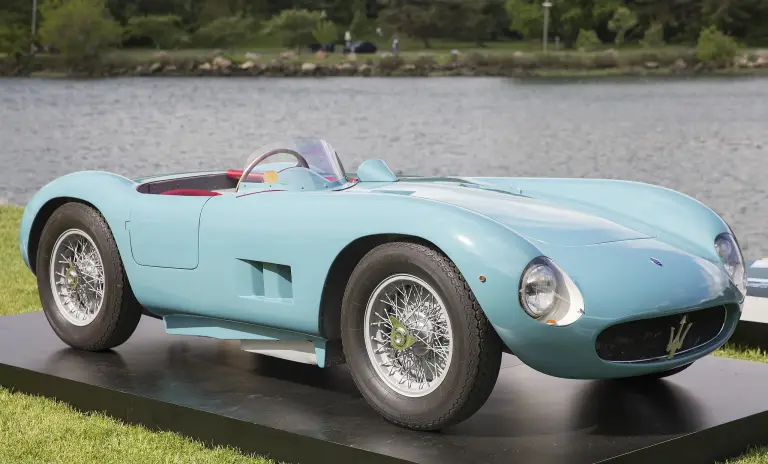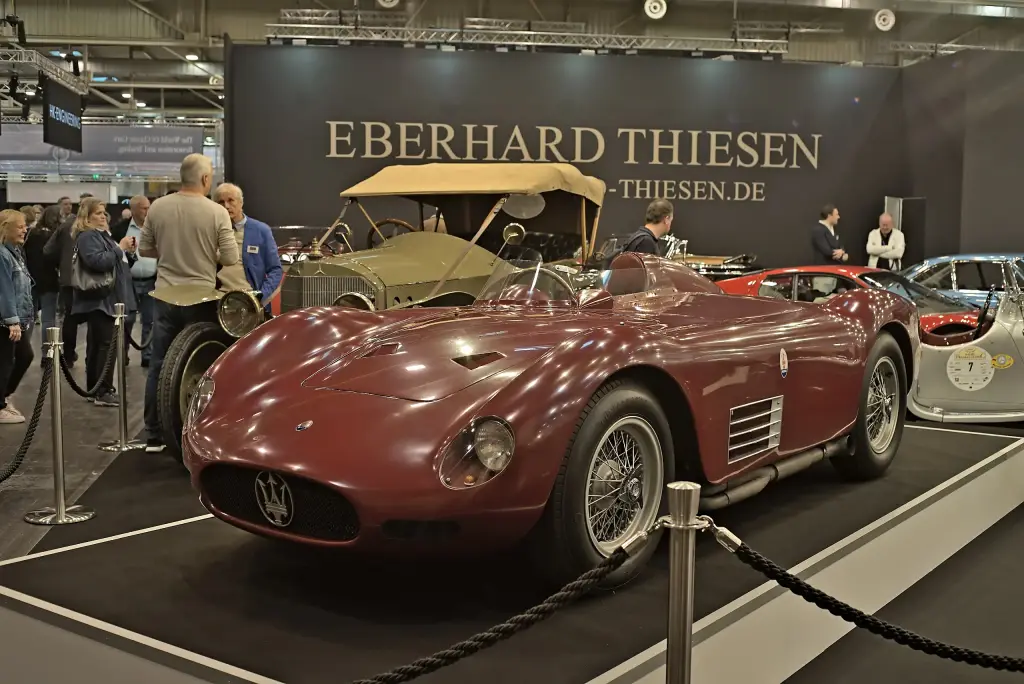
The Maserati 200S, internally Tipo 52, was a two-litre sports racing car built as the successor to the A6GCS. Twenty-eight cars were made in total, and the design was later developed into the 200SI and the 250S. Its 1,994 cc four-cylinder engine produced 190 hp from a light alloy block.
Maserati 200S at a glance
| Maker | Maserati, Modena |
|---|---|
| Project code | Tipo 52 |
| Production | 1955–1959 |
| Engine | 1,994.3 cc inline-four, twin camshafts, double overhead valves |
| Carburettors | Weber 50DCO3 on the first cars, later 45DCO3 |
| Power | 190 PS (140 kW) at 7,500 rpm |
| Chassis | tubular frame by Gilco, modified by Maserati |
| Rear axle | rigid axle from the A6 |
| Body | aluminium, first five by Celestino Fiandri, 23 by Medardo Fantuzzi |
| Debut | 1955 Imola Grand Prix |
| Built | 28 |
Based on one source: the English Wikipedia article on the 200S.
History of the Maserati 200S
Development of the 200S, codenamed Tipo 52, began in 1952 under Vittorio Bellentani. The car was a response to Ferrari’s four-cylinder 500 Mondial, which was doing well in sports car racing. Its 2.0-litre inline-four had a light-alloy block, dual overhead valves per cylinder and twin camshafts, fed by double Weber 50DCO3 carburettors on the first few cars and 45DCO3 units afterwards; Maserati rated it at 190 PS at 7,500 rpm. Many chassis components were shared with the 150S to speed up development, but the rear axle was the rigid unit inherited from the A6.
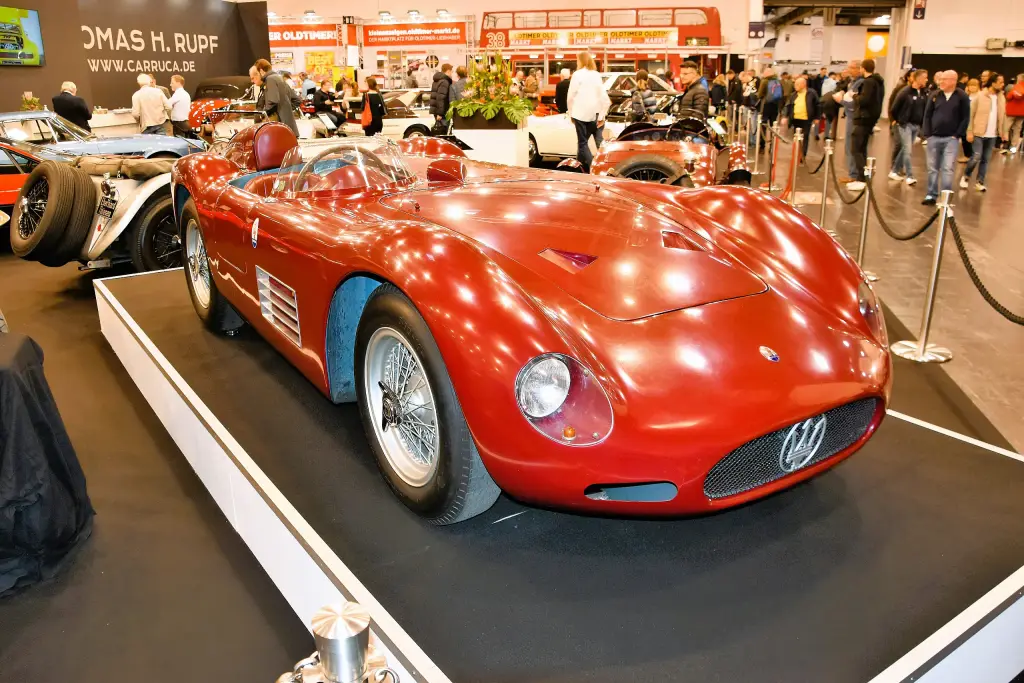
Maserati built the first three chassis in-house and outsourced a tubular frame to Gilco, which Maserati then modified. Celestino Fiandri made the first five aluminium bodies and Medardo Fantuzzi the remaining 23. The 200S debuted at the 1955 Imola Grand Prix in the hands of Franco Bordoni with disappointing results, and at the 1955 Targa Florio both works cars retired while an A6GCS won the race.
Racing years
In 1956 Maserati entered three new 200S cars at the Supercortemaggiore Grand Prix. Suspension problems were addressed by fitting two cars with a de Dion tube attached to the differential by a sliding pin, while the third kept a conventional live axle; one car was damaged in practice, the second retired after a lap, and the third finished 27 seconds behind the winning Ferrari 250 Testa Rossa. At the Bara Grand Prix the car won outright, a more promising result.
For 1957 Maserati introduced the 200SI, Sport Internazionale, to conform to international sports car rules. It had a wider windscreen, wipers, doors and a rudimentary hood that kept the rain out only when the car was parked. One 200SI, chassis 2407, was a converted 150S originally numbered 1672.
Into the 250S
The 200S was replaced by the 250S with an enlarged 2.5-litre engine. Most 250S cars were converted 200S: four of the 200SI were rebuilt to 250S specification and only two were built from scratch. The 250S was no more competitive than its predecessor, and the line came to an end as Maserati’s attention turned to the three-litre 300S.
Design and features
- Two-litre four: light-alloy block, twin camshafts and 190 PS at 7,500 rpm.
- Shared 150S components: many chassis parts were common to the smaller car to save development time.
- Gilco frame: a tubular chassis made outside Maserati and modified in Modena.
- Fantuzzi bodywork: 23 of the 28 aluminium bodies came from Medardo Fantuzzi.
- 200SI specification: windscreen, wipers, doors and a token hood for international sports car rules.
Maserati 200S versions
- 200S (1955–1959): the original open sports racer, 28 built.
- 200SI (1957): Sport Internazionale version with windscreen, wipers and doors.
- 250S conversions: four 200SI cars rebuilt with the 2.5-litre engine.
The 200S was developed alongside the Maserati 150S and replaced by the Maserati 250S; the bigger 300S followed the same ideas. More cars are in the Maserati collection.
Sources
- Maserati 200S, English Wikipedia: development, racing, 200SI, production