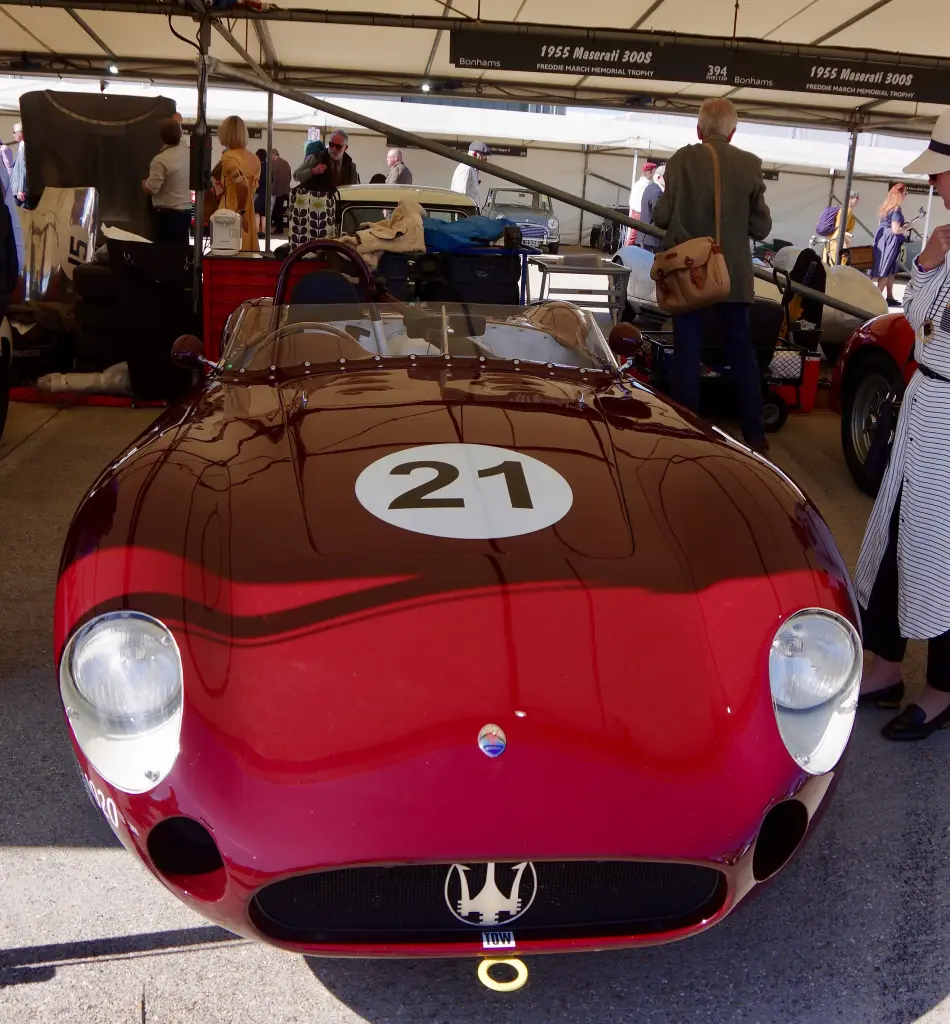
The Maserati 300S was a sports racing car built between 1955 and 1958 for the FIA World Sportscar Championship. Its three-litre straight-six came from the 250F Formula One engine with a longer stroke, and the aluminium body was made by Medardo Fantuzzi. Twenty-six examples were produced.
Maserati 300S at a glance
| Maker | Maserati, Modena |
|---|---|
| Production | 1955–1958 |
| Engine | 3.0-litre straight-six based on the 250F |
| Power | about 245 bhp (183 kW) at 6,200 rpm |
| Compression | 9.5:1, down from 12:1 for road-car fuel |
| Carburettors | three Weber, 42DCO3 then 45DCO3 |
| Chassis | trellis frame |
| Body | aluminium by Medardo Fantuzzi |
| Brakes | machined alloy drums as on the 250F |
| Rear axle | de Dion, new for the 300S |
| Gearbox | four-speed transaxle |
| Built | 26 |
Based on one source: the English Wikipedia article on the 300S.
History of the Maserati 300S
The 3.0-litre engine of the 300S was based on the straight-six of the 250F, with a lengthened stroke developed by Vittorio Bellentani to raise capacity from 2.5 litres. The compression ratio was reduced from 12:1 to 9.5:1, partly because FIA regulations required the engine to run on road-car fuel. It used three Weber carburettors, initially 42DCO3 and later 45DCO3, and produced about 245 bhp at 6,200 rpm.
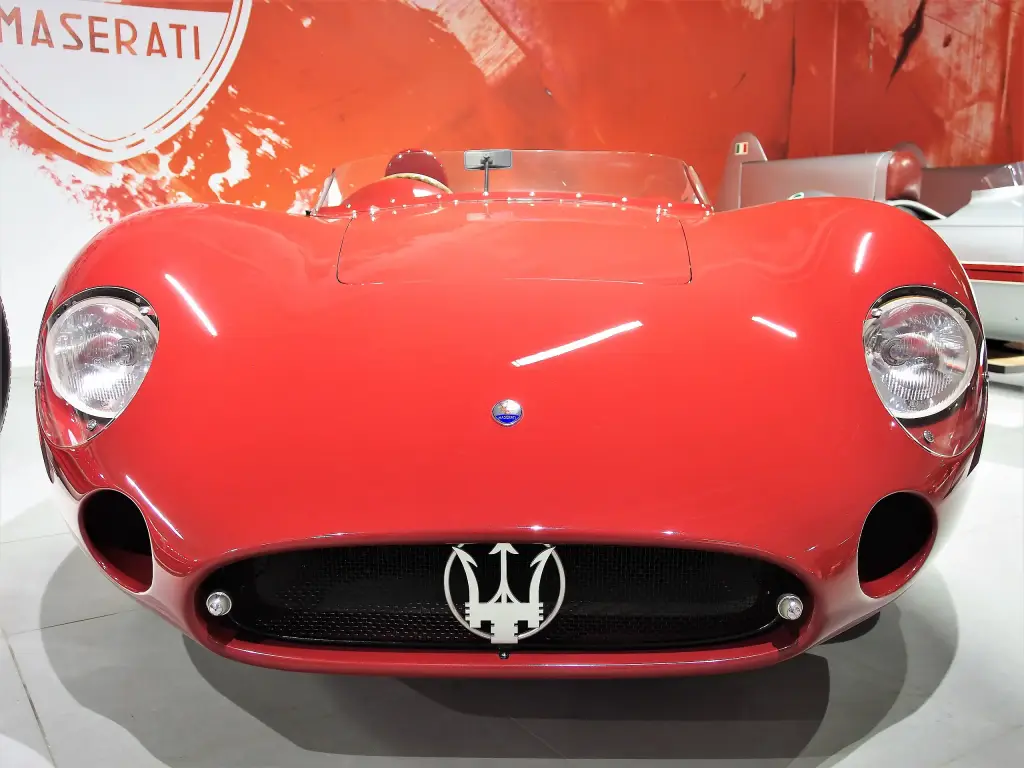
Where the 250F had a tubular frame, the 300S used a trellis structure, and the aluminium body was by Medardo Fantuzzi. The brakes were the same precisely machined alloy drums with extensive finning as on the 250F, and the suspension followed the same design with some strengthening to cope with the rougher tracks and road surfaces of the World Sportscar Championship. New features included a de Dion rear axle, a transverse four-speed gearbox and two chain-driven camshafts.
Racing
The first season, 1955, was poor, mainly because of mechanical problems and development troubles. In 1956 the 300S won at the Nürburgring and finished second overall. It was second to the 450S in the Maserati hierarchy and was followed by the 350S. After the major accident at Guidizzolo during the 1957 Mille Miglia, the last few examples were sold to customers in the United States. Giulio Alfieri gave up an attempt to fit the car with fuel injection, and one 300S was developed with the new V12 engine to become the 350S.
Owners
Mark Knopfler, originally of Dire Straits, has long owned a 300S and has raced it in historic competition. He also worked the car into the lyrics of “Red Staggerwing” on his 2006 album All the Roadrunning: “If I was a Maserati, a red 300s, I’d ride around to your house, baby, give you a driving test.”
Design and features
- Three-litre straight-six: the 250F engine with a longer stroke, 245 bhp at 6,200 rpm.
- Road-car fuel: the compression ratio was cut to 9.5:1 to meet FIA rules.
- Trellis frame: a lighter arrangement than the 250F’s tubular chassis.
- De Dion rear axle: one of the features new to the 300S.
- Fantuzzi body: hand-beaten aluminium bodywork by Medardo Fantuzzi.
Maserati 300S versions
- 300S (1955–1958): the standard works and customer car, 26 built.
- Early cars: 42DCO3 carburettors before the switch to 45DCO3.
- 350S: one 300S developed with the new V12 engine.
The 300S’s engine came from the Maserati 250F and it was joined at the top of the range by the Maserati 450S. Its smaller stablemate was the 150S. More cars are in the Maserati collection.
Sources
- Maserati 300S, English Wikipedia: engine, chassis, racing history