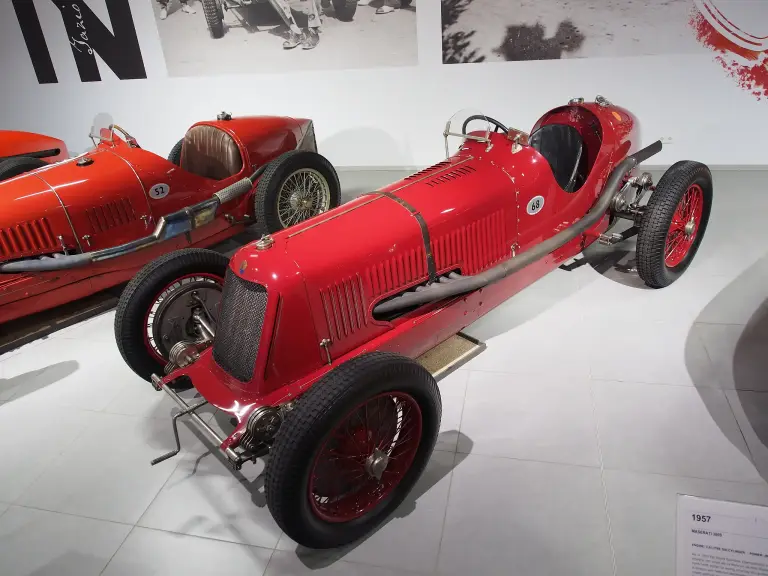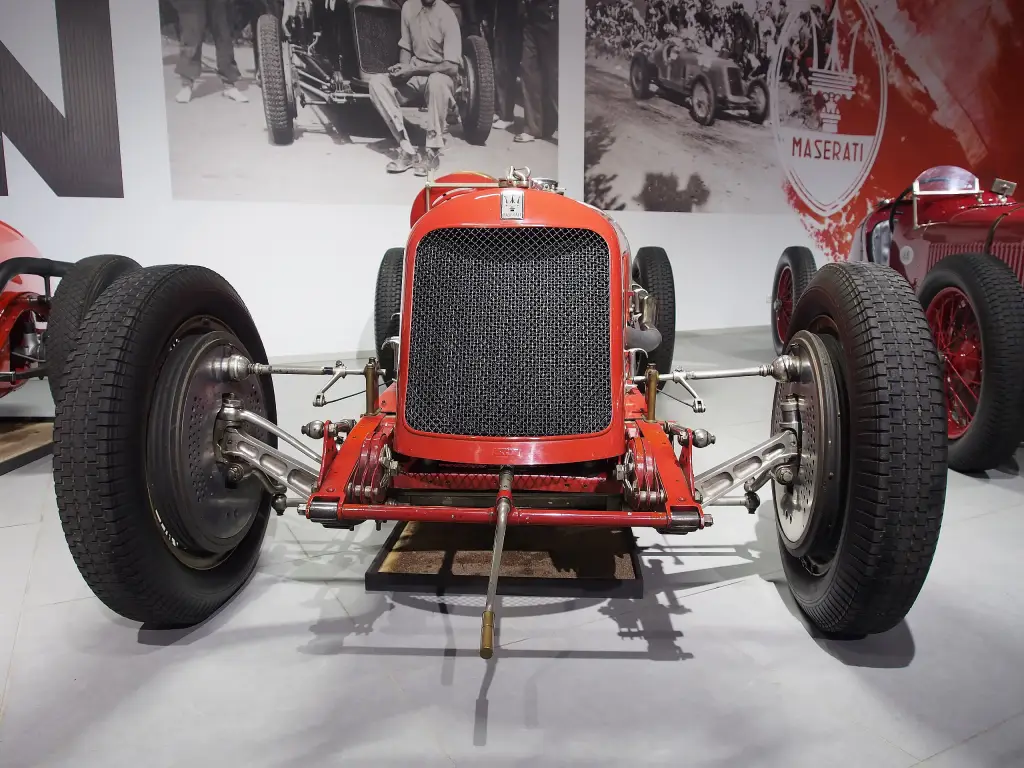
The Maserati 8C was a Grand Prix racing car built between 1931 and 1933. Alfieri Maserati was designing it in the early 1930s but died before it was completed. Two versions were made, the 8C 2800 and the 8C 3000, and the car won the 1933 French Grand Prix. It was the last two-seater Grand Prix Maserati.
Maserati 8C at a glance
| Maker | Maserati, Modena |
|---|---|
| Production | 1931–1933 |
| Versions | 8C 2800 and 8C 3000 |
| Engine | inline-eight, 69 mm bore |
| 8C 2800 | 2,811.9 cc, 94 mm stroke, 205 CV at 5,500 rpm |
| 8C 3000 | 2,991.4 cc, 100 mm stroke, 220 CV at 5,500 rpm |
| Supercharger | Roots type |
| Body | two-seat aluminium, compact and low |
| Top speed | 210–230 km/h (2800), 220–240 km/h (3000) |
| Chassis | from the Tipo 26M |
| First race | French Grand Prix, 21 June 1931 |
History of the Maserati 8C
The 8C was designed by Alfieri Maserati at the beginning of the 1930s, but he died before the project was completed and development continued without him; the car was ready for racing in 1932. It was the definitive mid-range model Maserati intended to campaign in Grands Prix. The car was rear-wheel drive with a front-mounted engine, and its chassis came from the Tipo 26M.
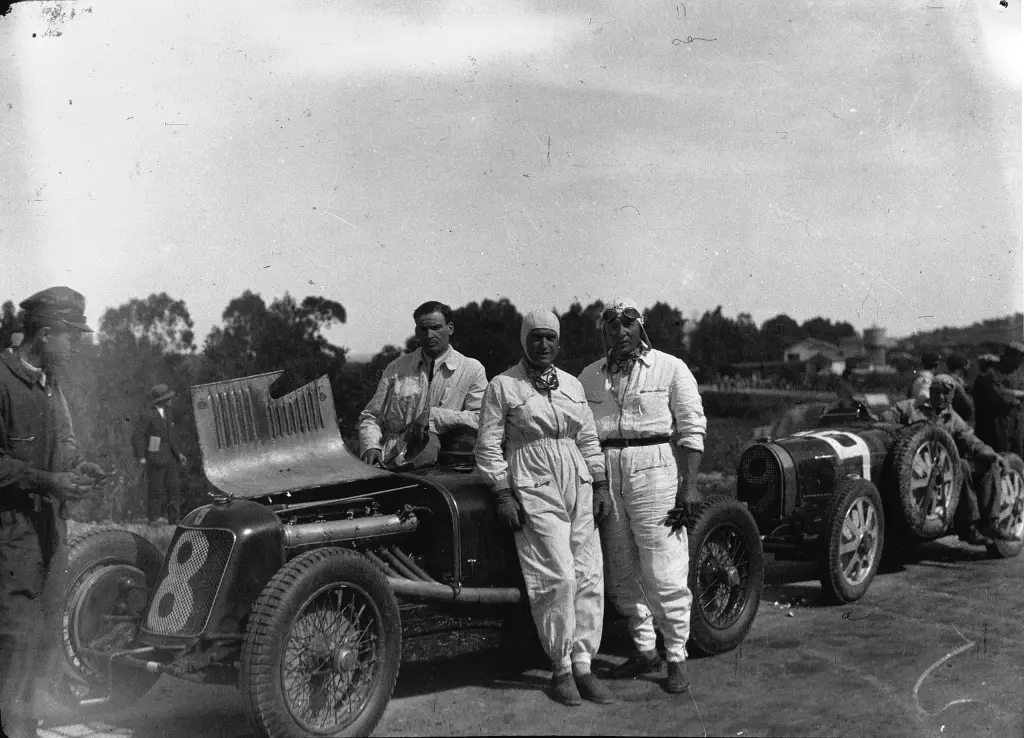
The 8C 2800
The 8C 2800 was the final result of the evolution of the Tipo 26, built to race the Alfa Romeo 8C Monza, the Alfa Romeo Tipo A and the Bugatti Type 51. It used the Tipo 26M engine with the bore increased by 4 mm to reach 2,811.9 cc with a 69 × 94 mm bore and stroke, giving 205 CV at 5,500 rpm; the engine was developed with the carburettor maker Weber. The body was compact and low, which gave good aerodynamics, and top speed was between 210 and 230 km/h. Ignition was by a single Scintilla magneto, induction was forced by a Roots-type supercharger with a Weber ASS carburettor upstream of it, the distribution had two valves per cylinder arranged in a 90° V with twin overhead camshafts, and the compression ratio was 5.5:1. The frame was made of two side members with steel cross members, the body was a two-seat aluminium shell, the brakes were mechanical drums on the wheels and the suspension used leaf springs with friction dampers. The steering was worm and sector and the transmission a four-speed gearbox plus reverse. Four of the fourteen Tipo 26M cars built were given the 2.8-litre engine and a new body, becoming 8C 2800s.
The 8C 3000
Later in the line came the 8C 3000, with a 2,991.4 cc inline-eight inspired by the four-cylinder engine of the Maserati 4CTR. The bore was 69 mm and the stroke 100 mm, the compression ratio 5.26:1, and the engine gave 220 CV at 5,500 rpm, for a top speed of 220 to 240 km/h. Ignition was by Bosch or Scintilla magneto, induction by a Roots supercharger with a Weber 55AS1 carburettor upstream of it, and the distribution again had two valves per cylinder at 90 degrees with twin overhead camshafts. The chassis was the same Tipo 26M arrangement and the four-speed gearbox had several points in common with the Fiat 522, though drivers complained about vibration through the lever. Dunlop tyres were used at first and later Pirelli. Both cars still exist, and one engine was fitted to a Bugatti chassis.
Racing and value
The 8C won the 1933 French Grand Prix with Giuseppe Campari, and Sir Henry Birkin finished third with one at the Tripoli Grand Prix; other drivers included Luigi Fagioli and Baconin Borzacchini, but the car was not successful in other races. The design featured some of the world’s earliest hydraulic brakes and was succeeded in 1933 by the 8CM, whose M stood for monoposto, single-seater. In 2000 an original 8C 2800 sold at auction for US$1.65 million and a 1932 8C 3000 for $1.08 million.
Design and features
- Alfieri’s last design: begun by Alfieri Maserati and completed after his death.
- Two capacities: 2.8-litre Tipo 26M-derived and 3.0-litre eight-cylinder engines.
- Early hydraulic brakes: among the first cars in the world to use them.
- Last two-seater: the final two-seat Grand Prix Maserati before the 8CM single-seater.
- Grand Prix win: Campari won the 1933 French Grand Prix with an 8C 3000.
Maserati 8C versions
- 8C 2800 (1931): Tipo 26M chassis and engine bored to 2.8 litres, 205 CV.
- 8C 3000 (1932–1933): 2,991 cc engine with 220 CV and a 240 km/h top speed.
The 8C grew out of the Maserati Tipo 26M and was replaced by the single-seat Maserati 8CM. The later six-cylinder car was the 6C 34. More cars are in the Maserati collection.
Sources
- Maserati 8C, English Wikipedia: history, versions, racing, auction values
- Maserati 8C, Italian Wikipedia: technical data, production, owners